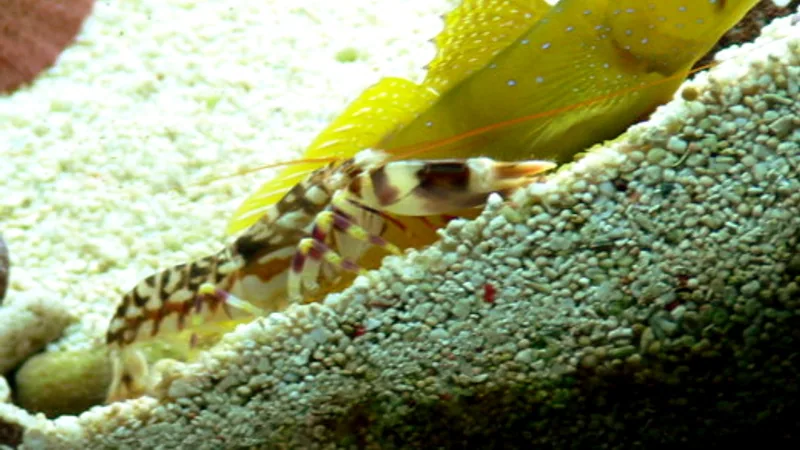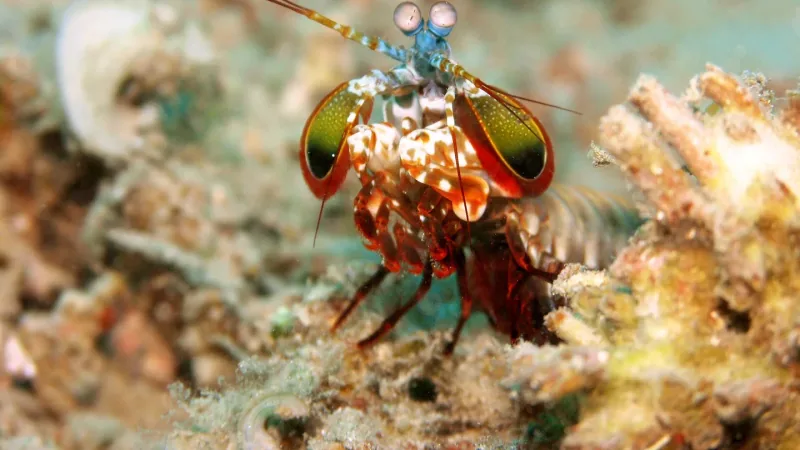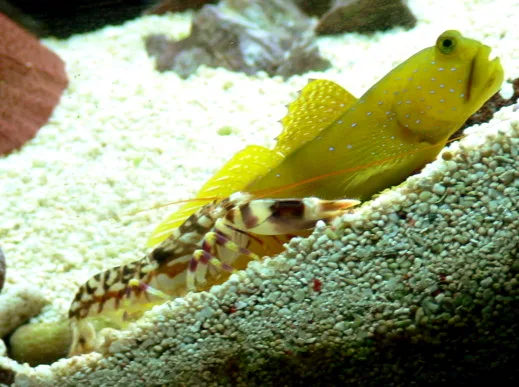
Tiger pistol shrimp (Alpheus bellulus), Indonesia
Field
notes
A Claw That Fires Water
The tiger pistol shrimp (Alpheus bellulus) carries one oversized claw, the snapper claw. One half of the claw has a stopper-shaped tooth called the plunger. When the claw snaps shut, the plunger is driven into a socket on the other half, pushing water out through a narrow groove as a rapid jet. Snapping shrimp use this claw to fire a cavitating high-speed water jet for hunting, defense and communication. A 2013 study built an enlarged, see-through model of the tiger pistol shrimp’s claw to watch how that jet forms.
Cavitation happens when the pulling forces of a fast water jet tear open a bubble in the water. Researchers once believed the crack came from the claw’s two halves hitting each other. In a relative in the same genus, Alpheus heterochaelis, they timed the sound against high-speed footage and found it is emitted when the cavitation bubble collapses, not when the claw closes. In a related snapping shrimp, the collapsing bubble gives off a short, intense flash of light, showing that temperatures inside reach at least 5,000 kelvin, along with extreme pressures. The researchers named the flash “shrimpoluminescence.” In A. heterochaelis, the snap can also stun or kill prey.
Small Shrimp, Big Burrows
Three of the specimens measured when the species was first described, in 1969, were 3.7 to 5.3 centimeters long. Carapace length (the shell covering the head and front of the body) was 13.3 to 19.4 millimeters in five shrimp from a 2022 lab study. It is one of the typical snapping shrimps of Japan’s southern coasts and is widely distributed across the Indo-West Pacific, digging below the low-tide line into seafloors typically mixed with sand, pebbles, coral debris and shell fragments. A 1984 field study in Japan could not measure its lifespan directly, but growth data suggested adults were probably one or two years old, with older shrimp, if any, likely very rare.
In the wild, its burrows reach 30 to 70 centimeters long and 70 centimeters deep, with chambers usually built under hard objects such as coral boulders. A lab study using repeated CT scans tracked how fast it builds one.
A survival burrow in under four hours Most burrows stopped changing 210 minutes after the experiment began, which the researchers read as the shrimp building a burrow good enough to survive in that time.
A Fish for an Alarm
Like other alpheid shrimps, the pistol shrimp family, it has poor vision. That leaves a shrimp without its fish partner open to predators. In Japan, researchers found it sharing its burrow with a goby fish, a partnership that starts soon after they settle as juveniles and lasts their lives. Outside the burrow, the shrimp almost always keeps an antenna touching the fish. When the goby quivers its tail, the movement passes through the shrimp’s antenna as an alarm signal, and the shrimp retreats into the burrow.
Pair bonds start early too. In that field study, small juveniles mostly lived alone, but by the first winter two shrimp were seen in more than half of their burrows. More than 80 percent of adult burrows held a pair, always a male and a female, with the female slightly larger. The largest brood counted held 4,484 eggs.
Published Updated
Traits
Intel
& FAQ
Sources
- 01Yanagisawa (1984). Studies on the interspecific relationship between gobiid fish and snapping shrimp II. Life history and pair formation of snapping shrimp Alpheus bellulus. Publications of the Seto Marine Biological Laboratory.
- 02Miya & Miyake (1969). Description of Alpheus bellulus sp. nov. associated with gobies from Japan (Crustacea, Decapoda, Alpheidae). Publications of the Seto Marine Biological Laboratory.
- 03Umehara, Seike & Furuyama (2022). Repeated computed tomography scanning reveals morphological development of burrows produced by the tiger pistol shrimp Alpheus bellulus. PLOS ONE.
- 04Hess et al. (2013). Vortex Formation with a Snapping Shrimp Claw. PLoS ONE.
- 05Versluis et al. (2000). How Snapping Shrimp Snap: Through Cavitating Bubbles. Science.
- 06Lohse, Schmitz & Versluis (2001). Snapping shrimp make flashing bubbles. Nature.
- 07Pistol Shrimp. Oregon Coast Aquarium.