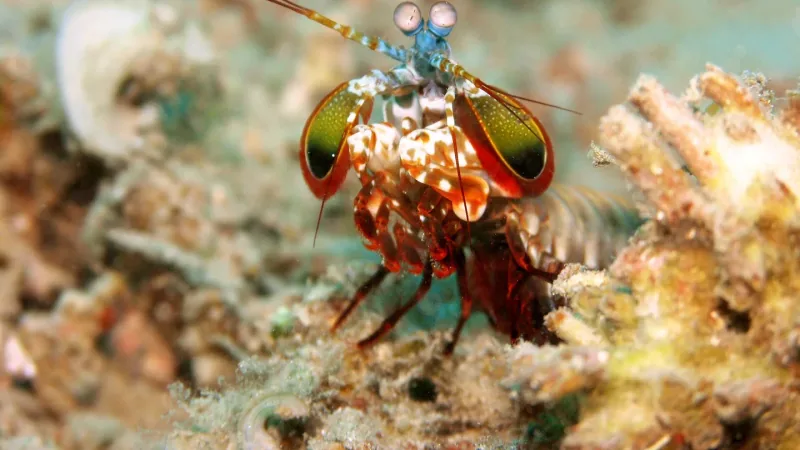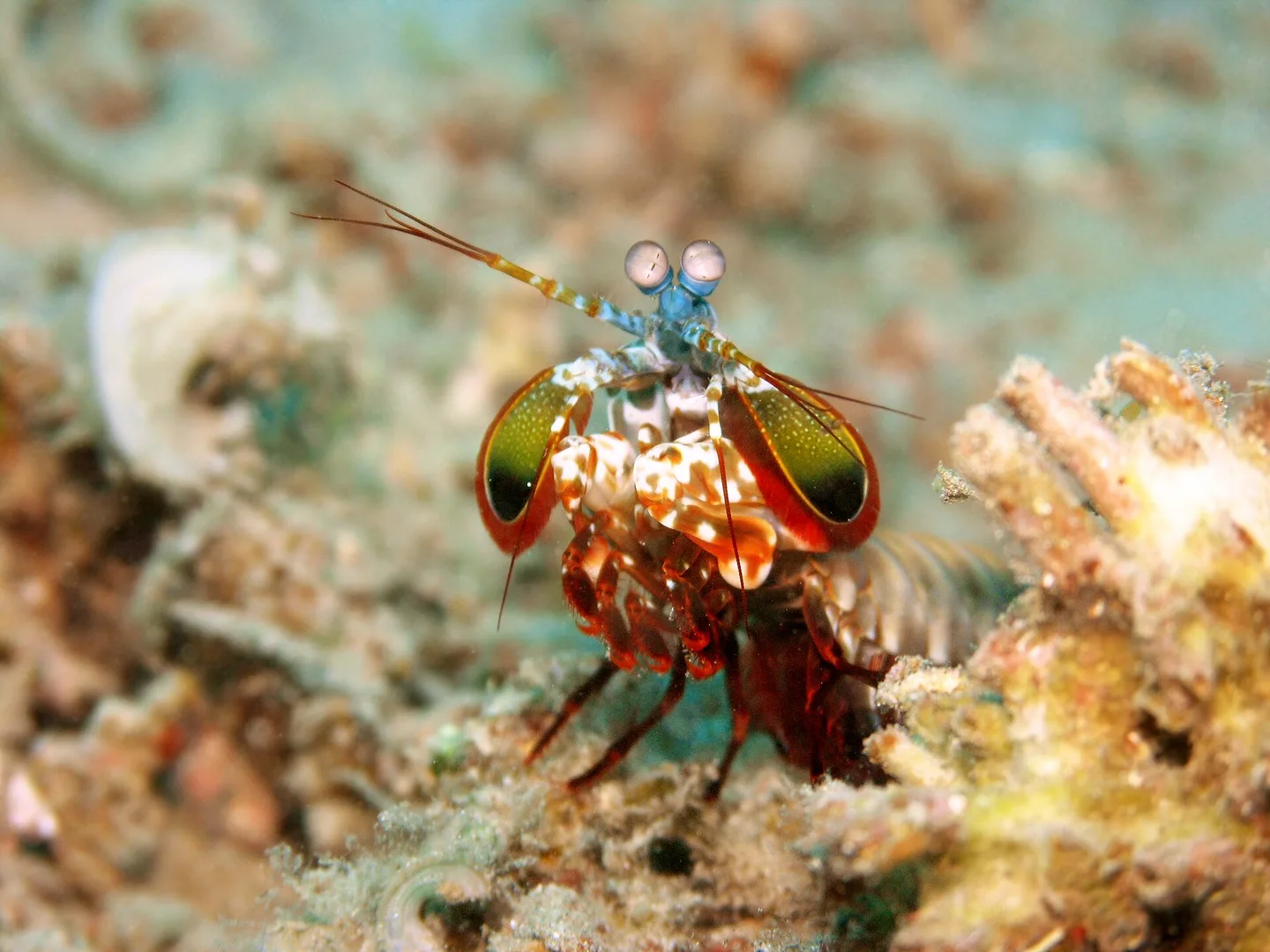
A peacock mantis shrimp on the Tasik Ria house reef, Manado, Indonesia.
Field
notes
A Jewel With a Hammer
The peacock mantis shrimp (Odontodactylus scyllarus) is very brightly colored. Its body is olive or green, its antenna scales are bright orange, and its smashing limbs are red. These shrimp average 3-18 cm in length.
It lives in the Indo-Pacific Ocean, south of Japan, north of Australia, and between eastern Africa and Guam. It is most commonly found in a U-shaped burrow, often built near the base of a coral reef on sandy and gravelly ground.
One Strike, Two Hits
Researchers found that this species makes an extremely fast strike by storing energy in a saddle-shaped exoskeletal spring, then releasing it.
Each strike lands two blows. There are two force peaks, typically 390-480 microseconds apart (a microsecond is a millionth of a second). The first is the limb hitting. The second is the collapse of cavitation bubbles, which are vapor bubbles that form next to the prey when the appendage moves swiftly toward it.
Limb impact peaks between 400 and 1501 newtons. Despite its small size, this shrimp can generate impact forces thousands of times its body weight.
A club built for impacts The club is hypermineralized, with minerals combined with a helicoidal chitin matrix. Together they give it several lines of defense against catastrophic failure during repeated high-energy impacts.
Dinner and Duels
This shrimp is a carnivore. Prey includes gastropods, crustaceans and bivalves, and crabs are the preferred meal. It uses the club to break open shells. Kept in aquaria, it can break the glass.
It is known to be territorial. Individuals strike each other’s tail areas, and the telson is the most heavily armored part of the body. It does not have many known predators, though it has been found in the stomachs of yellowfin tuna. In the burrow, it may use vibrations called stomatopod rumbles to warn off predators or others of its kind.
Eyes That Roll
A photoreceptor is a light-sensing cell. Some mantis shrimp species have 12 different types, sampling wavelengths from deep ultraviolet to far red (300 to 720 nanometers). Some stomatopods can also detect circularly polarized light.
This species rotates its eyes to line up its photoreceptors with the angle of linearly polarized light, whose waves wiggle in one set direction. That maximizes the polarization contrast between an object and its background.
Published Updated
Traits
Intel
& FAQ
Guess
first
How big is a Peacock Mantis Shrimp, really? Slide, lock in, and see what the sources say. Every answer is a figure from this page, quoted from where it came from.
Sources
- 01Patek, Korff & Caldwell (2004). Deadly strike mechanism of a mantis shrimp. Nature.
- 02Patek & Caldwell (2005). Extreme impact and cavitation forces of a biological hammer: strike forces of the peacock mantis shrimp Odontodactylus scyllarus. Journal of Experimental Biology.
- 03Weaver et al. (2012). The Stomatopod Dactyl Club: A Formidable Damage-Tolerant Biological Hammer. Science.
- 04Thoen et al. (2014). A Different Form of Color Vision in Mantis Shrimp. Science.
- 05Chiou et al. (2008). Circular Polarization Vision in a Stomatopod Crustacean. Current Biology.
- 06Daly et al. (2016). Dynamic polarization vision in mantis shrimps. Nature Communications.
- 07Odontodactylus scyllarus. Animal Diversity Web, University of Michigan.
What the sources say: 41 claims checked word for word against these sources →