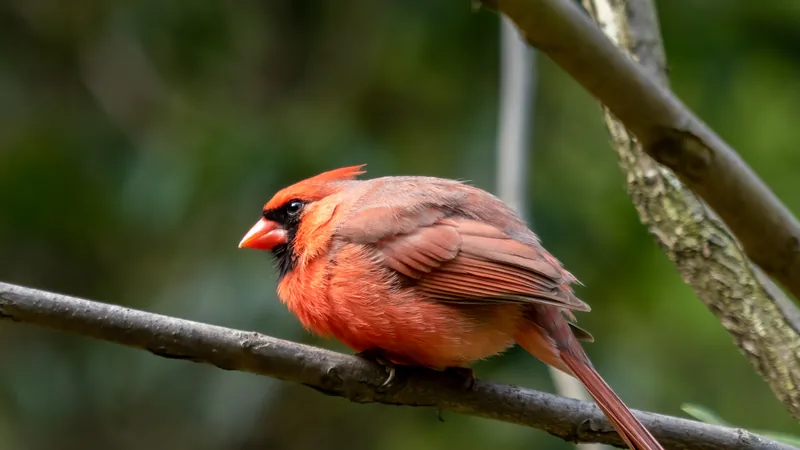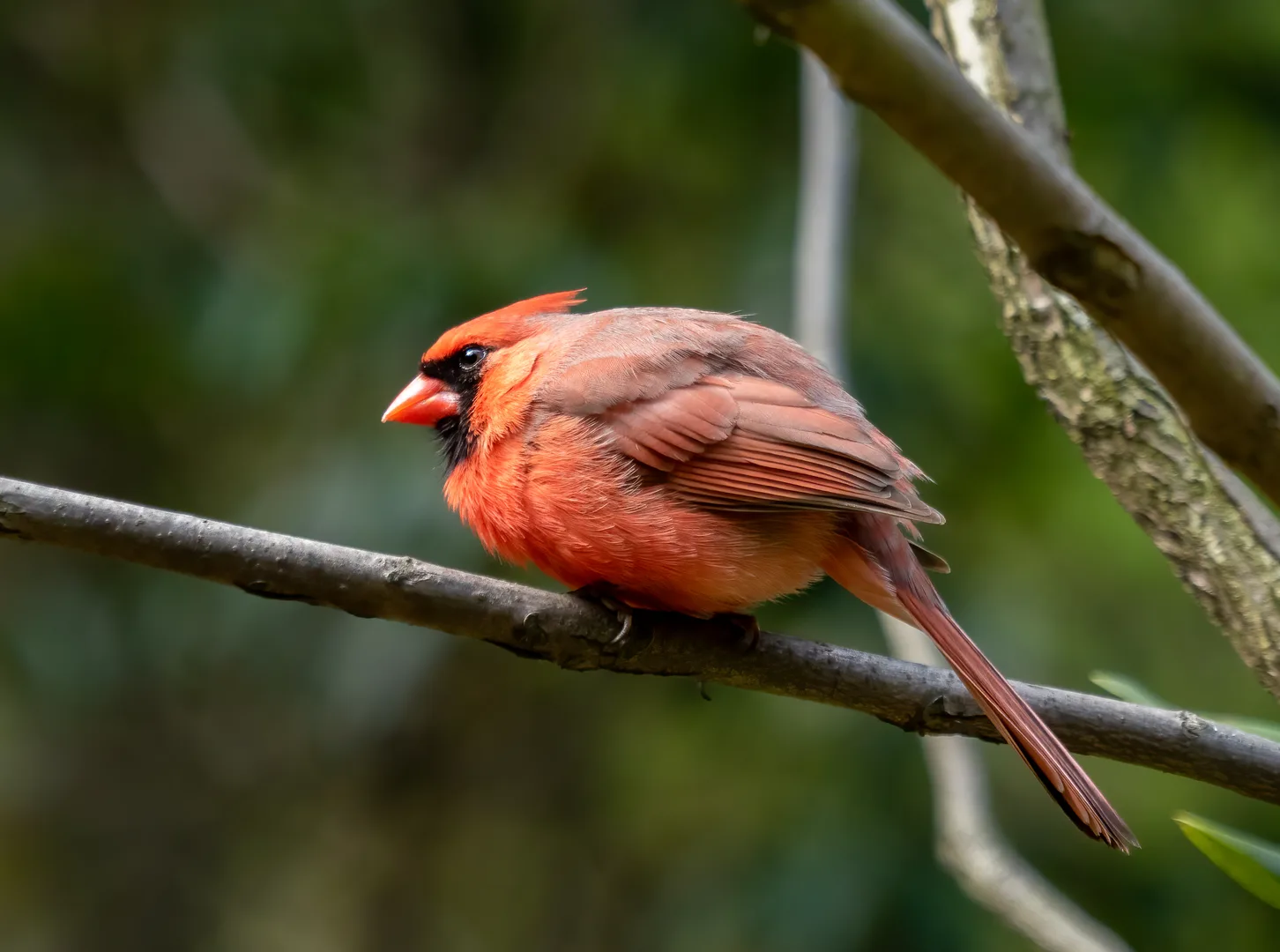
Male northern cardinal in Prospect Park, Brooklyn
Field
notes
Red is a recipe
Male northern cardinals are brilliant red. Females are mostly grayish tan, with red on the wings, tail and crest. That red is not made from scratch. It comes from carotenoids, pigments the bird eats, changes chemically inside its body and deposits in new feathers while it molts, which is when it swaps old feathers for fresh ones.
Colour may carry a message. Redder males have denser vegetation on their territories, and may be larger and have higher reproductive success. Studies in cities and the countryside have found different links between colour and success, so the message is not simple.
The yellow cardinal Researchers once studied a cardinal with yellow feathers. They lacked all four of the usual red pigments and held yellow ones instead, including lutein, a yellow pigment from food. The mutation seems to have impaired only one class of chemical reaction, leaving the rest working.
Loud songs from both sexes
Both males and females sing. The songs are loud, whistled phrases that defend territory and court mates. Mates and neighbours share most or all of their songs, and the repertoires drift apart with distance, which makes local dialects. Chip calls work as contact calls and alarms, and raising and lowering the crest, the tuft of feathers on the head, also signals alarm. Both sexes attack their own reflections in windows and car mirrors, most often in spring and early summer, when they are defending their territory.
Small bird, seed cracker
An adult is 20.9 to 23.5 cm long, averages 42 to 48 g and has an average wingspan of 30.5 cm. The bill is thick and cone-shaped, and cardinals prefer seeds that are easily husked, meaning the shell comes off with little work. The diet is mainly seeds, fruits and insects, and parents feed their chicks almost exclusively insects.
A backyard success story
Cardinals live across eastern, central and parts of southwestern North America, from southern Canada to northern Central America, and have been introduced to Hawaii, southern California and Bermuda. The range has been expanding northward since at least the mid-1800s, as the birds took advantage of moderate temperatures, human habitation and bird feeders. The IUCN rates the species Least Concern.
Life is risky at the nest. The female incubates the eggs for 11 to 13 days, predators take many eggs and nestlings, and only 15 to 37 percent of nests produce fledglings, the young that leave the nest. The oldest recorded cardinal was a female, 15 years and 9 months old when she was found in Pennsylvania.
Published
Traits
Intel
& FAQ
Guess
first
How big is a Northern Cardinal, really? Slide, lock in, and see what the sources say. Every answer is a figure from this page, quoted from where it came from.
Sources
- 01Cardinalis cardinalis. The IUCN Red List of Threatened Species 2018: e.T22723819A132024136.
- 02Cardinalis cardinalis (northern cardinal). Animal Diversity Web, University of Michigan.
- 03Halkin et al. (2021). Northern Cardinal (Cardinalis cardinalis). Birds of the World.
- 04McGraw et al. (2001). The Influence of Carotenoid Acquisition and Utilization on the Maintenance of Species-Typical Plumage Pigmentation in Male American Goldfinches (Carduelis tristis) and Northern Cardinals (Cardinalis cardinalis). Physiological and Biochemical Zoology.
- 05Northern Cardinal Overview. All About Birds, Cornell Lab of Ornithology.
- 06McGraw, Hill & Parker (2003). Carotenoid Pigments in a Mutant Cardinal: Implications for the Genetic and Enzymatic Control Mechanisms of Carotenoid Metabolism in Birds. The Condor.
What the sources say: 46 claims checked word for word against these sources →