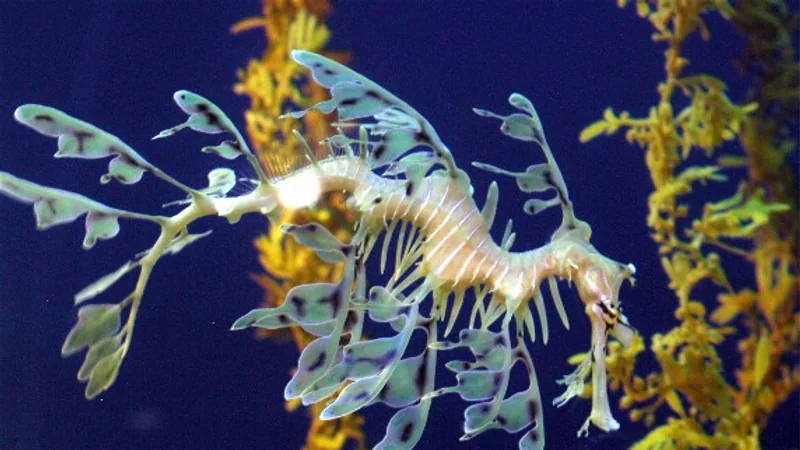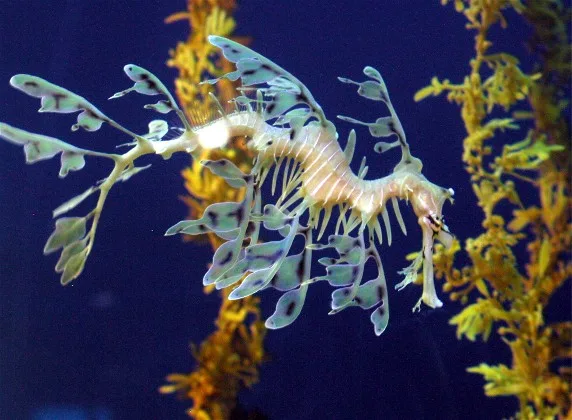
A wild leafy seadragon (Phycodurus eques) off Kangaroo Island, South Australia.
Field
notes
A Costume Made of Its Own Skin
The leafy seadragon (Phycodurus eques) lives in the coastal waters off Western Australia, South Australia and Victoria, keeping to rocky reefs, seaweed beds and seagrass meadows from the surface down to about 30 meters (98 feet), where the water swings seasonally between 13 and 19°C. It grows to a maximum of about 35 cm (14 in) long. Hard bony plates cover its body, bristling with sharp spines and leaf-like flaps. The skin flaps don’t seem to help it move; the seadragon actually gets around on small, almost translucent fins that oscillate rapidly, using its tail as a rudder, and it can sway like a plant in the current. Predators that see through the act are often surprised by its bony exterior and sharp spines.
A Home Range of Up to 5 Hectares
Researchers who tracked nine adult seadragons for 2 to 10 days around West Island, Australia found that all but one stayed inside home ranges of up to 5 hectares. The odd one out headed away from where it was tagged in almost a straight line, at up to 146 meters an hour. Long spells of up to 68 hours without moving were broken by short bursts of movement averaging 2 to 17 meters an hour. The seadragon is usually solitary. It moves to deeper water in the Australian winter, when food is scarce, and in late winter migrates to shallow bays, where groups gather to pair up and mate.
A Father Built to Carry the Nursery
Eggs set in his skin A female pushes 250 to 300 eggs, each 4 mm across, into the skin under a male’s tail to be fertilized. Soft when the eggs first go in, his skin hardens into a cup around each one, holding it securely through a six- to eight-week incubation.
When hatching starts, the male lets go of only a few eggs at a time, and he may take hours to days to release the whole brood. Newborns have a very short snout, no leafy flaps and silver-and-black coloring. They settle on the bottom in shallow water and live off the still-attached egg capsule for about two days, until the snout is more pronounced and they’re ready to start hunting.
No Teeth, No Stomach, Constant Snacking
A leafy seadragon has no teeth and no stomach, so it eats almost constantly, covering wide areas as it searches for mysid shrimp, a favorite food, plus other small crustaceans, plankton and larval fish. It creates suction by expanding a joint on the lower part of its snout, pulling prey into its small mouth and swallowing it whole, much like a pipette. How long a leafy seadragon lives in the wild is unknown, though estimates say it may live seven to ten years. In 2015, scientists described a third species of seadragon, the first discovered in 150 years. The specimen it was named from had been catalogued at the Western Australian Museum as a common seadragon, and only DNA sequencing revealed it was new. The IUCN lists the leafy seadragon as Least Concern.
Published Updated
Traits
Intel
& FAQ
Guess
first
How big is a Leafy Seadragon, really? Slide, lock in, and see what the sources say. Every answer is a figure from this page, quoted from where it came from.
Sources
- 01Leafy Seadragon. Aquarium of the Pacific.
- 02Phycodurus eques (Glauert's sea-dragon). Animal Diversity Web, University of Michigan.
- 03Connolly, Melville & Preston (2002). Patterns of movement and habitat use by leafy seadragons tracked ultrasonically. Journal of Fish Biology.
- 04Stiller, Wilson & Rouse (2015). A spectacular new species of seadragon (Syngnathidae). Royal Society Open Science.
- 05Pollom (2017). Phycodurus eques. The IUCN Red List of Threatened Species 2017: e.T17096A67622420.
What the sources say: 42 claims checked word for word against these sources →