AnimalTracks.wiki

Thorny Seahorse

Hippocampus histrix

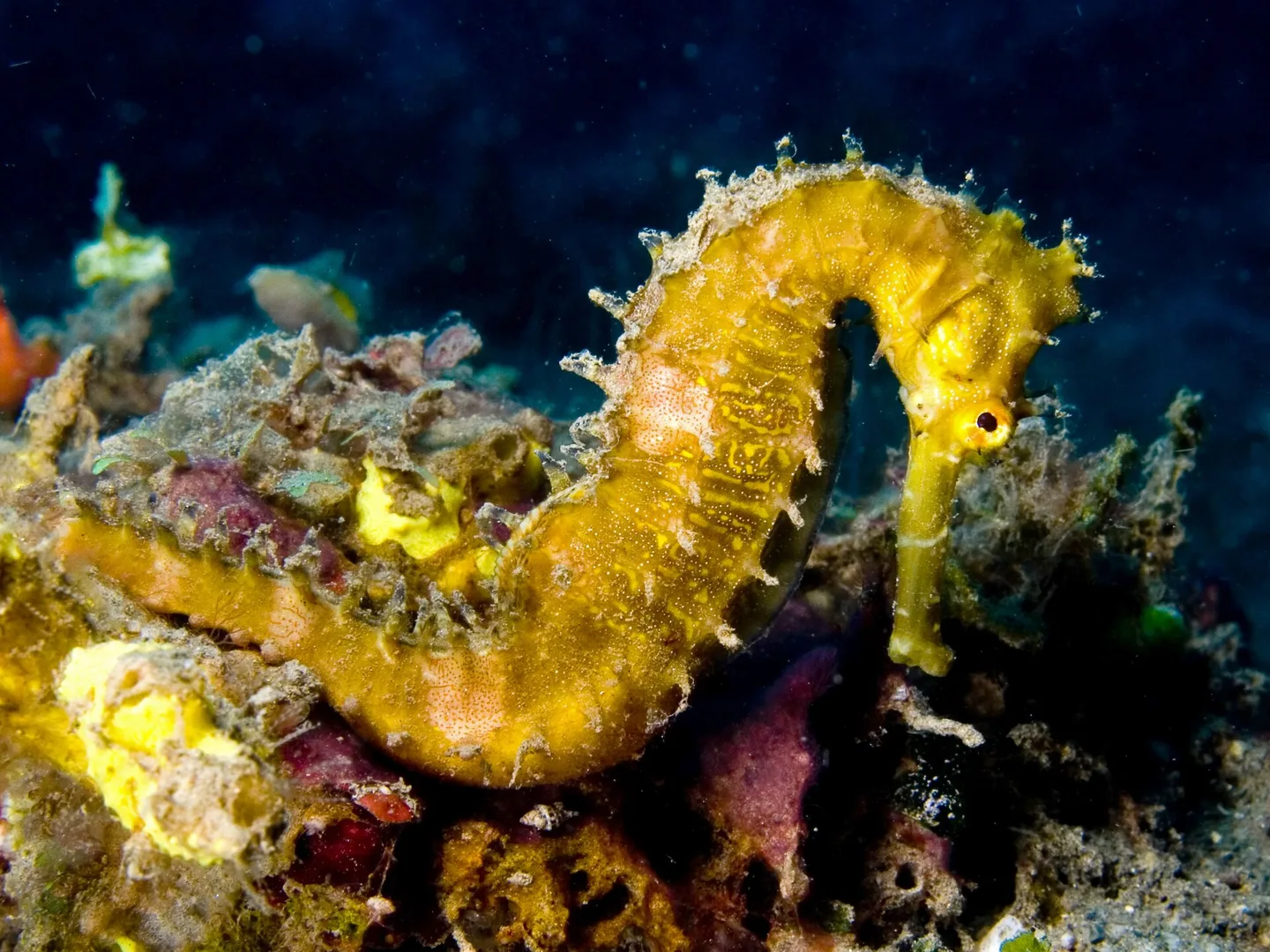
A seahorse with extremely sharp spines, a crown on its head and fathers that carry the babies.

Danger tierLowEffectively harmless to people.
IUCN status [VU]VulnerableHigh risk of endangerment in the wild.Source: IUCN Red List
Vibe checkHole90s Grunge & Alt-RockListen ↓

Field
notes

Checked against 3 sources ↓

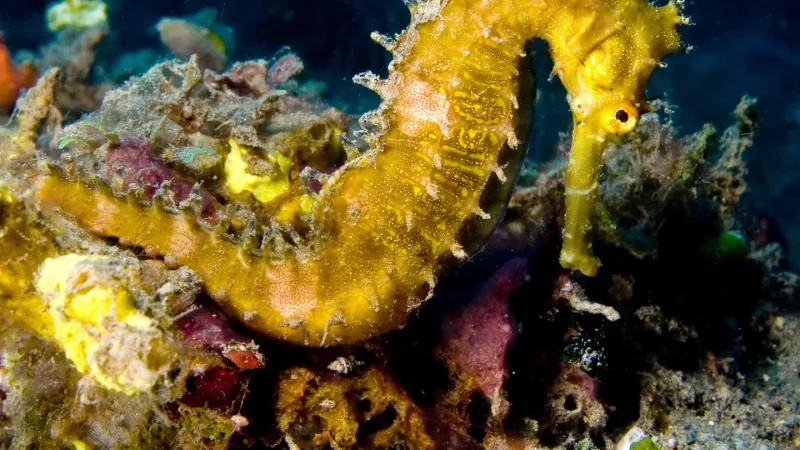
Meet a fish that looks like a chess piece and is armed like a medieval mace. The thorny seahorse (Hippocampus histrix) carries spines that Museums Victoria describes as very elongate and extremely sharp, often tipped in black. Five more spines crown the top of its head.

It is not big. Its height tops out at 150 mm, about 6 inches, and seahorse height is measured from the tail tip to the top of the crown. Wild lifespans are an open question: Project Seahorse says natural seahorse lifespans are virtually unknown, with most estimates coming from captivity. Known lifespans across the group run from about one year in the smallest species to an average of three to five years in the larger ones. That is the group’s figure, not this species’.

Dad does the pregnancy The female uses an ovipositor, an egg-laying tube, to place her eggs in a pouch under the male’s belly. The male fertilizes them, aerates them and regulates their salt balance. He may also give them some nourishment until they are born.

Project Seahorse writes that seahorse pregnancy lasts about two weeks to one month, and most males give birth to around 100 to 200 babies. Newborns of most species measure between 7 and 12 mm. These are group figures, not measurements of this species.

Suction dining without a stomach

Seahorses have no stomach and no teeth. They suck prey through a tubular snout and pass it through an inefficient digestive system. For the thorny seahorse specifically, Fishes of Australia says it presumably preys on small crustaceans and other planktonic organisms.

Spines, camouflage and a muddled name

Its base colour is highly variable to match its surroundings, from cream to grey, greenish, yellow or brown to burgundy-red. Seahorses in general are more adapted to maneuvering than to speed, and therefore rely on camouflage to avoid predators more than on speed to escape them.

It lives on both hard and soft bottoms, often attached to soft corals or sponges at 10 to 95 m, usually below 15 m. The range covers the tropical and subtropical Western Pacific, including Bali, Papua New Guinea, New Caledonia and Japan. In Australia it has been recorded south of Ashmore Reef in the Timor Sea, on the Great Barrier Reef and at Port Stephens in New South Wales.

The name has caused confusion. Museums Victoria notes that H. histrix has often been used for many spiny seahorses, making them look widespread when they have relatively restricted ranges. The IUCN rates the species Vulnerable. It is rarely collected for the aquarium trade due to its preferred habitat in moderately deeper waters, but specimens may be dried and sold in the traditional medicine trade or as curios.

Published Updated

Traits

Intel
& FAQ

01Do the spines protect the thorny seahorse from predators?

Project Seahorse says adult seahorses are presumed to have few predators due to their excellent camouflage, sedentary lifestyle and unappetizing bony plates and spines. Presumed is the key word: seahorses have still been found in the stomachs of large pelagic fishes such as tuna and dorado. Both points are made of seahorses as a group, not of this species.

Source: Project Seahorse, University of British Columbia and Zoological Society of London

02How does a seahorse eat with no teeth or stomach?

It waits until prey come close enough, then sucks them quickly out of the water with its long snout. Each eye moves independently, allowing the seahorse to maximize its search area. Project Seahorse says seahorses will ingest anything small enough to fit into the mouth, mostly small crustaceans such as amphipods but also fish fry and other invertebrates. It writes all of this of seahorses in general.

Source: Project Seahorse, University of British Columbia and Zoological Society of London

03Do male thorny seahorses carry the pregnancies?

Yes. The female transfers her eggs into an enclosed pouch on the male's abdomen, and he fertilizes them inside it. Fishes of Australia says he then gives the developing embryos physical protection, oxygen and salt control, and may provide some nourishment until the young are born.

Source: Fishes of Australia, Museums Victoria

Guess
first

How big is a Thorny Seahorse, really? Slide, lock in, and see what the sources say. Every answer is a figure from this page, quoted from where it came from.

  1. ?

Sources

More Ray-Finned Fishes

Actinopterygii & Sarcopterygii

Hydrodynamic aquatic rulers with lateral line pressure sensors, swim bladders, and electrical weaponry.

A captive African lungfish resting on aquarium gravel, its long thread-like fins trailing from a mottled olive body

African Lungfish

Protopterus annectens

A fish that breathes air through two lungs and can live for over a year inside a cocoon of its own dried slime.

Obligate air breathing through two lungs, and over a year inside a cocoon of dried slimeView →
▸ ElderHeavy Psych & Desert Rock
Close view of an alligator gar's diamond-scaled back and blunt snout breaking a marsh surface

Alligator Gar

Atractosteus spatula

Described as a 100-million-year-old living fossil, armored in interlocking ganoid scales, with two rows of fang-like teeth in its upper jaw and a swim bladder that can work as a lung.

Interlocking ganoid scale armor with a hard outer layer over a tough bony base, two rows of fang-like teeth in the upper jaw, and a vascularized swim bladder that can work as a lungView →
▸ Creedence Clearwater RevivalClassic Hard Rock & Southern Blues
American paddlefish from below in murky green water, the pale bars of its gill rakers showing inside the open gill slit

American Paddlefish

Polyodon spathula

An ancient river giant that carries 50,000 to 70,000 electroreceptor organs, the largest number of any living vertebrate species.

Paddle and head covered in ampullary organs: 50,000 to 70,000 electroreceptors per adult, the largest number of any living vertebrate speciesView →
▸ Blackberry SmokeDelta Blues & Swamp Rock
Live blackfin icefish, a close relative, seen from above in a pale holding tank at Palmer Station

Antarctic Icefish

Champsocephalus gunnari

A Southern Ocean fish with no working red blood cells, whose nearly clear blood carries oxygen dissolved in plasma, along with its own antifreeze.

Belongs to the only vertebrate family that lacks working hemoglobin genes and working red blood cells: its blood carries oxygen dissolved in the plasma instead.View →
▸ BiosphereGlacial Ambient & Drone Soundscapes

Clade factLateral line sensory systems detect water displacement and pressure waves from surrounding swimming creatures.

Explore all 53 →

Head-to-head showdowns

Simulated face-offs, biological power gauges, and 3-round combat

Down the Rabbit Hole

Associative matches based on weird shared evolutionary traits