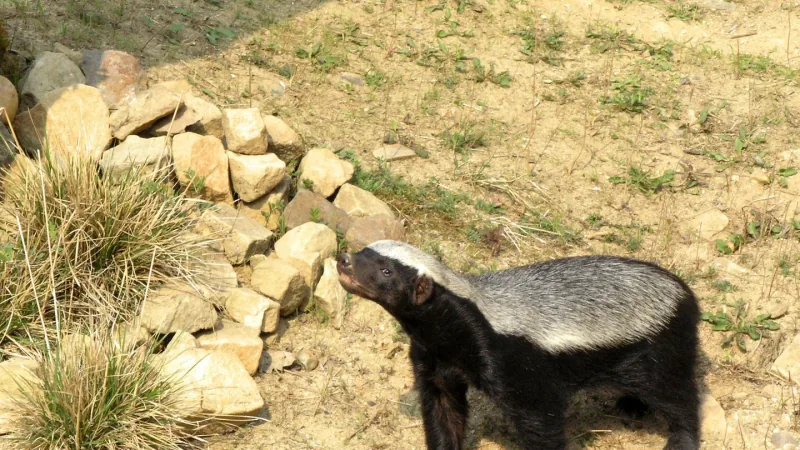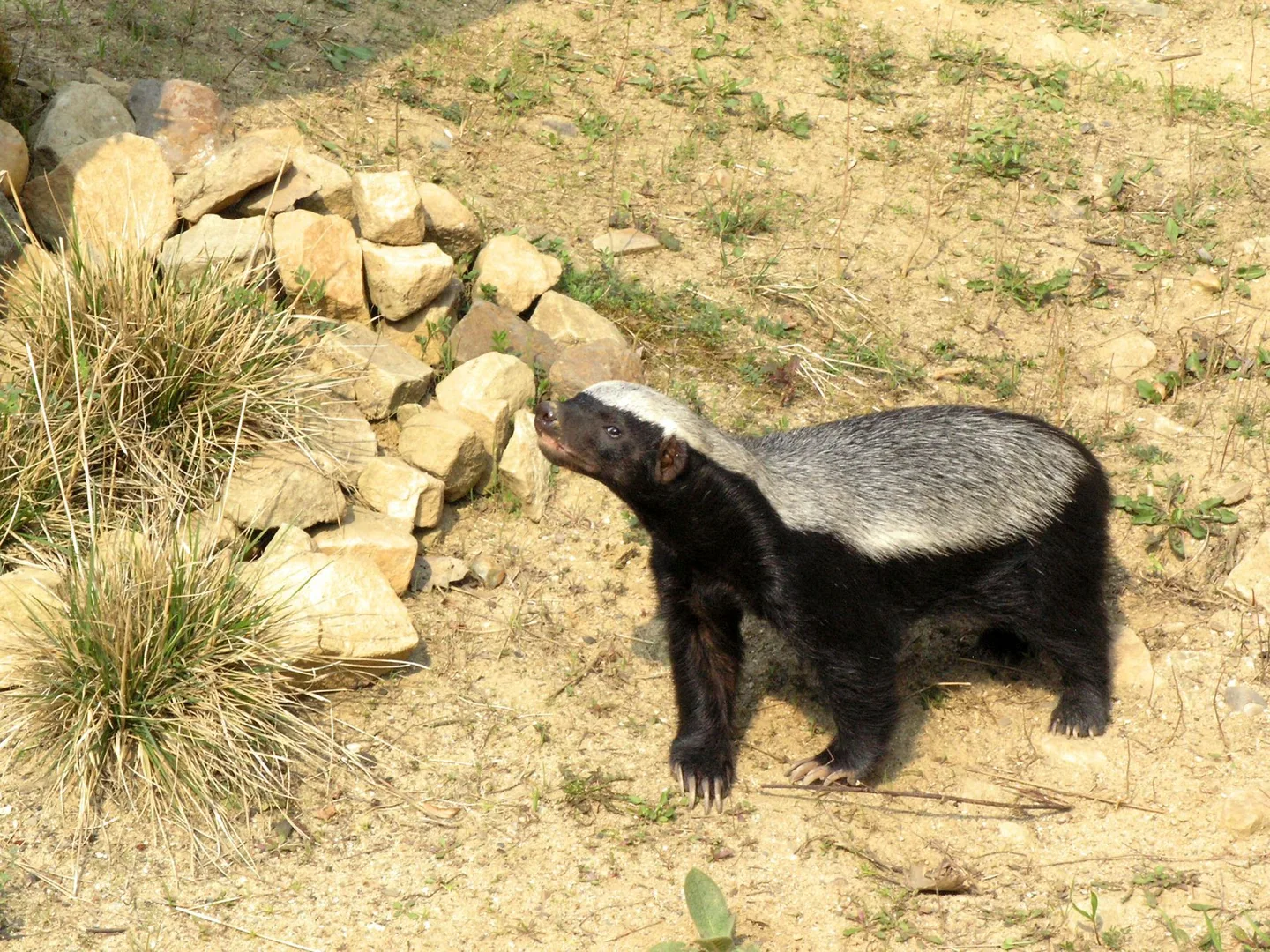
Honey badger west of Lower Sabie, Kruger National Park, South Africa
Field
notes
Officially Fearless
The honey badger (Mellivora capensis) is a stocky member of the mustelid family, the group that holds weasels and otters. It has a body 60 to 70 cm long and weighs 8 to 12 kg. The 2002 edition of the Guinness Book of World Records named it the “most fearless animal in the world.”
It lives across most of sub-Saharan Africa, throughout the Middle East, and eastward to India and Nepal. Wild honey badgers tend to live 7 to 8 years; in captivity, one lived 26 years and 5 months.
A Skin Hard to Grasp
A honey badger’s skin is thick and loose. It prevents a predator from getting a firm grasp, and the badger can turn around inside its own skin and bite back. Near the throat the skin is 6 mm thick.
Lions, leopards and spotted hyenas are among its known predators, but lions and leopards tend to kill only older and weaker ones. A threatened badger typically raises its hair, holds its tail up, makes a rattling sound and frequently charges.
Snake Eaters
Honey badgers eat eggs, rodents, birds, frogs and scorpions, and they raid beehives for the larvae and honey inside. In the Kgalagadi Transfrontier National Park, in southern Africa, they have been seen eating Cape cobras and puff adders.
Three animals, one trick Honey badgers, hedgehogs and pigs each independently changed the toxin-binding site of a muscle receptor that snake alpha-neurotoxins target. Each change puts a positively charged amino acid where an uncharged one used to sit, which impedes toxin binding.
One badger bitten on the cheek by a puff adder reacted to the bite and the site swelled up substantially, but it survived and was active again 5 hours later.
Clever, or Just Famous?
A captive badger named Stoffel was filmed at a South African rehabilitation centre using rakes and logs to climb his enclosure walls. Cambridge primatologist William McGrew called it astonishing and said that either honey badgers have been under-estimated, Stoffel is a one-off genius, or it is a hoax. In 2014, science writer Justin Gregg wrote that there are no studies of honey badger cognition in the scientific literature, and that tool use in honey badgers appears only in documentaries and campfire stories.
Published Updated
Traits
Intel
& FAQ
Guess
first
How big is a Honey Badger, really? Slide, lock in, and see what the sources say. Every answer is a figure from this page, quoted from where it came from.
Sources
- 01Drabeck, Dean & Jansa (2015). Why the honey badger don't care: Convergent evolution of venom-targeted nicotinic acetylcholine receptors in mammals that survive venomous snake bites. Toxicon.
- 02Mellivora capensis (ratel). Animal Diversity Web, University of Michigan.
- 03Mellivora Capensis. Mammalian Species, 2003.
- 04Honey badger. South African National Biodiversity Institute, Animal of the Week.
- 05The Honey Badger - F.A.Q. honeybadger.com.
- 06It's time to figure out just how smart honey badgers really are. Earth Touch News Network.
- 07Do Linh San et al. (2016). Mellivora capensis. The IUCN Red List of Threatened Species 2016: e.T41629A45210107.
What the sources say: 60 claims checked word for word against these sources →