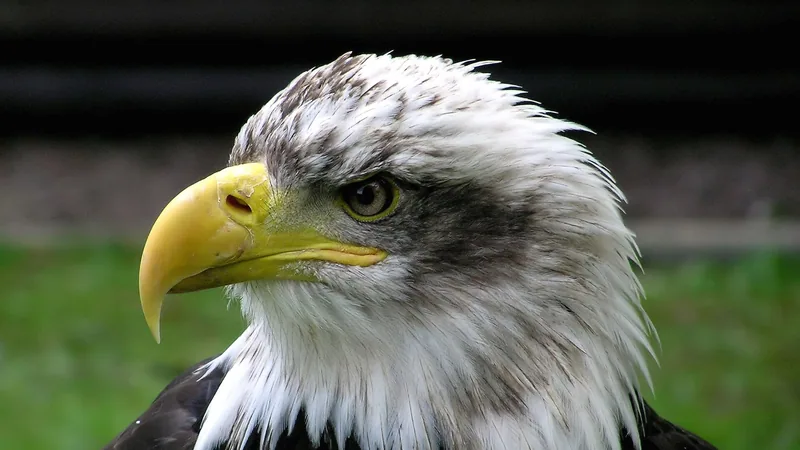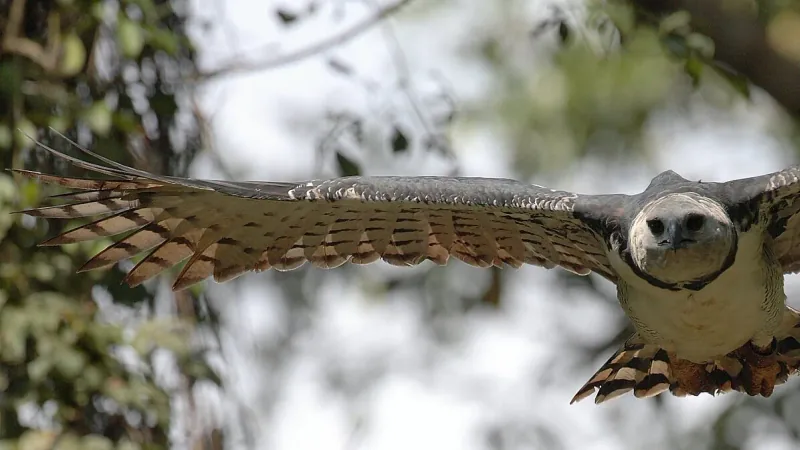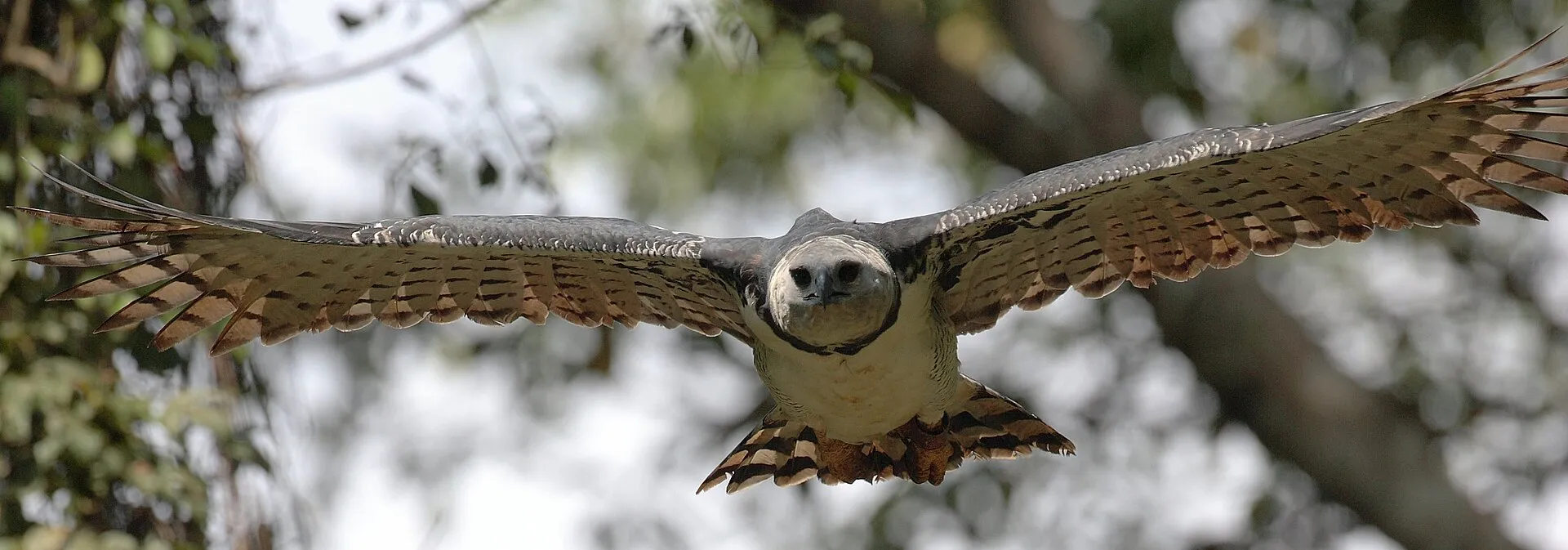
Harpy eagle (Harpia harpyja) arriving at a nest with a brown capuchin monkey
Field
notes
Built Around the Talons
The harpy eagle (Harpia harpyja) is the largest species of eagle, according to Animal Diversity Web, with a body up to 102 centimeters long and a wingspan reaching up to 2 meters (6.5 feet). The San Diego Zoo puts females at 6.3 to 9 kilograms and the smaller males at 3.8 to 5.4 kilograms. A 2019 study on the species put the average at 6.6 kilograms and called it “the largest extant raptor on Earth,” beaten in size only by the extinct Haast eagle of New Zealand. Its curved rear talons are about 13 centimeters (5 inches) long, which the San Diego Zoo says makes them larger than a grizzly bear’s claws, and they sit on legs as thick as a small child’s wrist. Animal Diversity Web estimates that a healthy wild harpy eagle lives 25 to 35 years, but the maximum AnAge lists is 16.8 years, for a captive bird recorded in a 1938 study of bird longevity.
Crushing grip The San Diego Zoo describes talons that can exert several hundred pounds of pressure, enough to crush the bones of their prey and kill it instantly.
Hunting Below the Canopy
A harpy eagle never soars over the top of the rainforest. It flies below the canopy instead, and in a serious chase it is capable of reaching 80 kilometers per hour (50 mph). Its eyesight can pick out something under 2 centimeters across from almost 200 meters away. A good part of the hunt is patience: a harpy eagle will perch silently for up to 23 hours, waiting to catch unsuspecting prey. Sloths and monkeys, including howler monkeys, are its main food sources, and the San Diego Zoo says the monkeys and sloths it snatches from the branches can weigh up to 7.7 kilograms (17 pounds).
A Face That May Funnel Sound
Long black crown feathers rise into a crest when the harpy eagle feels threatened, and some have suggested it also raises them to direct sound to its ears. A separate set of smaller face feathers forms a disc that the San Diego Zoo says may focus sound to improve hearing, similar to owls. Mantled howler monkeys are “one of their primary prey,” and after harpy eagles were reintroduced to Barro Colorado Island in Panama, where they had been extinct for 50 to 100 years, researchers played eagle calls to the island’s howlers. The monkeys quickly picked up an anti-predator response to those calls, ignored other birds’ calls, and kept it up several months after the eagles were removed.
Running Out of Canopy
Harpy eagles range from southern Mexico to the eastern part of Bolivia, southern Brazil, and northern Argentina, and a 2019 study found that Amazonian forests held 93% of the species’ current distribution. The IUCN lists the species as Vulnerable. A 2021 study of 16 active nests in Amazonian landscapes that had lost 0 to 85% of their forest found that harpy eagles could not switch to open-habitat prey in deforested areas, that feeding rates fell with forest loss, and that landscapes deforested by more than 70% supported no nests. Three fledged eaglets in that study died of starvation in landscapes that had lost 50 to 70% of their forest.
Published Updated
Traits
Intel
& FAQ
Guess
first
How big is a Harpy Eagle, really? Slide, lock in, and see what the sources say. Every answer is a figure from this page, quoted from where it came from.
Sources
- 01Harpia harpyja (harpy eagle). Animal Diversity Web, University of Michigan.
- 02Harpy Eagle. San Diego Zoo Wildlife Alliance.
- 03Harpia harpyja. AnAge: The Animal Ageing and Longevity Database, Human Ageing Genomic Resources.
- 04Miranda et al. (2019). Species distribution modeling reveals strongholds and potential reintroduction areas for the world's largest eagle. PLOS ONE.
- 05Miranda et al. (2021). Tropical deforestation induces thresholds of reproductive viability and habitat suitability in Earth's largest eagles. Scientific Reports.
- 06Gil-da-Costa et al. (2003). Rapid acquisition of an alarm response by a neotropical primate to a newly introduced avian predator. Proceedings of the Royal Society of London. Series B: Biological Sciences.
- 07Harpia harpyja. The IUCN Red List of Threatened Species 2021: e.T22695998A197957213.
What the sources say: 45 claims checked word for word against these sources →