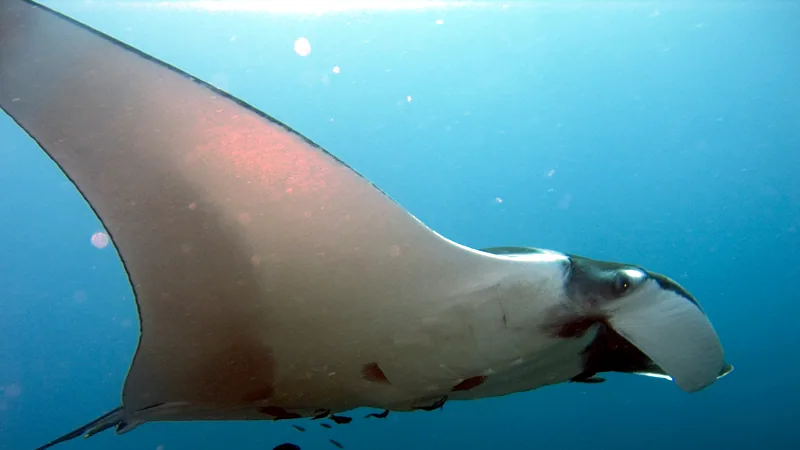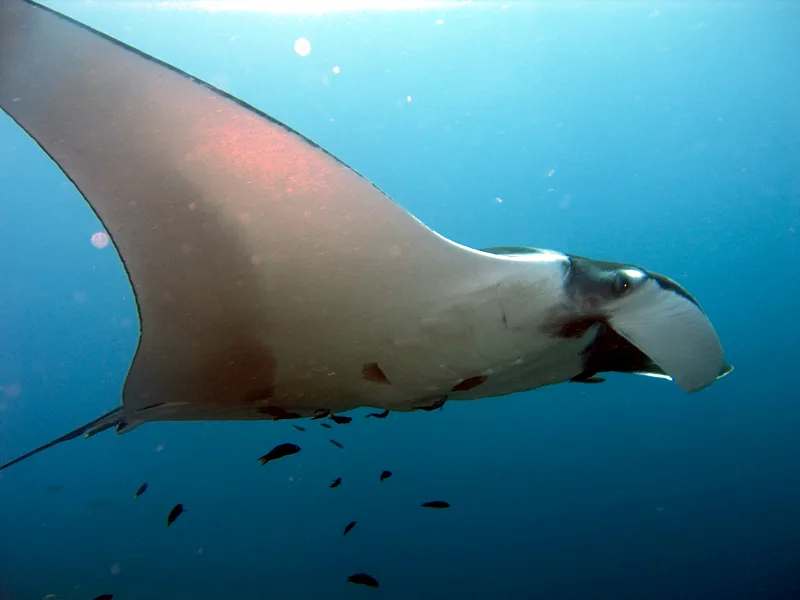
Giant oceanic manta ray (Mobula birostris) off San Benedicto, Revillagigedo Islands, Mexico
Field
notes
The Ocean’s Biggest Ray
The giant oceanic manta ray (Mobula birostris) is the largest ray species alive. NOAA Fisheries records a disc width, the distance from wingtip to wingtip, of up to 26 feet (about 8 metres) and a weight of up to 5,300 pounds (about 2,400 kilograms). Anecdotal reports go as high as 9.1 metres across. Manta rays have been reported to live at least 45 years.
Two structures called cephalic lobes extend in front of its mouth and help channel water in while it feeds. NOAA Fisheries says they make manta rays the only vertebrates with three paired appendages.
How It Feeds
Giant manta rays are filter feeders. Mantas hold their cephalic lobes in an “O” shape and open their mouths wide, pushing water and prey over their gill plates. They mainly eat krill, copepods, mysids, shrimp and decapod larvae, and some studies have noted small and moderately sized fish as well. Mantas also feed in chains with other mantas, or barrel roll, somersaulting over and over again.
Off mainland Ecuador, giant mantas likely get most of their food from deep water offshore. They were seen feeding in only 4 percent of encounters there during peak aggregation time, and an earlier chemical study estimated that, on average, 73 percent of their diet came from mesopelagic (deep-water) sources and 27 percent from surface zooplankton.
Deep Dives Tagging studies show giant manta rays making dives of up to 200 to 450 metres, and they are capable of diving deeper than 1,000 metres. That diving may be influenced by the season and by prey shifting with the thermocline, the layer where warm surface water gives way to colder water below.
Built of Cartilage
A manta ray’s entire skeleton is cartilage instead of bone, which allows a wide range of motion. Yet in 30 filmed slow, steady turns, the quickest fifth averaged about 43 degrees a second and the tightest fifth had a radius of about 2 metres, within the range of swimmers with rigid bodies.
Manta rays have no particular defences apart from their tough skin, but their size means they have few natural predators, although large sharks have been known to attack them. Giant manta rays tend to be solitary, but they gather at cleaning sites and to feed and mate.
Where They Live
Giant manta rays are found worldwide in tropical, subtropical, and temperate waters. A migratory species, they make seasonal visits to productive coastlines with regular upwelling, oceanic island groups, and offshore pinnacles and seamounts. The timing of those visits varies by region and seems to match the movement of zooplankton, currents, upwelling and water temperature.
Slow to Breed, Slow to Recover
Manta rays have among the lowest birth rates of any sharks or rays: a female typically gives birth to only one pup every two to three years, and pregnancy is thought to last around a year. NOAA Fisheries says that low reproductive output leaves giant manta ray populations inherently vulnerable to depletion, with a low likelihood of recovery.
The main threat is commercial fishing. Giant manta rays are both targeted and caught as bycatch in fisheries throughout their range, and manta rays are particularly valued for their gill plates, which are traded internationally. NOAA Fisheries listed the species as threatened under the US Endangered Species Act in 2018, and the IUCN Red List classifies it as Endangered.
Published Updated
Traits
Intel
& FAQ
Guess
first
How big is a Giant Oceanic Manta Ray, really? Slide, lock in, and see what the sources say. Every answer is a figure from this page, quoted from where it came from.
Sources
- 01Giant Manta Ray. NOAA Fisheries.
- 02Marshall et al. (2022). Mobula birostris. The IUCN Red List of Threatened Species 2022: e.T198921A214397182.
- 03Manta birostris. Animal Diversity Web, University of Michigan.
- 04McClain et al. (2015). Sizing ocean giants: patterns of intraspecific size variation in marine megafauna. PeerJ.
- 05Burgess et al. (2018). Novel signature fatty acid profile of the giant manta ray suggests reliance on an uncharacterised mesopelagic food source low in polyunsaturated fatty acids. PLOS ONE.
- 06Fish et al. (2018). Kinematics of swimming of the manta ray: three-dimensional analysis of open water maneuverability. Journal of Experimental Biology.
What the sources say: 54 claims checked word for word against these sources →