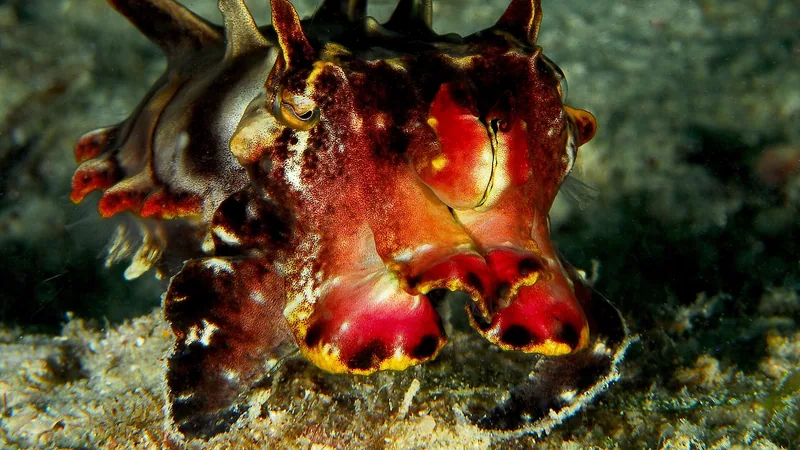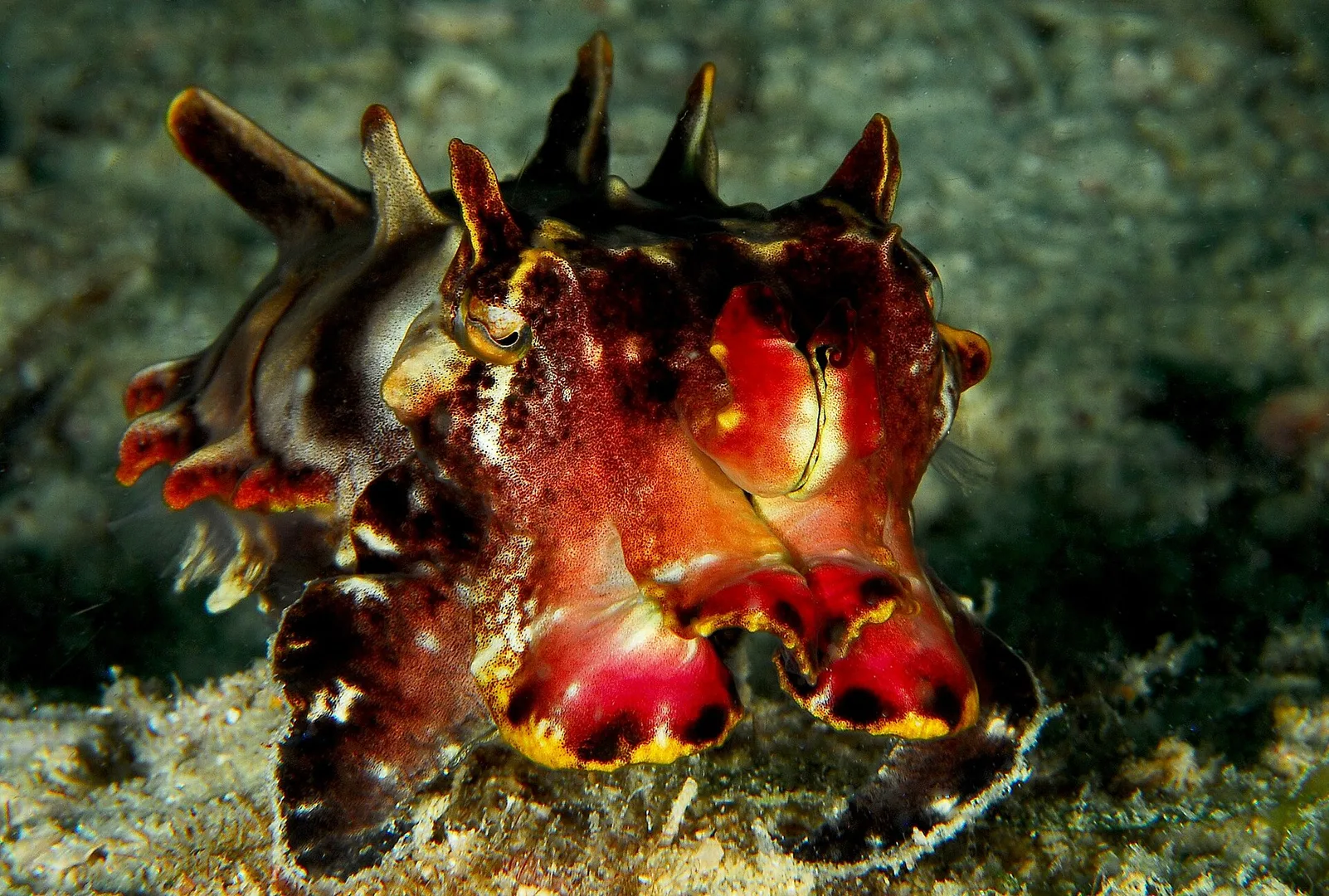
A flamboyant cuttlefish faces the camera with its arms raised, flushed red and yellow.
Field
notes
Colors That Travel Across Its Skin
A 2016 study watched five captive-bred adult flamboyant cuttlefish (Metasepia pfefferi) at Walt Disney World’s aquarium. It catalogued dozens of color, texture, posture and movement components, which combined into 11 distinct body patterns. Unusually for cuttlefish, 8 of those 11 patterns included colors that seemed to travel across the mantle, the main body behind the head. Other cuttlefish species are generally seen doing this while hunting or showing aggression. These aquarium animals did it often, in many kinds of situations. The authors could not say whether wild ones do the same, because so little had been published about their behavior in the wild.
Four zones of traveling color Waves, two or three at a time, ran from the front and the back of the mantle to a white square at its center. Others ran from that square out to the sides, toward the fins.
A Small Cuttlefish That Walks
It grows up to 60 mm (2.4 in) long. The study’s captive-bred females weighed about 20 grams and the males about 10 grams, at 3 to 4 months old. Three pairs of flat flaps, called papillae, cover its eyes. Its cuttlebone, which sits inside its body and controls how well it floats, runs about two-thirds to three-quarters the length of the mantle. That is small for its body, so it cannot swim for long. Instead it usually walks, or “ambles,” along the seafloor on two of its eight arms. Flaps of skin and muscle at the back of its underside, called glutapods, sometimes join in, letting it walk almost like a four-legged animal. In the wild it lives in shallow tropical waters, less than 85 meters deep, around Australia, Papua New Guinea and Indonesia. There it hunts fish and crustaceans on sandy or muddy seafloor.
A Flash of Warning Colors
When it feels threatened, the flamboyant cuttlefish quickly changes color. It makes black, white and yellow patches on its dark brown skin and turns its arm tips bright red. These bright colors warn other animals that it is venomous. It keeps the pattern, waving its protective arm membranes, until it no longer feels threatened. Animal Diversity Web lists it as an animal that can injure people. Cuttlefish in general fall prey to seals, dolphins and fish, and they can release ink to confuse a predator and escape.
Discovery, Life Cycle and Name
It was discovered in 1885, but the first sightings of living ones were not reported until 1988. A male passes packets of sperm to the female with a specialized arm. She lays her eggs one by one in hard-to-reach cracks and crevices, hidden from predators. Its lifespan is estimated at 18 to 24 months, based on what is known about other species in the same family, and many females die after spawning. The IUCN Red List last assessed it in 2009 and lists it as Data Deficient, meaning too little is known to judge how threatened it is. A 2023 DNA study of cuttlefish brought back several genus names, including Ascarosepion, and linked Metasepia to it. This profile keeps the name Metasepia pfefferi.
Published Updated
Traits
Intel
& FAQ
Guess
first
How big is a Flamboyant Cuttlefish, really? Slide, lock in, and see what the sources say. Every answer is a figure from this page, quoted from where it came from.
Sources
- 01Metasepia pfefferi. Animal Diversity Web, University of Michigan.
- 02Thomas & MacDonald (2016). Investigating body patterning in aquarium-raised flamboyant cuttlefish (Metasepia pfefferi). PeerJ.
- 03Lupše et al. (2023). Cuttlefishes (Cephalopoda, Sepiidae): the bare bones - an hypothesis of relationships. Marine Biology.
- 04Barratt & Allcock (2012). Metasepia pfefferi. The IUCN Red List of Threatened Species 2012: e.T162681A943607.
What the sources say: 61 claims checked word for word against these sources →