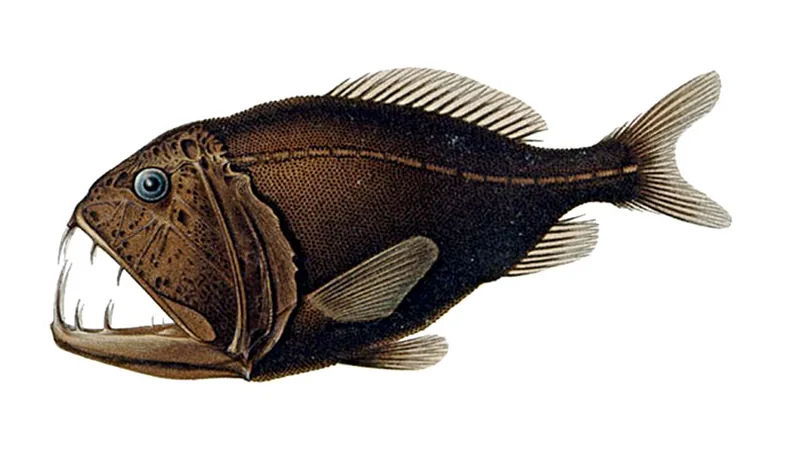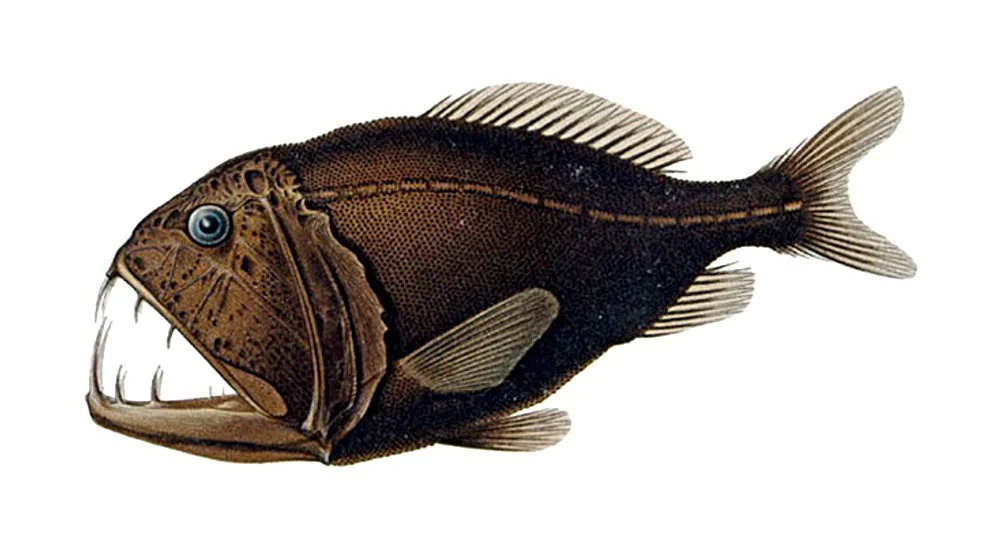
Anoplogaster cornuta, painted for August Brauer's Die Tiefsee-Fische (1906). No freely licensed photograph of a living fangtooth exists.
Field
notes
A Mouth That Won’t Shut
An adult fangtooth’s head takes up about a third of its maximum body length of about 16 to 17 centimetres. Its long front fangs stop an adult from closing its mouth completely: when the jaws are partly shut, the lower fangs slide into pockets in the roof of the mouth.
A 2022 microscope study of two adults caught in the North Atlantic found every tooth made solely of orthodentin (the dense tissue that normally sits under a tooth’s hard outer cap) with no cap of its own, and the jaw teeth fused solid to the bone. It found no sign that the big jaw teeth had been replaced. The teeth in the throat, by contrast, showed signs of replacement: empty sockets and small new teeth.
Largest Teeth of Any Marine Fish Relative to the size of its head, the common fangtooth is reported to have the largest teeth of any fish in the sea.
Two Species, and a Case of Mistaken Identity
The genus holds two species, the common fangtooth (Anoplogaster cornuta) and the shorthorn fangtooth (Anoplogaster brachycera). Young common fangtooths carry long spines on the head and gill cover that shorthorns lack.
Young A. cornuta start out silvery gray, large-eyed and spiny-headed; adults turn small-eyed, spineless and black or dark brown. Juveniles and adults look so different that in the 1800s they were believed to be separate species. The lower jaw’s fangs do not start growing until a young fish reaches about 2 centimetres long, the upper fangs wait until 5.3 centimetres, and only around 8 centimetres does a fangtooth begin to look like the adult it will become.
Breathing With a Mouth Full of Prey
Adults feed mainly on fish and shrimp, typically swallowed whole, and prey can reach a third of their own body size. With a full mouth, a fangtooth cannot pump water over its gills efficiently. Instead it bulges out the opercula, the bony gill covers, exposing the gill arches, and fans water over them from behind with its pectoral fins until the prey has been swallowed.
Juveniles hunt differently. A 2023 study examined 91 juvenile fangtooth, weighing 0.6 to 22 grams, recovered from the stomachs of longnose lancetfish caught on Hawaii-based longlines in the central North Pacific. They specialized on tiny crustaceans called hyperiid amphipods: one family, Phrosinidae, turned up in 86 percent of stomachs. Their estimated mean foraging depth, about 200 metres, was the shallowest of the three species studied.
Life Under Crushing Pressure
Anoplogaster cornuta lives worldwide in tropical, temperate and subarctic seas, most often between 500 and 2,000 metres down, though adults have been caught as deep as 5,000 metres. It is stenothermic, adapted to a narrow band of 4 to 6°C. Its dark brown to black colouring likely lowers the risk of being eaten where little or no sunlight reaches. The IUCN lists the species as Least Concern.
Published Updated
Traits
Intel
& FAQ
Guess
first
How big is a Fangtooth, really? Slide, lock in, and see what the sources say. Every answer is a figure from this page, quoted from where it came from.
Sources
- 01Kierdorf et al. (2022). Dental structure and tooth attachment modes in the common fangtooth Anoplogaster cornuta (Valenciennes, 1833) (Actinopterygii; Trachichthyiformes; Anoplogastridae). PLOS ONE.
- 02Portner et al. (2023). Harnessing a mesopelagic predator as a biological sampler reveals taxonomic and vertical resource partitioning among three poorly known deep-sea fishes. Scientific Reports.
- 03Anoplogaster cornuta (common sabertooth). Animal Diversity Web, University of Michigan.
- 04Iwamoto (2015). Anoplogaster cornuta. The IUCN Red List of Threatened Species 2015: e.T18123960A21910070.
What the sources say: 50 claims checked word for word against these sources →