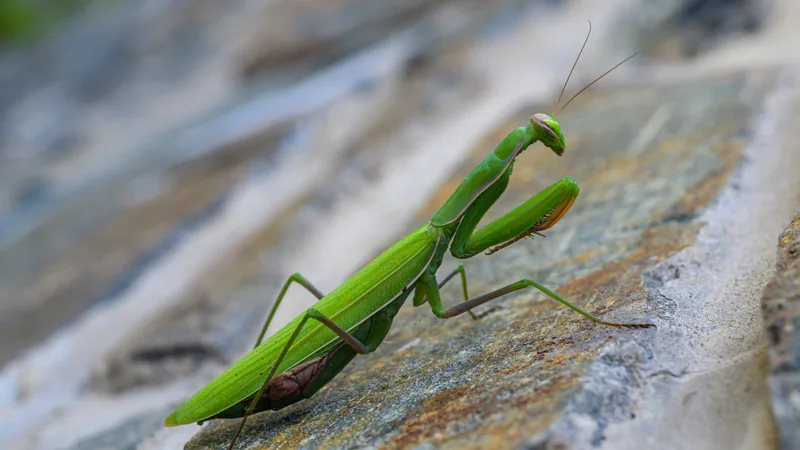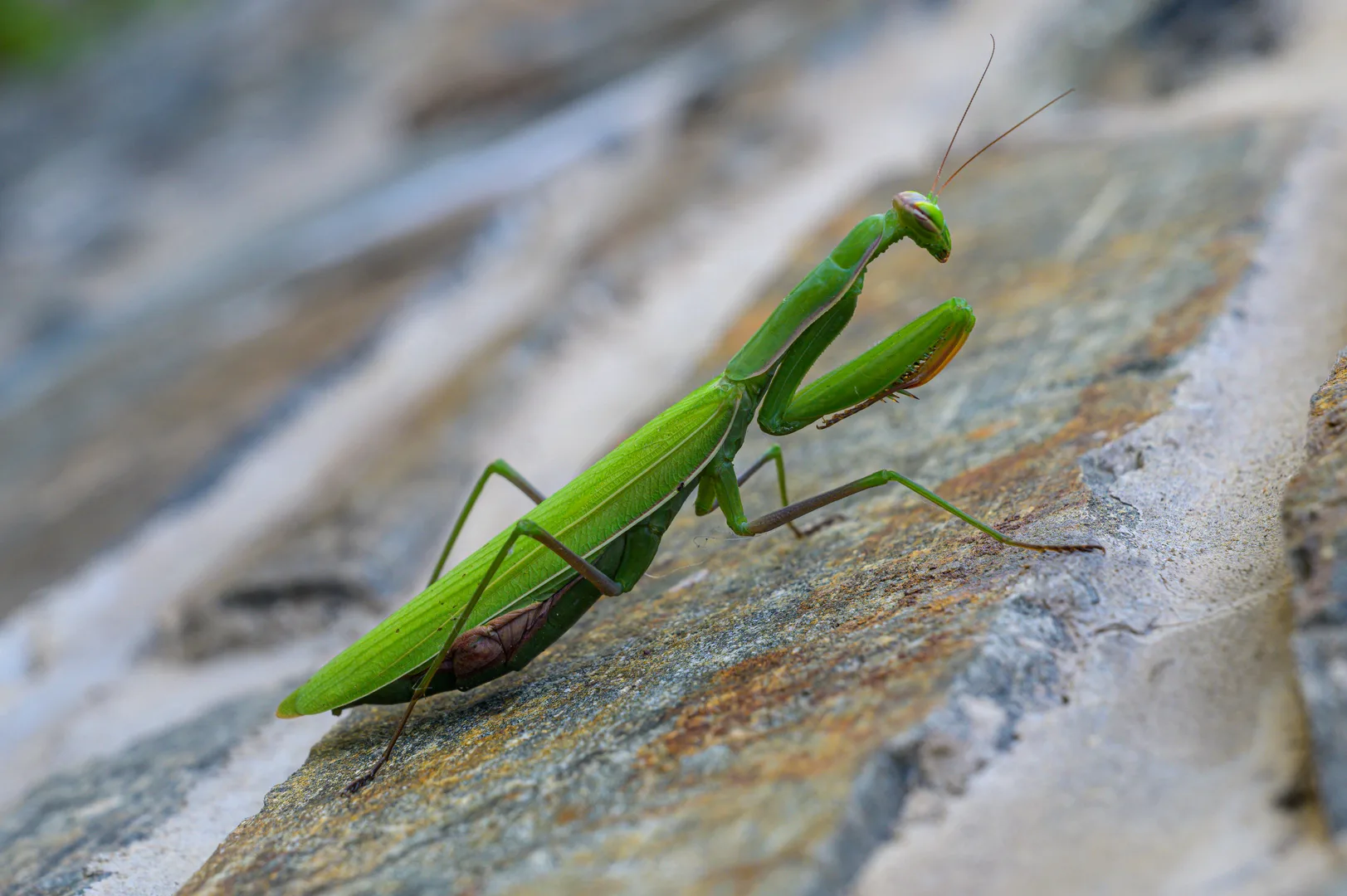
European mantis (Mantis religiosa) in the Kamp- and Kremstal European protected area
Field
notes
An ear on its belly
The European mantis, Mantis religiosa, hears with a single ear in the middle of its underside. The ear sits in a deep groove and is built from two eardrums that face each other, backed by large air sacs.
Ultrasound detector The ear is tuned broadly to ultrasound, with its best sensitivity between 25 and 45 kHz. The researchers who traced it argue that a pair of nerve cells carrying this hearing is part of a warning and escape system, which may defend the mantis against bats hunting at night.
Size, color and a short life
Adults range from 4.2 to 8.8 cm long. The species comes in green and brown forms, and older studies noticed green mantises on green grass and brown ones on dried, straw-colored grass.
Life is quick. In a lab rearing of the subspecies Mantis religiosa religiosa, the egg case took about 18 days to incubate. The nymph stage, the young form before adulthood, lasted about 61 days and included six moults, which means shedding the old skin. Adult males then lived 35 to 60 days and adult females 70 to 90. That is one subspecies in a lab, so wild lifespans may differ.
A stalk-and-pounce diet
In feeding tests on six mantis species, this one included, mantids stalked their prey and pounced, grasping it with their forelegs. They took only living prey and noticed only moving prey. On average they ate crickets 50% of their own body weight, while cockroaches could weigh up to 110%.
In the lab rearing, the first two nymph stages ate only fruit flies, while older nymphs and adults fed mainly on grasshoppers and crickets. A Montana field guide calls it a generalist predator, as likely to take beneficial pollinators and small birds as garden pests.
From Eurasia to New York
The European mantis is native to Eurasia. People have carried it to the United States and Canada both by accident and on purpose, and it is released into gardens to control insects. It was introduced from Europe to New York state in 1899.
It loves heat. In Poland, over 70% of recent sites were near a forest edge or partly open, mainly fallow land and wasteland with dry sandy grassland. These are often old fields that were farmed several years earlier or more recently. The IUCN Red List rates the species Least Concern, although a 2016 study called it endangered in Germany.
Published
Traits
Intel
& FAQ
Guess
first
How big is a European Mantis, really? Slide, lock in, and see what the sources say. Every answer is a figure from this page, quoted from where it came from.
Sources
- 01Battiston (2016). Mantis religiosa. The IUCN Red List of Threatened Species 2016: e.T44793247A44798476.
- 02European Mantid, Mantis religiosa. Montana Field Guide, Montana Natural Heritage Program.
- 03Raut & Gaikwad (2016). Observations on the Life cycle, Mating and Cannibalism of Mantis religiosa religiosa Linnaeus, 1758 (Insecta: Mantodea: Mantidae). Journal of Entomology and Zoology Studies.
- 04Reitze & Nentwig (1991). Comparative investigations into the feeding ecology of six Mantodea species. Oecologia.
- 05Yager & Hoy (1989). Audition in the praying mantis,Mantis religiosa L.: identification of an interneuron mediating ultrasonic hearing. Journal of Comparative Physiology A.
- 06Yager & Hoy (1987). The midline metathoracic ear of the praying mantis, Mantis religiosa. Cell and Tissue Research.
- 07Linn & Griebeler (2016). Habitat Preference of GermanMantis religiosaPopulations (Mantodea: Mantidae) and Implications for Conservation. Environmental Entomology.
- 08Liana (2007). Distribution of Mantis religiosa (L.) and its changes in Poland. Fragmenta Faunistica.
What the sources say: 50 claims checked word for word against these sources →