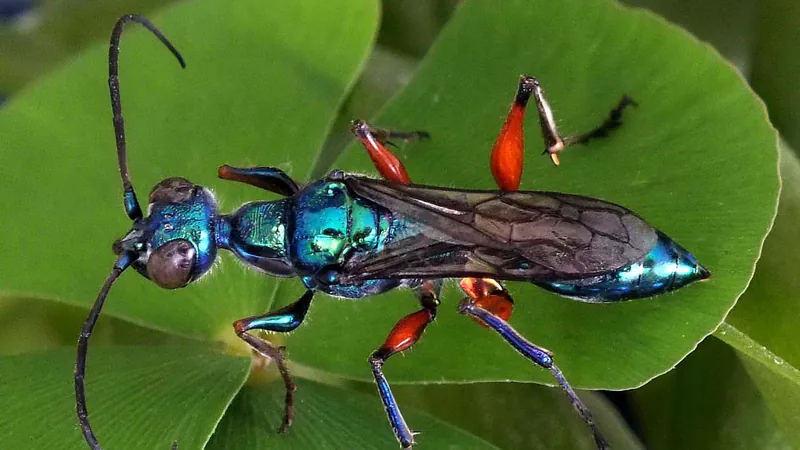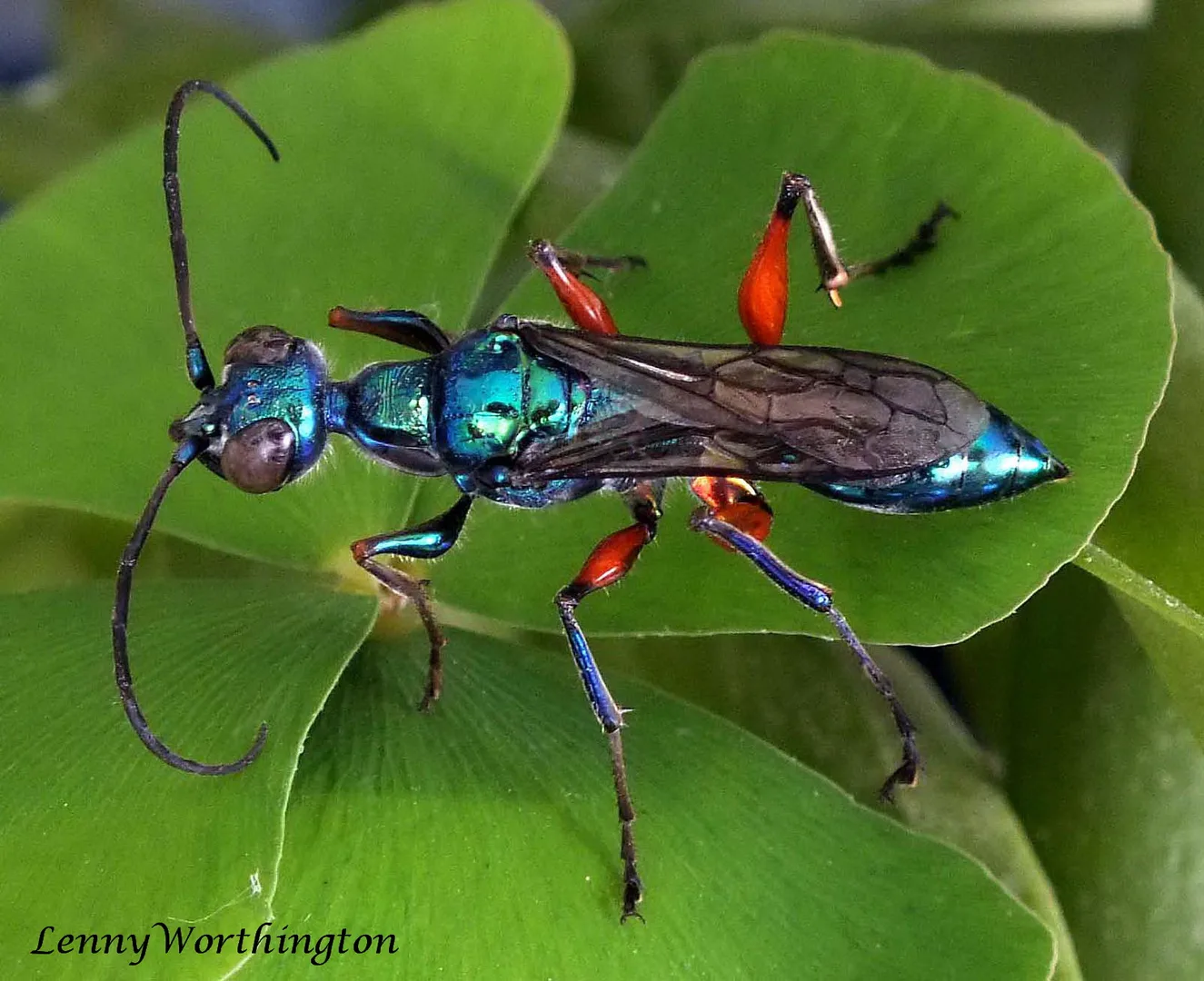
Emerald cockroach wasp, Pattaya, Thailand.
Field
notes
Neurosurgery with a stinger
A female emerald cockroach wasp hunts American cockroaches, and it does not kill them. It hijacks them. It stings twice. The first sting goes into the thorax, the middle section of the body, and paralyzes the front legs for 2 to 3 minutes. That makes the second sting easier.
The second sting goes into the head, aimed at the brain and at a cluster of nerve cells called the sub-esophageal ganglion. When scientists removed that ganglion before a wasp stung, the sting lasted five times longer, which suggests the wasp actively targets it. Sensors on the stinger help it feel its way to the target.
The venom does not paralyze the cockroach. It switches off the urge to walk. The roach grooms itself for about 30 minutes, then turns hypokinetic, which means it hardly starts walking on its own, for days.
Zombie on a leash The wasp clips the cockroach’s antennae with buzzsaw actions of its jaws, drinks hemolymph (insect blood) through the stumps like straws, then grabs the stumps and leads the cockroach into its burrow.
One egg, one living lunchbox
In the burrow, the wasp lays a single egg on the cockroach’s middle leg and seals the entrance with debris. In a lab colony kept at 28 °C, the egg hatched within three days. The larva starts outside the cockroach, drinking hemolymph. Then it moves inside. It grows through three stages, and in the same study the third stage, the one inside, averaged 28.4 millimetres long.
Inside, it eats fat and muscle first and spares the gut. The central nervous system is the final meal. The larva also coats its host from the inside with a blend of antimicrobial chemicals, and the host dries out without rotting.
Armour, range and a long wait
Then the larva spins a silk cocoon inside the husk, and one study suggests the cocoon is its armour. In its lab tests, hungry young cockroaches killed the developing wasp on days 0 to 8. On day 10, 90% of the larvae survived. Survival depended entirely on whether the cocoon was finished.
The adult breaks out of the cocoon and the husk about 1 to 2 months after the egg is laid, depending on sex and temperature. Females are larger than males, and only females make venom.
The Integrated Taxonomic Information System lists the wasp in Africa, southern Asia, Australia and Oceania, and records it as introduced to Hawaii.
Published Updated
Traits
Intel
& FAQ
Guess
first
How big is a Emerald Cockroach Wasp, really? Slide, lock in, and see what the sources say. Every answer is a figure from this page, quoted from where it came from.
Sources
- 01Arvidson et al. (2018). Life History of the Emerald Jewel Wasp Ampulex compressa. Journal of Hymenoptera Research.
- 02Gal & Libersat (2010). A Wasp Manipulates Neuronal Activity in the Sub-Esophageal Ganglion to Decrease the Drive for Walking in Its Cockroach Prey. PLoS ONE.
- 03Herzner et al. (2013). Larvae of the parasitoid wasp Ampulex compressa sanitize their host, the American cockroach, with a blend of antimicrobials. Proceedings of the National Academy of Sciences.
- 04Haspel & Libersat (2003). Wasp venom blocks central cholinergic synapses to induce transient paralysis in cockroach prey. Journal of Neurobiology.
- 05Catania (2024). The Cocoon of the Developing Emerald Jewel Wasp (Ampulex compressa) Resists Cannibalistic Predation of the Zombified Host. Brain, Behavior and Evolution.
- 06Ampulex compressa (TSN 154312). Integrated Taxonomic Information System.
- 07Olivia Barney (2026). The Zombie Wasp's Link to Parkinson's Research. Natural History Museum of Utah.
What the sources say: 62 claims checked word for word against these sources →