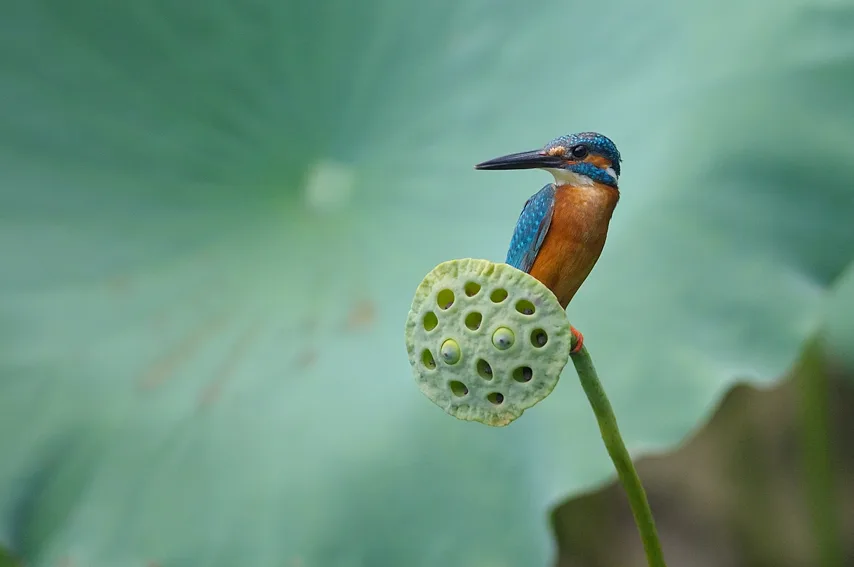
Common Kingfisher (also known as Eurasian Kingfisher) perching on a plant.
Field
notes
Diving Blind, Striking by Touch
The Common Kingfisher (Alcedo atthis) hunts from a perch that can be anywhere from several centimetres to several metres above the water, watching for movement below. Fish don’t sit where they appear to: light bends at a different angle passing from air into water, an effect called refraction, and a kingfisher learns to compensate for that shift, which helps it catch prey more effectively. Then, the instant it hits the surface, a third eyelid called a nictitating membrane closes over each eye, and the bird finishes the job blind: it relies on touch alone to know the moment to snap its bill shut on the fish.
Feathers With No Blue In Them
Its “blue” is not really there. Pluck a feather from a kingfisher’s back and you will find no blue pigment in it; the feather is really a dull brown. The blue and cyan you see come from spongy nanostructures inside the feather barbs, which scatter light differently depending on the angle, an effect called iridescence, while the orange breast feathers get their colour from pigment granules. Move around the bird and its “blue” can shift shade, because you are looking at a structure, not a dye.
A Bottomless Appetite
That hunting style is expensive to run. A kingfisher eats around 60% of its own body weight every day, which is mainly why it is fiercely territorial, defending its patch of water against rivals, its mate and even its own offspring. An adult weighs around 39 grams and measures about 17 centimetres long. Its diet is mostly small fish, including minnows, plus freshwater shrimp-like crustaceans and aquatic insects. After a catch, the bird carries the fish back to its perch, grips it by the tail and whacks it against the perch. That stuns or kills it, which is particularly important with spiny fish. Anything it cannot digest comes back up later as a pellet of bone.
Rivers Across Three Continents
Common kingfishers live along clear, slow-moving rivers, canals and ponds from Britain and Ireland across Europe and Asia as far east as Japan, and through Africa south of the Sahara. Southern birds stay put all year, while northern populations move south in winter to escape freezing water. Numbers swing hard from one year to the next, mostly because of severe cold: one census in Belgium counted 8 pairs after a severe winter, 45 five years later, and 25 the year after that. Life itself is short. UK ringing data collected by the British Trust for Ornithology show about 21.5% of young kingfishers survive their first year, and a bird that reaches breeding age has a typical life expectancy of two years; the oldest in the BTO’s ringing records reached 4 years, 6 months and 29 days. Even so, the IUCN rates the species Least Concern worldwide, and the UK’s breeding population was stable from 1995 to 2024.
Published Updated
Traits
Intel
& FAQ
Guess
first
How big is a Common Kingfisher, really? Slide, lock in, and see what the sources say. Every answer is a figure from this page, quoted from where it came from.
Sources
- 01Alcedo atthis (common kingfisher). Animal Diversity Web, University of Michigan.
- 02BirdFacts: Kingfisher (Alcedo atthis). British Trust for Ornithology.
- 03Kingfisher. Royal Society for the Protection of Birds.
- 04Stavenga et al. (2011). Kingfisher feathers – colouration by pigments, spongy nanostructures and thin films. Journal of Experimental Biology.
- 05Vilches, Miranda & Arizaga (2019). Does the Common Kingfisher (Alcedo atthis) select the most energetic fish prey? Ornis Fennica.
- 06Alcedo atthis. The IUCN Red List of Threatened Species 2024: e.T22683027A264589271.
What the sources say: 41 claims checked word for word against these sources →