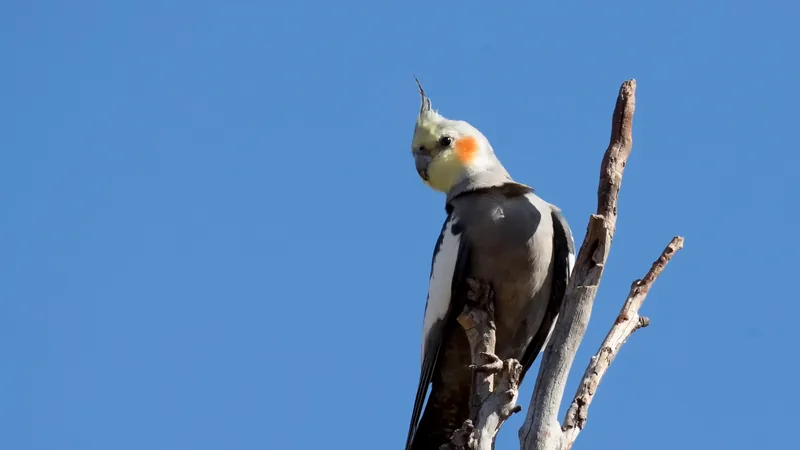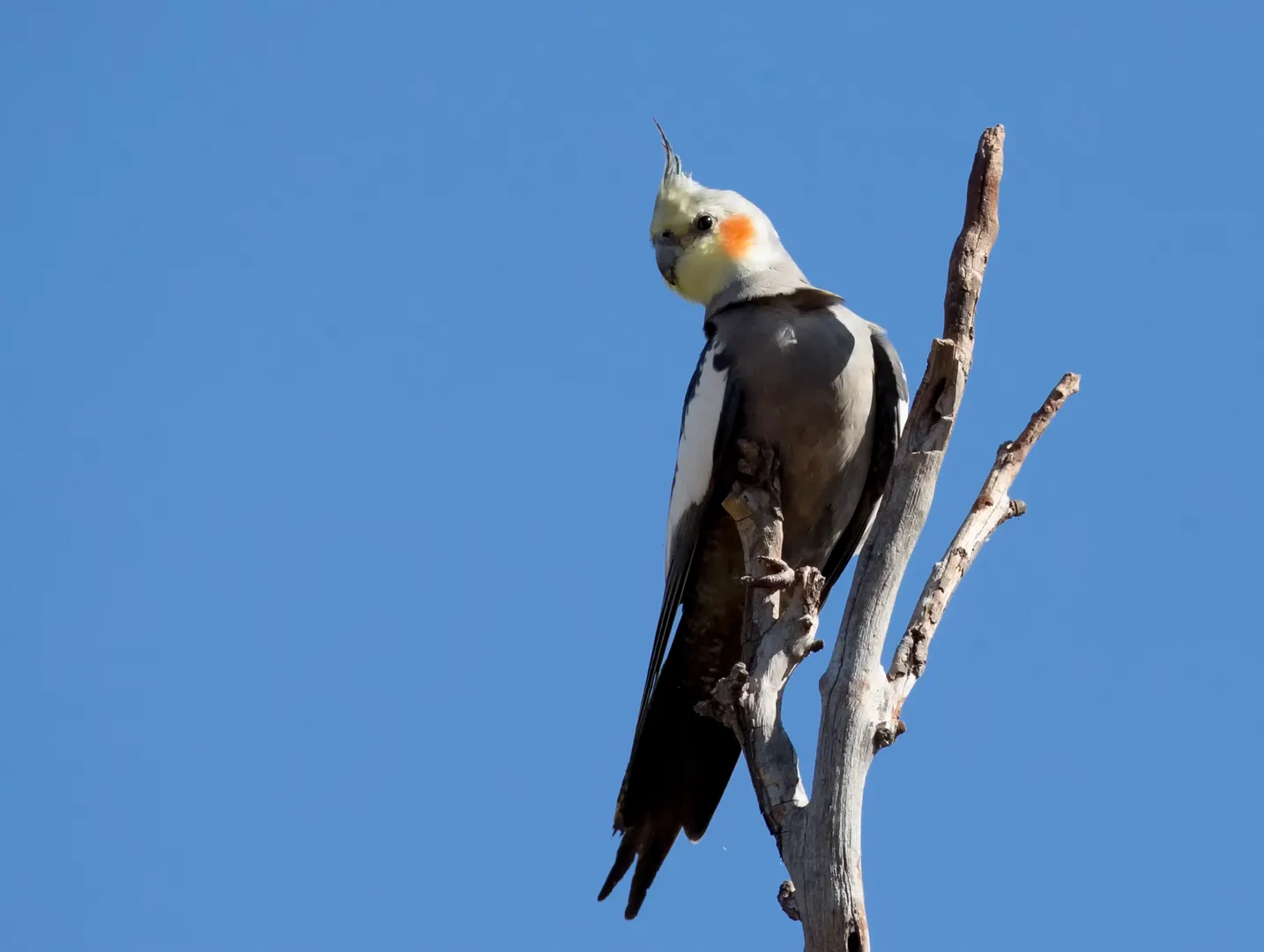
A male on a bare branch.
Field
notes
Sings along, in sync
Singing in unison is several singers producing one acoustic pattern in synchrony, and studies showing it in non-human animals are quite rare. Cockatiels managed it in a study published in 2021. Three hand-raised birds learned a whistled melody made of two halves of 11 notes each, separated by a long pause. Two of them then joined in while the whistling was already running, and bird and human were nearly perfectly synchronous.
The trick is timing. When a recording of the melody was played after a bird had started singing, the birds changed the length of the pause in their own song, and the later the playback came, the longer the delay.
Beat matching Two cockatiels joined a human whistler mid-melody and sang nearly perfectly in sync.
Small, grey and built to blend in
An adult is 30 to 33 cm long, with an average of 32 cm, and weighs about 90 g. Half of that length is a long, pointed tail. The plumage is mostly grey with a white wing patch, orange cheeks and a pointed crest. Males have a bright yellow face. Their colouring lets aerial predators overlook them easily, especially in shady areas.
The crest works as a mood ring. Held straight up, the crest shows a startled or alert bird. At about 45 degrees, the bird is content. Flat against the head shows an agitated one, and in flight it also lies flat, which reduces wind drag.
With no strong defences, a cockatiel in danger takes off. Flocks put many eyes on watch for predators, mostly Australian birds of prey.
Nomads of the dry country
Cockatiels are widespread across mainland Australia and uncommon in Tasmania. They live in pairs or small flocks in open country, usually near water, and are common in the arid inland. They are strongly nomadic, moving around in response to food and water.
Seeds are the main course. They eat grass seeds, nuts, berries and grain, and they use the tongue to rotate a seed while the upper beak strips off the shell. Drinking is a quick job: one or two sips, then necks stretch up to swallow and survey the surroundings. They also use metabolic water and can go long stretches without a drink.
The maximum recorded life is 35 years, from one bird in captivity. The IUCN Red List, in its 2018 edition, rates the species Least Concern.
Published Updated
Traits
Intel
& FAQ
Guess
first
How big is a Cockatiel, really? Slide, lock in, and see what the sources say. Every answer is a figure from this page, quoted from where it came from.
Sources
- 01Nymphicus hollandicus. The IUCN Red List of Threatened Species 2018: e.T22684828A132056250.
- 02Seki (2021). Cockatiels sing human music in synchrony with a playback of the melody. PLOS ONE.
- 03Nymphicus hollandicus (cockatiel). Animal Diversity Web, University of Michigan.
- 04Cockatiel. Birds in Backyards, BirdLife Australia.
- 05AnAge entry for Nymphicus hollandicus. AnAge, Human Ageing Genomic Resources.
What the sources say: 48 claims checked word for word against these sources →