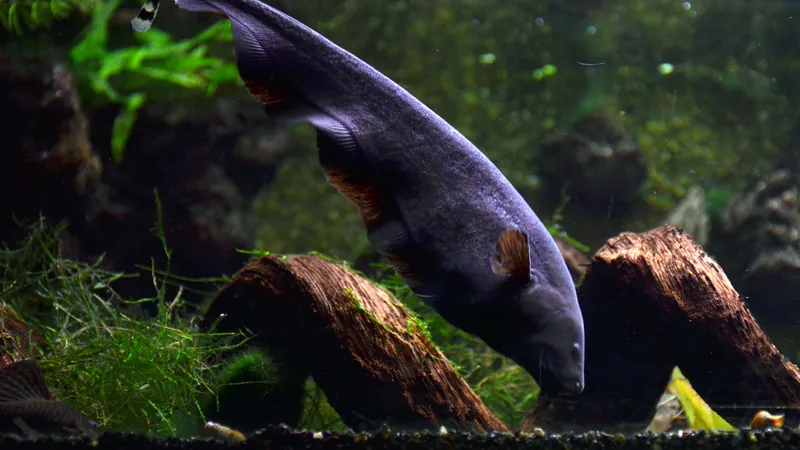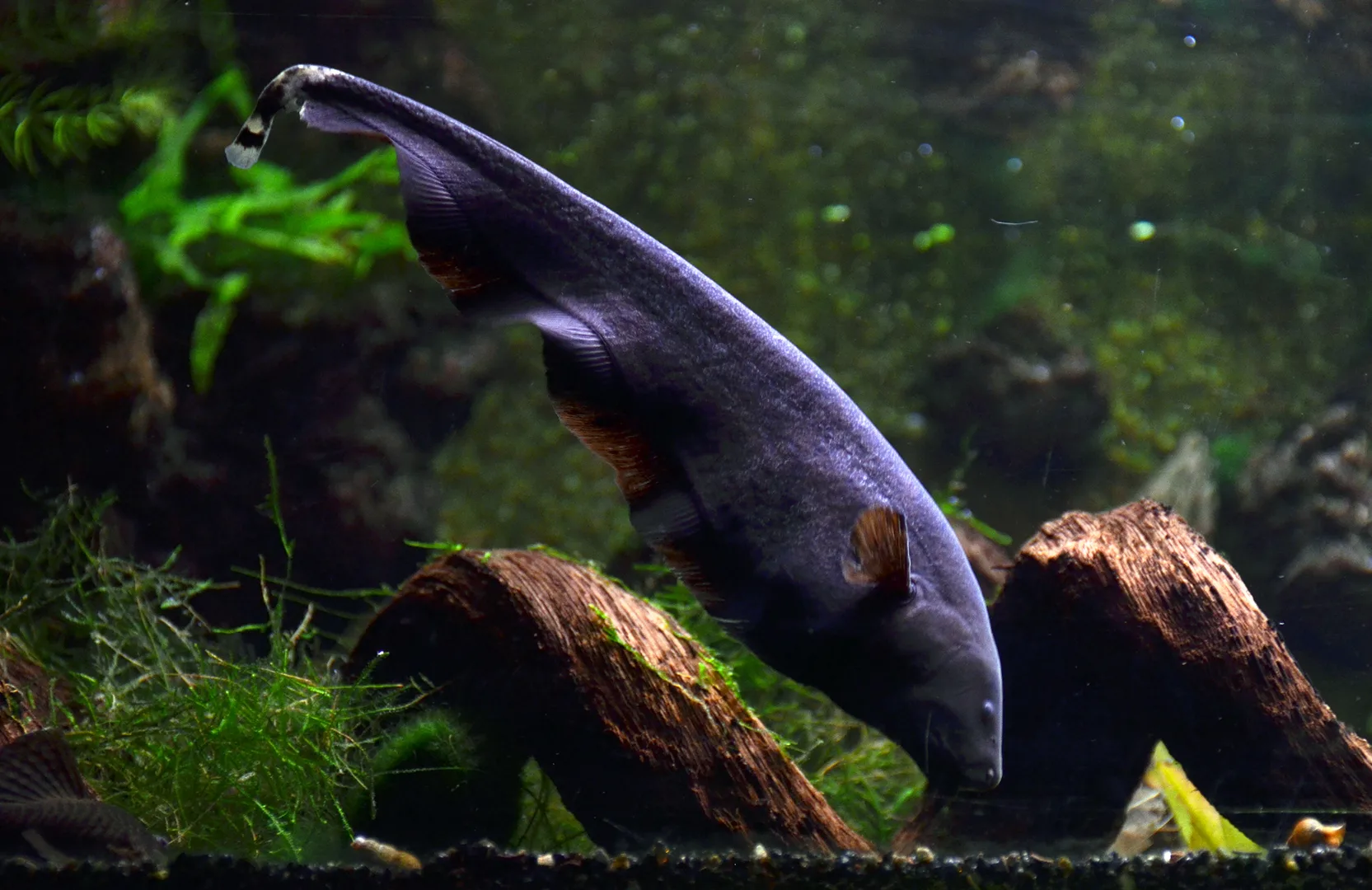
A captive black ghost knifefish hanging head down over sunken wood.
Field
notes
A Fish That Reads the World in Electricity
The black ghost knifefish (Apteronotus albifrons) is a nocturnal, weakly electric fish. Like other weakly electric fish, it makes an electric field around its body by discharging a special electric organ. Its discharge is continuous and wave-type, and each fish has its own frequency somewhere between 800 and 1,200 hertz (cycles a second). Its body surface carries two kinds of electroreceptor, sense organs that detect electricity: ampullary receptors, tuned to low frequencies, and tuberous receptors, tuned to high ones. One count found 151 ampullary receptors on one side of the head and 208 on one side of the body, and estimated 3,000 to 3,500 tuberous receptors on one side of the head and 3,500 to 5,000 on one side of the body.
Sensing without light. Weakly electric fish make an electric field around their body, and by sensing distortions in that field they can find their way and locate objects, including prey in dark, murky water.
Without visual cues, this species probably detects prey through weak electrical cues and the water movements the prey makes. Infrared video of black ghost knifefish catching small water fleas in the dark led researchers to stress the role of the dorsal edge, the top edge of the fish’s back, in catching prey.
It lives in South America, from Venezuela to the Paraguay and Paraná rivers, and in the Amazon basin of Peru, where it is found in fast-flowing creeks with a sandy bottom. It grows to as much as 50 centimetres long, and sexually mature adults typically weigh at least 20 grams. It hunts insect larvae.
A Ribbon Fin Along the Belly
Knifefish swim with a rippling fin that runs most of the length of the body along the belly, and this enables them to keep the body relatively straight while swimming. In the black ghost knifefish this is the anal fin, the fin on its underside. It stretches nearly three-quarters the length of the body, is made of about 150 fin rays (the thin supports inside a fin), and is highly flexible, which is where the fish’s ability to manoeuvre comes from. Researchers used high-speed video to study the fin as the fish swam forward, swam backward, moved up and down, and hovered.
To hover, a ghost knifefish sends two waves along the fin toward each other, one from the rear end of the fin and one from the front end. They meet near the middle of the fin, where their forward and backward pushes cancel out.
A Signal That Differs by Sex
Weakly electric fish also use their electric fields to communicate with each other. In the black ghost knifefish, males discharge at lower frequencies than females, and androgens, hormones such as testosterone, lower the frequency. Its close relative the brown ghost knifefish (Apteronotus leptorhynchus) shows the opposite: males discharge at higher frequencies than females, and androgens raise the frequency.
When researchers lowered the oxygen step by step in one half of a two-chamber tank holding young black ghost knifefish, the fish on average avoided that half once its oxygen fell below 22 percent air saturation, a measure of dissolved oxygen. Fish that avoided it more also swam more, but the frequency of their discharges did not change. The IUCN lists the species as Least Concern.
Published Updated
Traits
Intel
& FAQ
Sources
- 01Frederico (2022). Apteronotus albifrons. The IUCN Red List of Threatened Species 2022: e.T49829499A159047904.
- 02Apteronotus albifrons (Linnaeus, 1766), Black ghost. FishBase.
- 03Carr, Maler & Sas (1982). Peripheral organization and central projections of the electrosensory nerves in gymnotiform fish. Journal of Comparative Neurology.
- 04Nelson & Maciver (1999). Prey capture in the weakly electric fish Apteronotus albifrons: sensory acquisition strategies and electrosensory consequences. Journal of Experimental Biology.
- 05Curet et al. (2011). Mechanical properties of a bio-inspired robotic knifefish with an undulatory propulsor. Bioinspiration & Biomimetics.
- 06Youngerman, Flammang & Lauder (2014). Locomotion of free-swimming ghost knifefish: anal fin kinematics during four behaviors. Zoology.
- 07Ruiz-Torres et al. (2012). Kinematics of the ribbon fin in hovering and swimming of the electric ghost knifefish. Journal of Experimental Biology.
- 08Dunlap, Thomas & Zakon (1998). Diversity of sexual dimorphism in electrocommunication signals and its androgen regulation in a genus of electric fish, Apteronotus. Journal of Comparative Physiology A: Sensory, Neural, and Behavioral Physiology.
- 09Mucha, Chapman & Krahe (2021). The weakly electric fish, Apteronotus albifrons, actively avoids experimentally induced hypoxia. Journal of Comparative Physiology A.
- 10Nelson, MacIver & Coombs (2002). Modeling Electrosensory and Mechanosensory Images during the Predatory Behavior of Weakly Electric Fish. Brain, Behavior and Evolution.