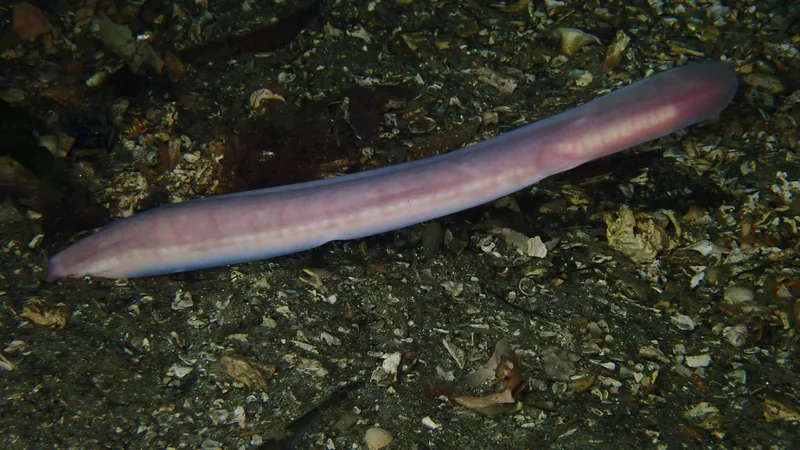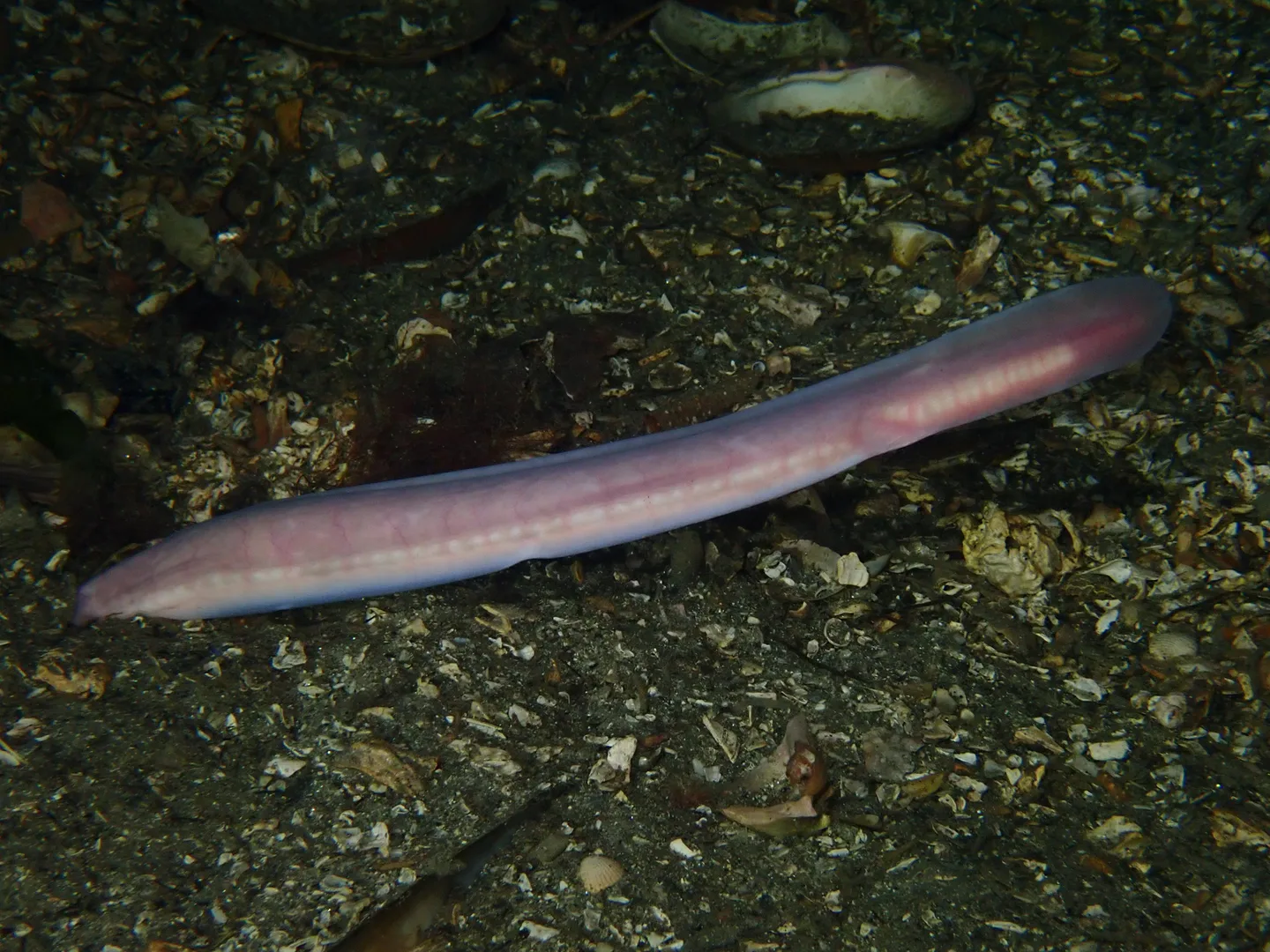
An Atlantic hagfish on a shell-gravel seabed off Bodø, Norway.
Field
notes
A Living Fossil With No Face to Speak Of
Look at an Atlantic hagfish’s head and there isn’t much there: a jawless mouth, a single nostril, one pair of gill openings, barbels. Hagfish and lampreys are the most ancient extant vertebrates, and the hagfish eye is strikingly rudimentary: no lens, no pigment, and in the genus Myxine buried under a layer of muscle, possibly a photoreceptive organ for circadian timing rather than image formation. Behind the mouth there is no jaw, and the feeding apparatus is tooth cusp plates and a dental muscle complex. A big adult reaches 95 centimeters, though a common length is 30 centimeters, or 40 for a female. One Gulf of Maine sample averaged 51 centimeters (19.5 to 72.4), and those over 35 centimeters had an average weight of 140 grams.
A Gland Full of Coiled Thread
A Gulf of Maine survey counted 114 slime pores on average down the left side alone. Each gland behind them holds thread cells packed with coiled bundles of protein fiber, and mucus cells; striated muscle squeezes both into the seawater when the animal is provoked. Clogging the gills of fish predators is one of the primary functions of hagfish slime, and the threads keep a predator from flushing it out.
A Hundredfold Unraveling Mucus vesicles mixed into seawater swell into long strands that attach to a thread bundle and transmit the forces that unravel it, turning a 150-micrometer coil into a thread a hundred times longer in a fraction of a second.
That last step is this species’ own: Atlantic hagfish skeins need both vigorous mixing and mucus to unravel, while Pacific hagfish skeins come undone spontaneously. Emptied glands take three to four weeks to refill in both, though the Pacific hagfish recovers exudate at the faster absolute rate.
The Choke Test, on Camera
A 2011 study put baited video units on the seafloor off New Zealand, 50 to 1,200 meters down. The hagfish on those tapes were New Zealand species, not Atlantic hagfish. In 14 recorded incidents, catsharks, spiny dogfish and conger eels were clearly repelled: slime filled the mouth and gill chamber in under four-tenths of a second, the predators convulsed their gill arches in a gagging effort to clear it, and could not acquire their prey. The hagfish, in all cases, appeared to sustain no injury, often carrying on feeding. Of the Atlantic hagfish, FishBase says that its slime is used for defense.
A Deep, Cold, Anonymous Life
Atlantic hagfish range the North Atlantic, Greenland and the USA to Murmansk and down to the Mediterranean Sea (absent from its eastern end and the Black Sea), in 2 to 13°C water from 20 to 1,200 meters down. It is the only hagfish in the northeast Atlantic. They hide in muddy bottoms, usually in shallow burrows with nose and barbels in the current, and are chiefly nocturnal. The diet is chiefly dead and dying fish, bored into for viscera and musculature; juveniles may feed solely on invertebrates in the substrate. The mucus doubles as an immune barrier: myxinidin, a 12-amino-acid peptide from this species’ mucus, killed a broad range of bacteria and yeast pathogens, two to 16 times more effectively than the potent fish peptide pleurocidin against most of those screened. How long one lives is not known: the Gulf of Maine population profile reports no data on life span or growth rates. The IUCN lists it as Least Concern.
Published Updated
Traits
Intel
& FAQ
Guess
first
How big is a Atlantic Hagfish, really? Slide, lock in, and see what the sources say. Every answer is a figure from this page, quoted from where it came from.
Sources
- 01Myxine glutinosa (Linnaeus, 1758), Atlantic hagfish. FishBase.
- 02Martini, Heiser & Lesser (1997). A population profile for Atlantic hagfish, Myxine glutinosa (L.), in the Gulf of Maine. Part I: Morphometrics and reproductive state. Fishery Bulletin (NOAA Fisheries).
- 03Winegard & Fudge (2010). Deployment of hagfish slime thread skeins requires the transmission of mixing forces via mucin strands. Journal of Experimental Biology.
- 04Schorno, Gillis & Fudge (2018). Emptying and refilling of slime glands in Atlantic ( Myxine glutinosa ) and Pacific ( Eptatretus stoutii ) hagfishes. Journal of Experimental Biology.
- 05Zintzen et al. (2011). Hagfish predatory behaviour and slime defence mechanism. Scientific Reports.
- 06Fudge & Schorno (2016). The Hagfish Gland Thread Cell: A Fiber-Producing Cell Involved in Predator Defense. Cells.
- 07Bradshaw & Allison (2022). Hagfish to Illuminate the Developmental and Evolutionary Origins of the Vertebrate Retina. Frontiers in Cell and Developmental Biology.
- 08Subramanian, Ross & MacKinnon (2009). Myxinidin, A Novel Antimicrobial Peptide from the Epidermal Mucus of Hagfish, Myxine glutinosa L. Marine Biotechnology.
- 09Mincarone (2013). Myxine glutinosa. The IUCN Red List of Threatened Species 2013: e.T196057A8988080.
What the sources say: 50 claims checked word for word against these sources →