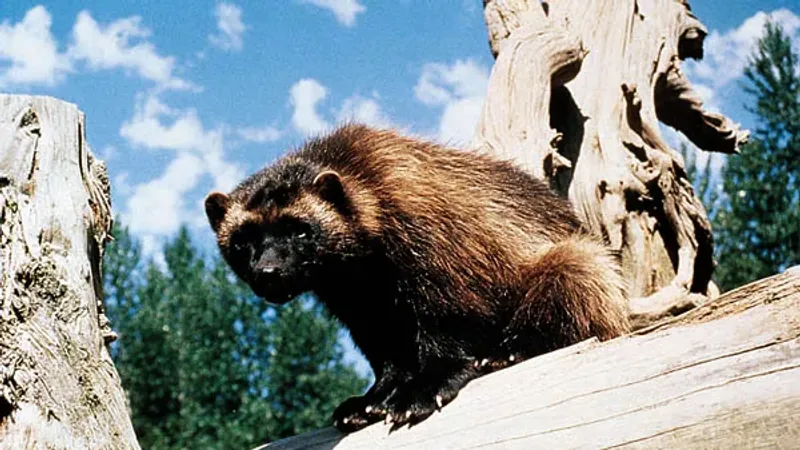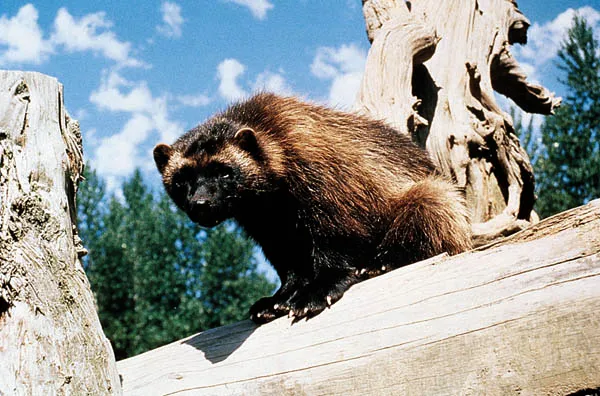
Wolverine, Snoqualmie Pass-Interstate 90 corridor, east of Seattle.
Field
notes
Small Body, Big Range
An adult male wolverine generally weighs 11 to 18 kilograms (24 to 40 pounds) and a female 6 to 12 kilograms (13 to 26 pounds). It is the largest land-dwelling member of the weasel family, Mustelidae, and resembles a small bear with a bushy tail, generally 33 to 44 inches long including that tail. Wolverines live in the boreal, or far northern, zone of the northern hemisphere, from Alaska and northern Canada to Scandinavia and Russia. That is a small body for the ground it needs: home ranges can vary from 100 to 600 square miles. It covers that ground fast, too. Alaska’s state wildlife agency has documented movements of 40 miles in a day. Few wild wolverines appear to live longer than 5 to 7 years, though some survive to 12 or 13, and the oldest captive wolverine on record reached 19.5 years.
Ferocious Reputation, Rare Reality
Wolverines have a fierce reputation, but Alaska’s wildlife agency says it has often been exaggerated: contrary to stories, a wolverine will not attack a larger predator like a wolf or a bear, and avoids both, as an encounter with either may be fatal to the wolverine. Wolverines are opportunistic, eating about anything they can find or kill, from voles and squirrels to snowshoe hares and birds. In winter they mainly rely on carrion: remains of moose and caribou killed by wolves and hunters, or animals that died of natural causes. Killing a moose or caribou is rare. On hard ground, hoofed animals can outrun a wolverine. In snow, the wolverine is less likely to sink in, and large claws and padded feet let it chase down prey in deep snow. It can bring down prey five times bigger than itself, but generally only when deep snow leaves that prey stranded.
A Bite Built to Crush Bone
A 2018 study 3D-printed models of the spongy bone inside the jaw joint of 40 carnivore species, one animal per species, and squeezed each model in a testing machine. The wolverine’s bone was the stiffest and had the greatest relative compressive strength, a measure of how much squeezing it takes to break it. The study calls the wolverine durophagous, meaning it has teeth for crushing hard food, and notes it is known to crush the bones of much larger species.
Bones and frozen flesh Alaska’s wildlife agency says a wolverine’s powerful jaw and large neck muscles let it crush and use bones and frozen flesh.
The Skunk Bear’s Scent
“Skunk bear” is one of the wolverine’s many nicknames, and like most mustelids it has scent glands with a strong odor, used for marking territory and sexual signaling. Chemists who analyzed anal gland secretions from six wolverines found the mix complex and variable, from 45 to 71 compounds per animal, with only six compounds common to every sample, including two forms of methylbutanoic acid. Wolverines also spray their food caches with scent gland secretions to discourage other animals from raiding them.
Published Updated
Traits
Intel
& FAQ
Guess
first
How big is a Wolverine, really? Slide, lock in, and see what the sources say. Every answer is a figure from this page, quoted from where it came from.
Sources
- 01Wolverine. Alaska Department of Fish and Game.
- 02Gulo gulo (wolverine). Animal Diversity Web, University of Michigan.
- 03Wolverine. National Wildlife Federation, Wildlife Guide.
- 04North American wolverine (Gulo gulo luscus). U.S. Fish & Wildlife Service, FWS Focus.
- 05AnAge entry for Gulo gulo. AnAge: The Animal Ageing and Longevity Database, Build 15.
- 06Wysocki & Tseng (2018). Allometry predicts trabecular bone structural properties in the carnivoran jaw joint. PLOS ONE.
- 07Wood, Terwilliger & Copeland (2005). Volatile Compounds from Anal Glands of the Wolverine, Gulo gulo. Journal of Chemical Ecology.
- 08Andrén (2025). Gulo gulo. The IUCN Red List of Threatened Species 2025: e.T9561A216872666.
What the sources say: 47 claims checked word for word against these sources →