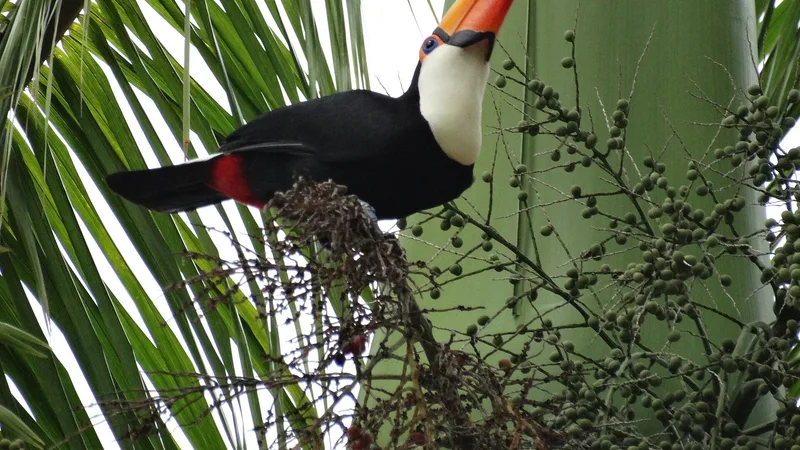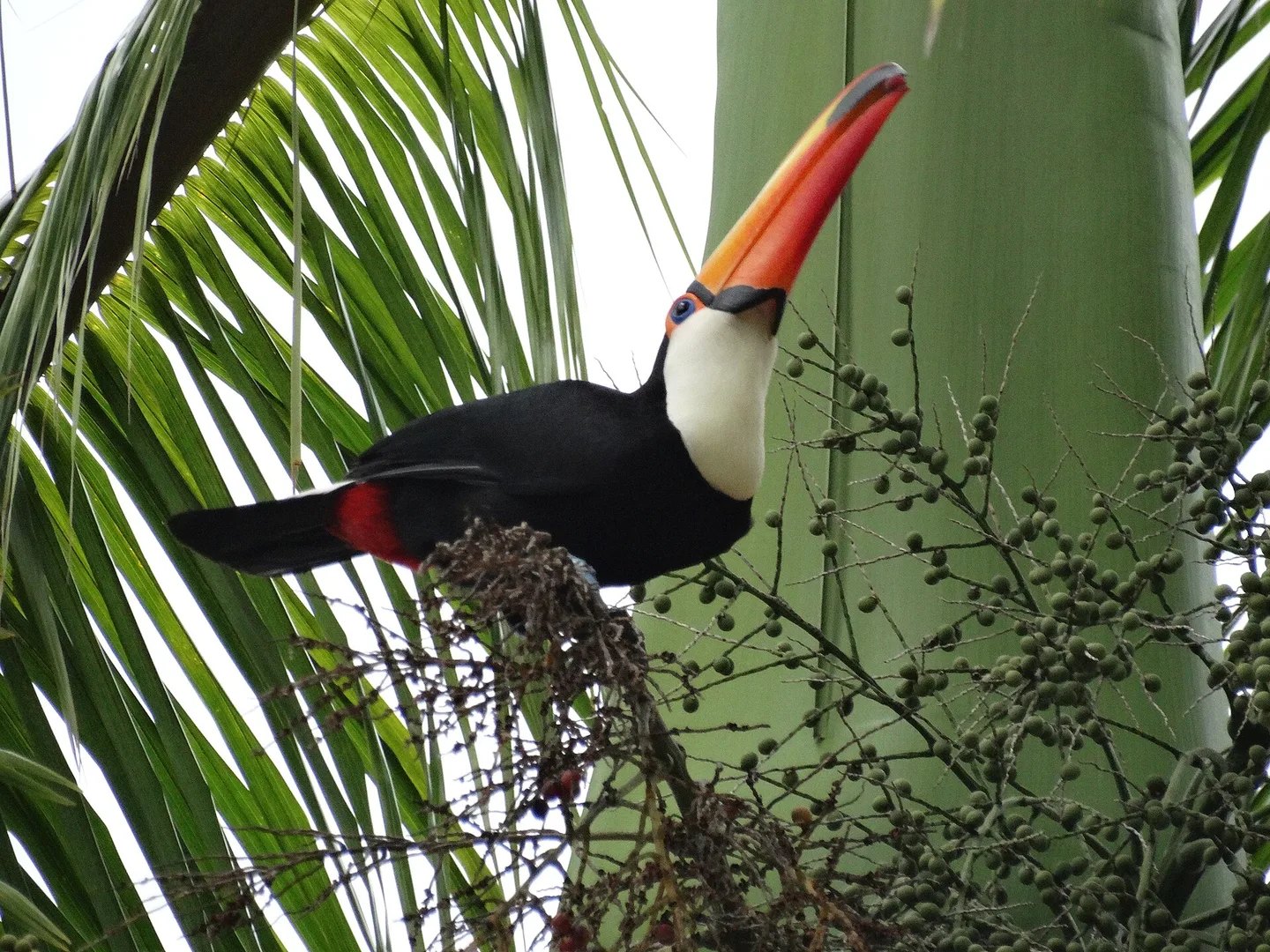
Toco toucan in Parque Estadual Encontro das Águas, Brazil
Field
notes
A Bill That Sheds Heat
The toco toucan carries the largest beak relative to body size of any bird, and it also works as a radiator. Adult toco toucans can widen the blood vessels in their beaks depending on the temperature, letting heat escape from the bill. At air temperatures above 28°C (82°F), the bill carries away an average of 60 percent of the bird’s non-evaporative heat loss.
A vascular radiator Relative to its size, the toucan’s bill is one of the largest thermal windows in the animal kingdom, rivaling an elephant’s ears in its ability to radiate body heat.
The Biggest Bill for Its Size
The toco is the largest and heaviest toucan, up to 61 centimeters (24 inches) long and 860 grams (1.9 pounds). The oldest toco toucan in the AnAge longevity database lived 16.2 years, in captivity. Its bill can make up 30 to 50 percent of its total body surface area, yet it accounts for just one-twentieth of its mass. Under the surface is a sandwich: a shell of overlapping keratin tiles, each about 50 microns across, around a core of bony foam. The bill is the toucan’s main foraging tool, letting it reach into tree holes and grasp fruit from surrounding branches.
Fruit Thrown to the Throat
Many birds move food to the throat with the tongue. A toco toucan does not. It places a piece of fruit at the very tip of its bill and leans its head back, projecting the food straight into its pharynx. Its tongue never touches the fruit. Tongue movement instead goes with a widening of the throat that lets the food reach the esophagus.
Life in Semi-Open Country
Toco toucans range from Guyana south to Argentina and from central Brazil west to southeastern Peru. The toco is the only non-forest toucan, found mostly in dry, semi-open country with scattered trees, such as woodland and savanna, and along forest edges. In Brazil it is abundant in the cerrado. It relies on seasonal fruit, so it moves from one habitat and region to the next to feed. It eats a great many figs and other fruit, and occasionally insects and other birds’ eggs, including those of hyacinth macaws. When foraging, toco toucans travel in small groups through the canopy, gliding in single file from site to site. Jaguars, snakes, coatis, and eagles are among their predators. The IUCN Red List classifies the species as Least Concern.
Published Updated
Traits
Intel
& FAQ
Guess
first
How big is a Toco Toucan, really? Slide, lock in, and see what the sources say. Every answer is a figure from this page, quoted from where it came from.
Sources
- 01AnAge entry for Ramphastos toco. AnAge: The Animal Ageing and Longevity Database, Human Ageing Genomic Resources.
- 02Ramphastos toco. The IUCN Red List of Threatened Species 2025: e.T22682164A281011279.
- 03Ramphastos toco (Toco toucan). Animal Diversity Web, University of Michigan.
- 04Toucan. San Diego Zoo Wildlife Alliance.
- 05Tattersall, Andrade & Abe (2009). Heat Exchange from the Toucan Bill Reveals a Controllable Vascular Thermal Radiator. Science.
- 06van de Ven et al. (2016). Regulation of Heat Exchange across the Hornbill Beak: Functional Similarities with Toucans? PLOS ONE.
- 07Seki, Bodde & Meyers (2010). Toucan and hornbill beaks: A comparative study. Acta Biomaterialia.
- 08Baussart et al. (2009). Ballistic food transport in toucans. Journal of Experimental Zoology Part A: Ecological Genetics and Physiology.
- 09Sedgwick (2020). Toco Toucan (Ramphastos toco). Birds of the World.
What the sources say: 58 claims checked word for word against these sources →