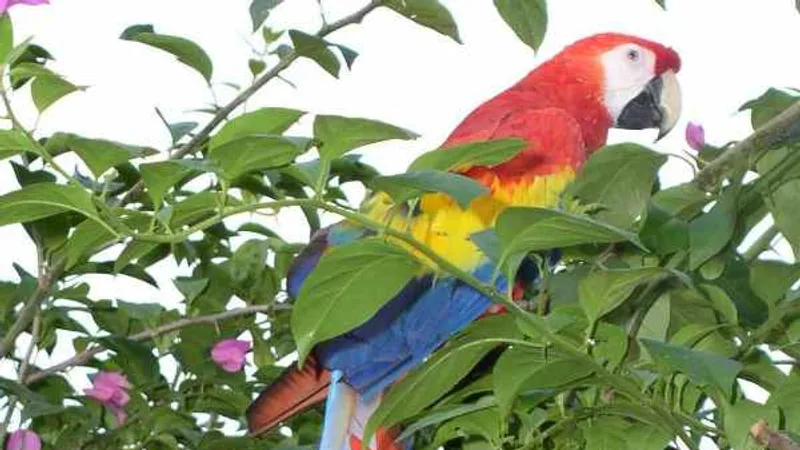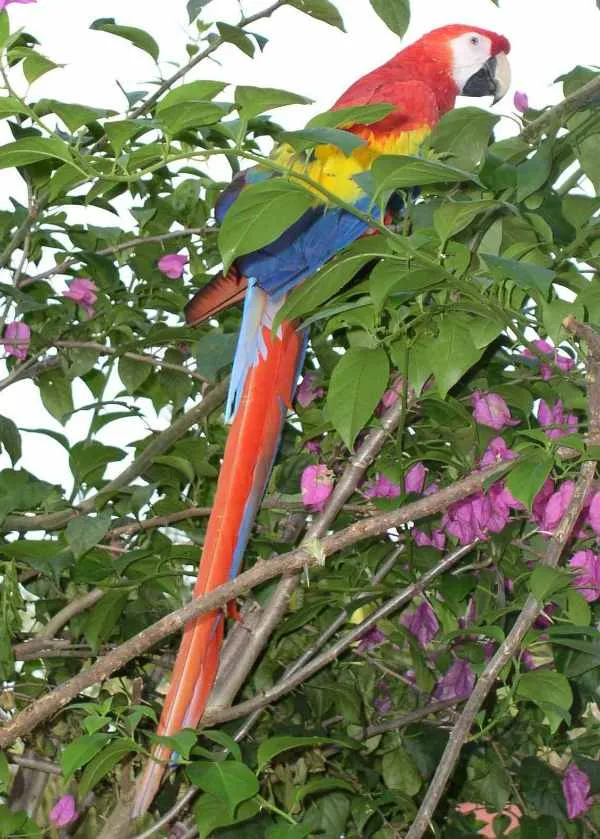
Wild scarlet macaws on the Osa Peninsula, Costa Rica.
Field
notes
A Macaw Built Big, Ranging Far
The Scarlet Macaw (Ara macao) measures 84 to 89 centimeters long and weighs between 900 and 1,490 grams, making it one of the larger macaws. No macaw covers more ground: its range runs from Mexico through Central America and across the Amazon basin to central Bolivia and Brazil, an area of roughly 7 to 10 million square kilometers. About 83 percent of that territory lies within the Amazon Biome of South America.
In captivity, one female was still alive after 33 years, and she had bred with the same male for 22 years. In the wild, adults may escape most predators thanks to their size and flight, but jaguars, eagles and hawks may take adults and fledglings, and tree-climbing snakes, monkeys and small carnivores may take young in the nest.
A Beak for the Toughest Nuts
Fruit and seeds make up most of a scarlet macaw’s diet, topped up with flowers, leaves, bark, lichen and bromeliads. They’ve been reported eating up to 52 plant species in the Peruvian Amazon and up to 43 in Costa Rica. In southwest Belize, a breeding-season study found adults and nestlings eating mostly seeds from a narrow range of foods, with nestlings fed chiefly on seeds of floodplain trees that may be rich in protein.
Scarlet macaws can break open the toughest nuts. Structures inside the beak let a scarlet macaw press a hard seed between its tongue and palate and grind it up, and parrots’ beaks move more than other birds’ do, which makes for a more powerful bill. Pairs mate for life and are rarely found alone once paired, nesting in natural or abandoned tree cavities that they do not dig themselves.
Eating the Riverbank
In parts of their range scarlet macaws regularly visit walls of clay on riverbanks to eat soil or minerals.
One suggested benefit is counteracting toxins in their food, but the U.S. Fish and Wildlife Service’s 2019 listing rule found it unclear whether the habit brings a nutritional or any other benefit.
Status Symbol, Fractured Range
Pueblo people at Chaco Canyon in New Mexico were acquiring scarlet macaws from Mesoamerica through long-distance networks as early as AD 900 to 975, radiocarbon dates on macaw skeletons show. That runs against models crediting Chaco’s 11th-century peak of influence for bringing macaws to the canyon: most of the dated skeletons predate that period.
The species as a whole is rated Least Concern, but its northern subspecies, Ara macao cyanoptera, was listed as endangered under the U.S. Endangered Species Act in 2019. The listing rule names habitat loss, poaching for the pet trade, lack of enforcement of existing regulations and small population size as the main causes of the scarlet macaw’s decline. A 2009 estimate put the northern subspecies at fewer than 1,000 birds, and by 2019 scarlet macaws had been wiped out from almost all of their former range in Mexico and all of it in El Salvador. The same rule very roughly estimated South America’s scarlet macaws at 15,000 to 45,000 birds.
Published Updated
Traits
Intel
& FAQ
Guess
first
How big is a Scarlet Macaw, really? Slide, lock in, and see what the sources say. Every answer is a figure from this page, quoted from where it came from.
Sources
- 01Endangered and Threatened Wildlife and Plants; Listing the Scarlet Macaw. Federal Register, U.S. Fish and Wildlife Service, 2019.
- 02Ara macao (scarlet macaw). Animal Diversity Web, University of Michigan.
- 03AnAge entry for Ara macao. AnAge: The Animal Ageing and Longevity Database, Human Ageing Genomic Resources.
- 04Ara macao. The IUCN Red List of Threatened Species 2022: e.T22685563A163778999.
- 05Watson et al. (2015). Early procurement of scarlet macaws and the emergence of social complexity in Chaco Canyon, NM. Proceedings of the National Academy of Sciences.
- 06Renton (2006). Diet of Adult and Nestling Scarlet Macaws in Southwest Belize, Central America1. Biotropica.
What the sources say: 47 claims checked word for word against these sources →