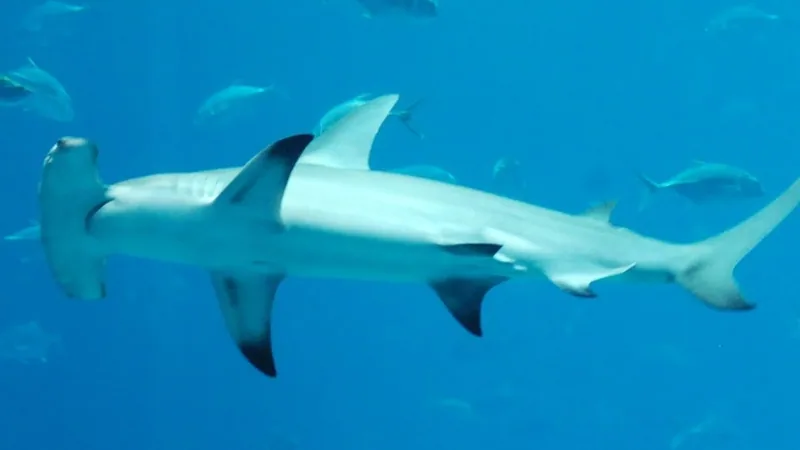
A tiger shark in the Bahamas.
Field
notes
An Appetite for Almost Anything
The tiger shark has a reputation for eating almost anything. One large female caught in the Red Sea held two empty cans, a plastic bottle, two burlap sacks, a squid, and a 20 cm fish. Garbage dumped into harbors and river inlets often turns up in the stomachs of sharks caught there. Its usual prey, which varies by region, includes sea turtles, rays, other sharks, bony fish, sea birds, dolphins, squid, crustaceans and carrion.
Tiger sharks commonly reach 3.25 to 4.25 m long and weigh 385 to 635 kg. The largest reach over 5.5 m and are estimated to weigh over 900 kg. In a Hawaii tagging program, sharks over 450 cm long were very rare: just 2 of 420 captured. Vertebrae from tiger sharks caught off Western Australia were aged up to 31 years old in females and 21 in males.
Saw-Edged Teeth
Each tooth has curved cusps, finely serrated edges and a deep notch on the outer margin, and teeth in the upper and lower jaws are similarly shaped. Combined with a saw-like shake of the head, those teeth tear chunks from much larger animals, and they can pierce the shells of sea turtles. Lab tests on tiger shark and shortfin mako teeth found the mineral in them is fluoroapatite, and the hard outer layer is about six times harder than the dentin beneath it. The same study found that each tooth’s job, tearing for the mako and cutting for the tiger shark, is set by its shape rather than its chemistry.
Hunting by Stealth
A tiger shark most likely relies on stealth rather than strength and speed to catch prey, and its camouflage lets it get within striking range. If prey flees, it may back off instead of chasing at high speed, but it can manage a short burst of speed once prey is within range. Sensing organs called ampullae of Lorenzini, on the end of its snout, detect electromagnetic signals given off by fish. It feeds mainly at night, moving further inshore and closer to the surface.
A Nose for Open Water A study of 58 species of sharks, rays and their relatives measured the olfactory bulbs, the part of the brain that receives signals from the smell nerve. Relative to the rest of the brain, the largest bulbs belonged to open-water sharks, especially migratory species such as the great white and the tiger shark.
Tiger sharks are solitary except during mating season or while feeding together on a large carcass. At those feeds, larger sharks eat first in a loose pecking order, and violence is minimal.
A Wide Range Under Pressure
Tiger sharks live in tropical and temperate waters around the world, except the Mediterranean Sea. They are commonly found in river estuaries, harbors and other inlets, and around the lagoons and coral atolls of oceanic islands. Often seen at the surface, they have been reported at depths of 350 m. They move into temperate waters in warmer months and return to the tropics for winter.
Queensland, Australia, has run shark-control nets and baited drumlines since 1962, and the program grew to span 1,760 km of coast. Tiger shark catch rates there were relatively stable until the early 1990s, then fell 74% over the next 25 years. The IUCN lists the tiger shark as Near Threatened.
Published Updated
Traits
Intel
& FAQ
Guess
first
How big is a Tiger Shark, really? Slide, lock in, and see what the sources say. Every answer is a figure from this page, quoted from where it came from.
Sources
- 01Galeocerdo cuvier (tiger shark). Animal Diversity Web, University of Michigan.
- 02Galeocerdo cuvier. Florida Museum of Natural History, Discover Fishes.
- 03Emmons et al. (2021). Age and growth of tiger shark (Galeocerdo cuvier) from Western Australia. Marine and Freshwater Research.
- 04Ferreira & Simpfendorfer (2019). Galeocerdo cuvier. The IUCN Red List of Threatened Species 2019: e.T39378A2913541.
- 05Enax et al. (2012). Structure, composition, and mechanical properties of shark teeth. Journal of Structural Biology.
- 06Meyer et al. (2014). Growth and Maximum Size of Tiger Sharks (Galeocerdo cuvier) in Hawaii. PLoS ONE.
- 07Roff et al. (2018). Decline of coastal apex shark populations over the past half century. Communications Biology.
- 08Yopak, Lisney & Collin (2014). Not all sharks are "swimming noses": variation in olfactory bulb size in cartilaginous fishes. Brain Structure and Function.
What the sources say: 54 claims checked word for word against these sources →