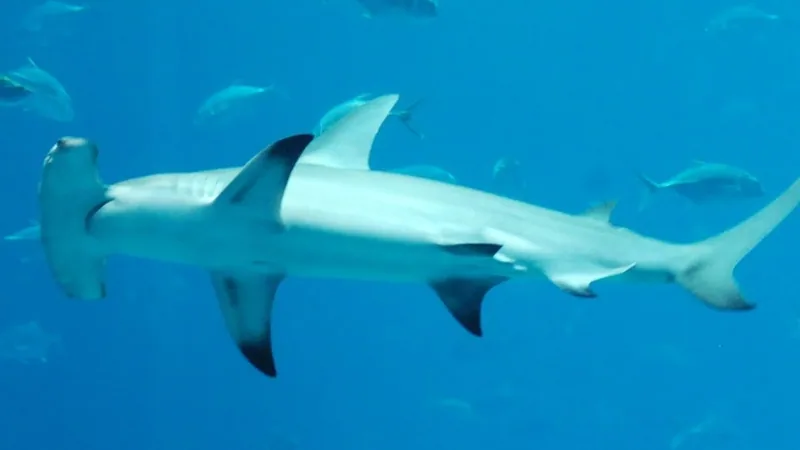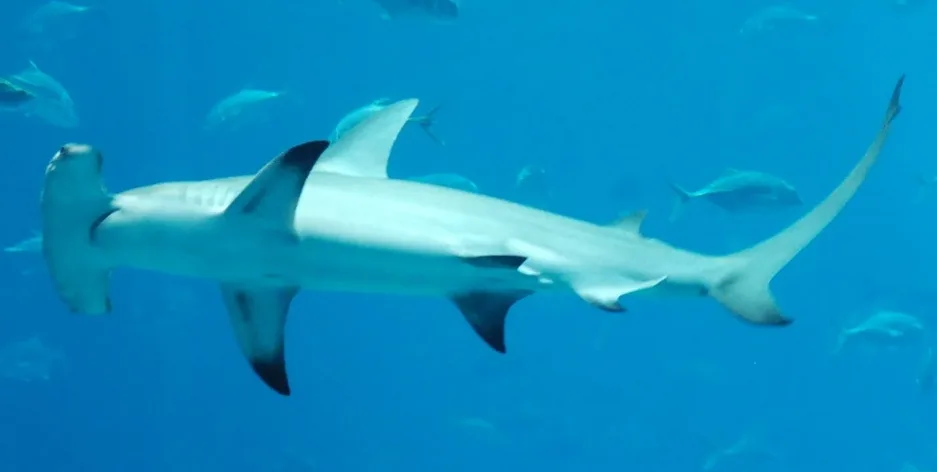
Great hammerhead (Sphyrna mokarran) off Bimini, Bahamas
Field
notes
The Largest of the Hammerheads
The great hammerhead (Sphyrna mokarran) is the largest of the hammerhead sharks. It can reach a maximum length of 18 to 20 feet and averages over 500 pounds (230 kg). One caught off Sarasota, Florida, weighed 991 pounds (450 kg). Great hammerheads are expected to live 20 to 30 years. A 2010 study aged 216 sharks from the Gulf of Mexico and the northwest Atlantic by counting yearly growth bands in their backbones, and the oldest was 44.
It lives in warm coastal seas around the world, from the Gulf of Mexico and the Caribbean to the Mediterranean, the Indo-Pacific and the Pacific coasts of Mexico and Peru. It is often found in shallow water down to 80 meters, over continental shelves (the shallow seabed that borders the land) and in lagoons, but it also ranges far offshore as deep as 300 meters. Some populations move toward cooler water each summer.
Sensing Buried Prey
Its hammer-shaped head is called a cephalofoil. Like all sharks and rays, it has small gel-filled pores called ampullae of Lorenzini along the underside of its head. They work as highly sensitive electrical sensors, picking up the signals given off by prey, even a stingray buried under sand. Great hammerheads are known to prefer stingrays and other rays when they can find them. In 1990, scientists first described in detail how one used its head to pin a southern stingray to the seafloor, a move called “pin and pivot.” Great hammerheads also eat bony fish, squid and other sharks. Drone footage from southeast Florida shows adult blacktip sharks fleeing into shallow water when a great hammerhead comes after them. The Florida Museum counts 17 unprovoked attacks on people by hammerheads of all species, none fatal, and says few can be pinned on this one because hammerheads are hard to tell apart.
Swimming on Its Side
It Swims on Its Side to Save Energy A wild great hammerhead tagged on the Great Barrier Reef spent about 90% of an 18-hour tracking period tilted 50 to 75 degrees onto one side. Almost all sharks get lift, the upward push that stops them sinking, from the pectoral fins on their sides. A great hammerhead’s dorsal fin, on its back, is longer than those side fins, the opposite of every other shark measured. Tilting lets the dorsal fin share the work of making lift. In wind tunnel tests on a model shark, tilting cut drag, the force that slows a swimmer down, by more than 10%. The researchers estimate it uses about 8% less energy to cover the same distance.
Critically Endangered
The great hammerhead is listed as Critically Endangered on the IUCN Red List, mainly because it is fished heavily for its large fins. Its global population is estimated to have fallen by more than 80% over the last three generations. A 2023 study read the genome, the full set of DNA, of one great hammerhead from the North Atlantic. It had low genetic variety, at the bottom of a broad list of fish species, and signs of inbreeding (when parents are close relatives) as high as in some critically endangered animals. The authors say more sharks must be sampled before drawing firm conclusions about the whole species.
Published Updated
Traits
Intel
& FAQ
Guess
first
How big is a Great Hammerhead Shark, really? Slide, lock in, and see what the sources say. Every answer is a figure from this page, quoted from where it came from.
Sources
- 01Sphyrna mokarran. Florida Museum of Natural History, Discover Fishes.
- 02Sphyrna mokarran (great hammerhead). Animal Diversity Web, University of Michigan.
- 03Piercy, Carlson & Passerotti (2010). Age and growth of the great hammerhead shark, Sphyrna mokarran, in the north-western Atlantic Ocean and Gulf of Mexico. Marine and Freshwater Research.
- 04Rigby et al. (2019). Sphyrna mokarran. The IUCN Red List of Threatened Species 2019: e.T39386A2920499.
- 05Payne et al. (2016). Great hammerhead sharks swim on their side to reduce transport costs. Nature Communications.
- 06Roemer, Gallagher & Hammerschlag (2016). Shallow water tidal flat use and associated specialized foraging behavior of the great hammerhead shark (Sphyrna mokarran). Marine and Freshwater Behaviour and Physiology.
- 07Stanhope et al. (2023). Genomes of endangered great hammerhead and shortfin mako sharks reveal historic population declines and high levels of inbreeding in great hammerhead. iScience.
- 08Doan & Kajiura (2020). Adult blacktip sharks (Carcharhinus limbatus) use shallow water as a refuge from great hammerheads (Sphyrna mokarran). Journal of Fish Biology.
What the sources say: 64 claims checked word for word against these sources →