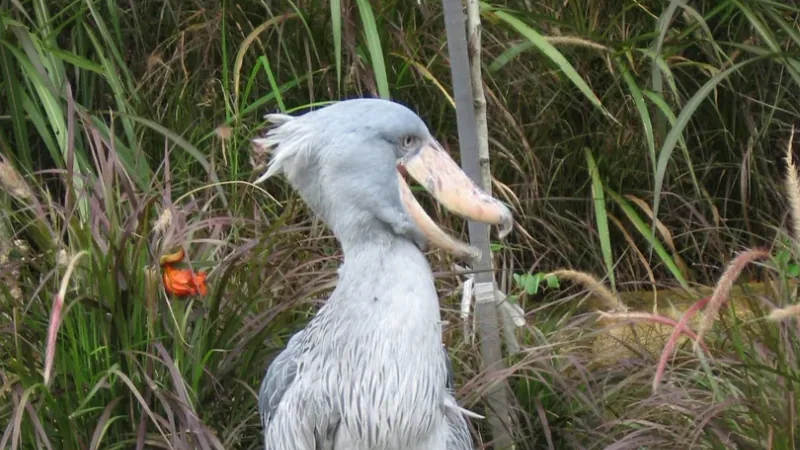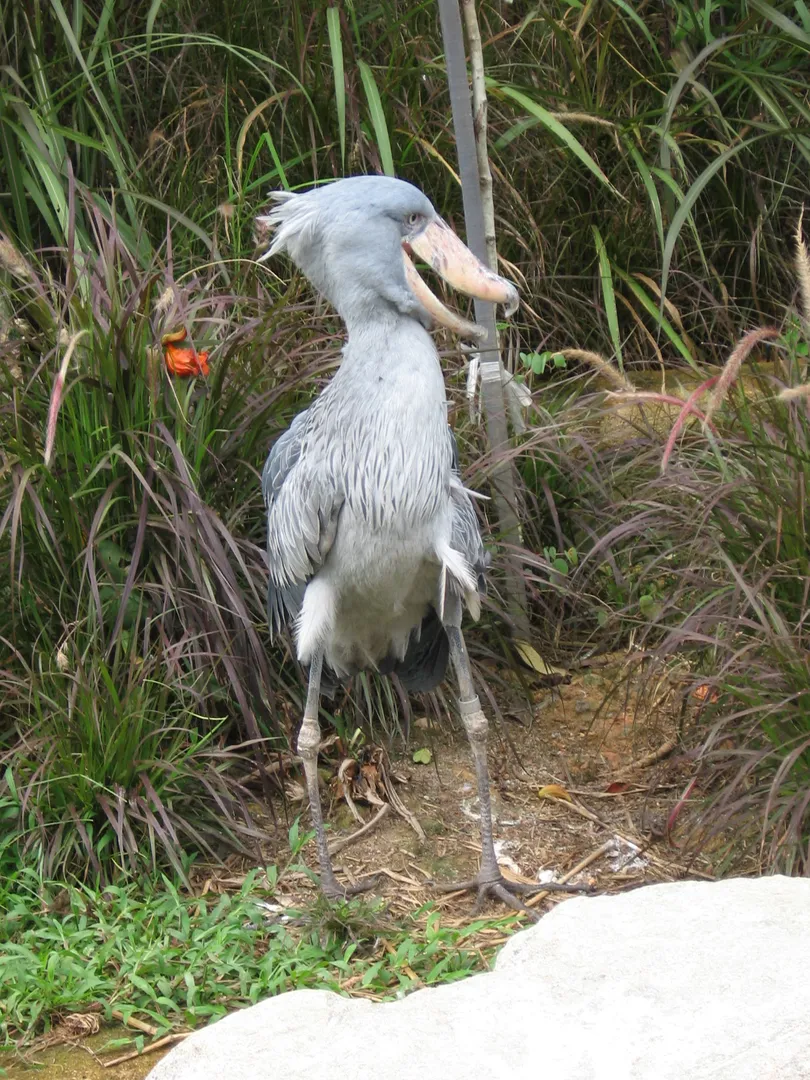
A shoebill in Uganda.
Field
notes
The Gargoyle of the Swamp
The shoebill hunts by doing almost nothing. It lives in the freshwater marshes and swamps of East Africa, from Ethiopia and South Sudan to Zambia, and can stay motionless there for hours, waiting for a lungfish to break the surface for air. Fish surface more often in the poorly oxygenated water where shoebills are also found. When it spots prey, its head and neck quickly stretch forward into the water, and the bird overbalances and collapses forward and down onto the fish. The move is called “collapsing.” The bird comes up with a mouthful of vegetation along with the catch. It swings its head from side to side to work the vegetation loose, then usually decapitates its catch before swallowing.
Barely Moving, Far Ranging Seven shoebills tracked by GPS over five years in Zambia’s Bangweulu Wetlands moved less than three kilometers on 81 percent of days. Yet their yearly home ranges averaged around 1,500 square kilometers.
A Bill Built Like a Boot
The bill is the shoebill’s most striking feature. It is about a foot long and five inches wide, yellowish with dark blotches, with a sharp hook on the end and sharp edges on both mandibles. The shoebill measures 100 to 140 centimeters, weighs between 4 and 7 kilograms and has an eight-foot wingspan. It is often seen soaring on thermals above its territory during the day. Its main prey is lungfish, bichirs, catfish, tilapia and water snakes. On occasion it also takes frogs, turtles, monitor lizards and young crocodiles.
Not Actually a Stork
Despite the name, the shoebill is not a stork. DNA studies found it more closely related to pelicans. It was taken out of the stork family and now sits alone in its own family, Balaenicipitidae, inside the order Pelecaniformes.
One Chick, If It’s Lucky
Shoebills form monogamous pairs to breed, but even partners keep their distance, often foraging on opposite sides of their territory. A clutch is normally two eggs, though one is frequent and three occasional. The nest is large and flat, usually built on a mound of floating vegetation or a small island. Both parents incubate the eggs and cool them with water carried in their bills. Usually only one chick survives, because the larger chick, generally the first-born, outcompetes or kills its siblings. In one breeding season studied in Zambia, the single chick first left the nest at 95 days. An estimated 5,000 to 8,000 shoebills are left, and the IUCN lists the species as Vulnerable. Threats include habitat destruction, pollution and capture for the live bird trade.
Published Updated
Traits
Intel
& FAQ
Guess
first
How big is a Shoebill Stork, really? Slide, lock in, and see what the sources say. Every answer is a figure from this page, quoted from where it came from.
Sources
- 01Balaeniceps rex (shoebill). Animal Diversity Web, University of Michigan.
- 02Shoebill. EDGE of Existence, Zoological Society of London.
- 03Shoebill. National Geographic.
- 04Stork. San Diego Zoo Wildlife Alliance.
- 05Buxton, Slater & Brown (1978). The breeding behaviour of the shoebill or whale-headed stork Balaeniceps rex in the Bangweulu Swamps, Zambia. African Journal of Ecology.
- 06Hedges & Sibley (1994). Molecules vs. morphology in avian evolution: the case of the "pelecaniform" birds. Proceedings of the National Academy of Sciences.
- 07Acácio et al. (2021). Changes in surface water drive the movements of Shoebills. Scientific Reports.
- 08Balaeniceps rex. The IUCN Red List of Threatened Species 2018: e.T22697583A133840708.
What the sources say: 54 claims checked word for word against these sources →