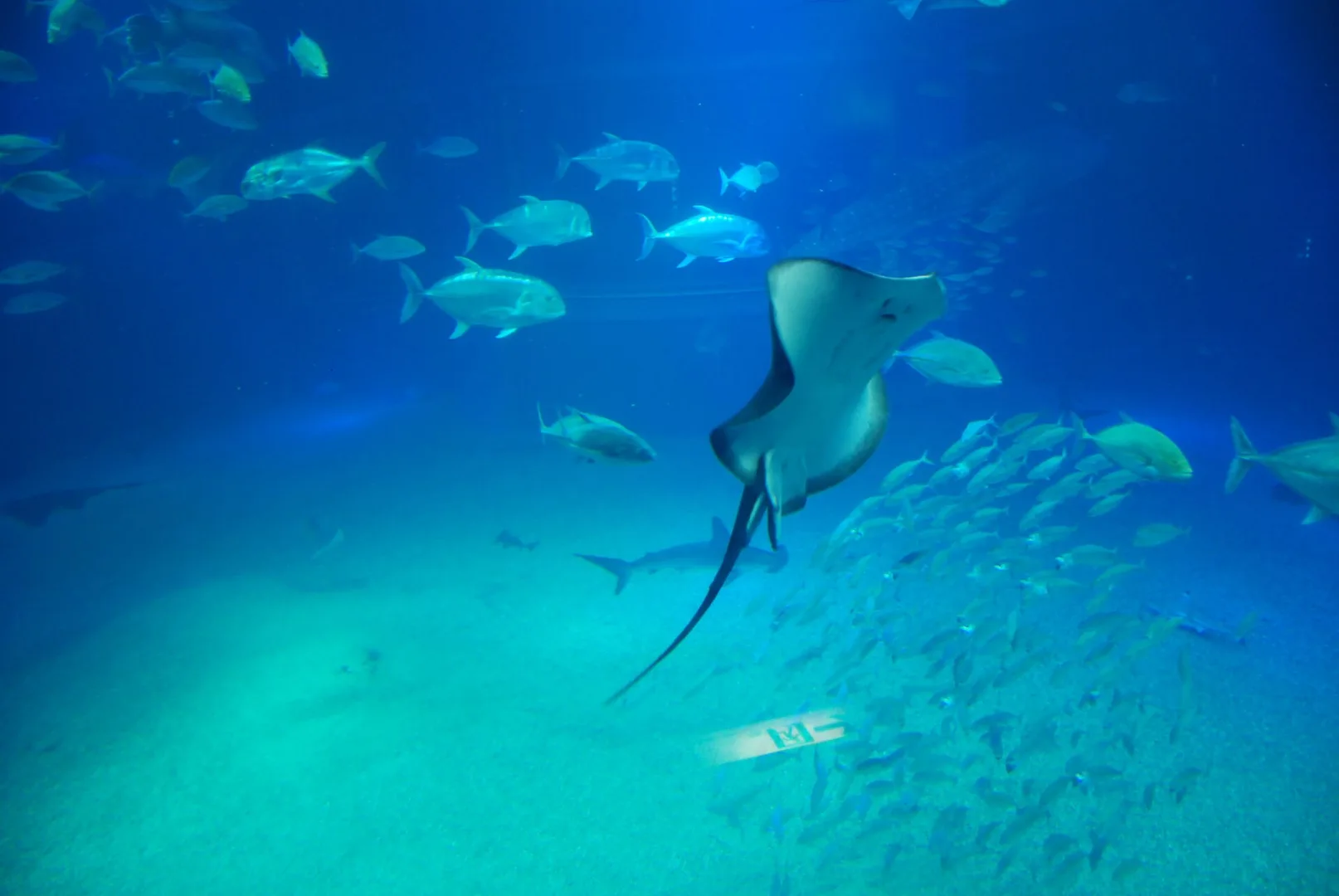
Scalloped hammerhead shark (Sphyrna lewini) off Costa Rica
Field
notes
A Head Built for Turning
A hammerhead’s wide head is called a cephalofoil, and one idea was that it evolved to sharpen the shark’s electric sense. A 2002 study tested that by comparing juvenile scalloped hammerheads with sandbar sharks, which have no hammer, using a weak electric field like the one prey gives off. Both species picked it up from the same maximum distance, about 30 centimeters: the wide head does not appear to make the shark’s electric sense sharper. What it does seem to give is a wider search area, which may help the shark find prey, and better maneuverability. The hammerheads typically turned by holding the edge of the head nearest the target still and bending the body toward it, a sharp turn made at high speed. The wider-bodied sandbar sharks swam in a broader arc.
Warm Seas Worldwide
A scalloped hammerhead can weigh up to 335 pounds, grow up to 11 feet long and live up to 30 years, according to NOAA Fisheries. It lives in warm temperate and tropical coastal seas worldwide: the western Atlantic from New Jersey to Brazil, the eastern Atlantic from the Mediterranean to Namibia, the Indian Ocean from South Africa and the Red Sea to Myanmar, and the Pacific from Japan to New Caledonia and from southern California to Ecuador. One shark tracked for 74 days was recorded diving into the Gulf of California’s oxygen minimum layer, a deep band of water with extremely little oxygen, which expanded the range of depths the species was known to use.
Fifty Stingray Spines and Counting
Sardines, many kinds of reef fish, squid, octopus and crustaceans are on the menu, along with smaller sharks and rays. Hunting at night, a scalloped hammerhead uses a “smash and grab” technique: it accelerates toward prey and either swallows it whole or disables it with a bite. Stingrays seem to be a favorite, at a price: hammerhead sharks are often found with up to 50 or more stingray spines in their mouths and guts.
Built From the Same Blueprint, Almost In 2013, scientists named a new hammerhead species, Sphyrna gilberti, from young sharks caught off South Carolina that had passed as scalloped hammerheads. In body shape and anatomy, the only difference the paper found was the number of vertebrae in front of the tail. Nobody knew yet how far the new species ranged.
Crowded Schools, Crowded Nets
By day, scalloped hammerheads move to drop-off zones and reefs, where most females gather in all-female schools with the larger, more mature females in the center. Adult males join schools almost exclusively to find a mate. At dusk the sharks head back offshore to hunt. Studies have found them clustering around seafloor features such as seamounts, and a 2018 study listed possible reasons: better hunting, magnetic patterns in the seafloor, or simply that tagged sharks were tracked for only a short time.
Gathering in large groups also makes them easier to catch in large numbers on longlines, bottom nets and trawls, which has wiped out populations in some areas. Their fins are highly valued too: estimates published in the 2000s put 1.3 to 2.7 million scalloped and smooth hammerheads through the Hong Kong fin trade each year. NOAA Fisheries says the species is threatened by commercial fishing, mainly for the fin trade, and the IUCN’s 2019 assessment rates it Critically Endangered.
Published Updated
Traits
Intel
& FAQ
Guess
first
How big is a Scalloped Hammerhead, really? Slide, lock in, and see what the sources say. Every answer is a figure from this page, quoted from where it came from.
Sources
- 01Scalloped Hammerhead Shark. NOAA Fisheries.
- 02Sphyrna lewini. Florida Museum of Natural History, Discover Fishes.
- 03Sphyrna lewini (scalloped hammerhead shark). Animal Diversity Web, University of Michigan.
- 04Kajiura & Holland (2002). Electroreception in juvenile scalloped hammerhead and sandbar sharks. Journal of Experimental Biology.
- 05Wells et al. (2018). Movement, Behavior, and Habitat Use of a Marine Apex Predator, the Scalloped Hammerhead. Frontiers in Marine Science.
- 06Jorgensen, Klimley & Muhlia-Melo (2009). Scalloped hammerhead shark Sphyrna lewini utilizes deep-water, hypoxic zone in the Gulf of California. Journal of Fish Biology.
- 07Quattro et al. (2013). Sphyrna gilberti sp. nov., a new hammerhead shark (Carcharhiniformes, Sphyrnidae) from the western Atlantic Ocean. Zootaxa.
- 08Rigby et al. (2019). Sphyrna lewini. The IUCN Red List of Threatened Species.
What the sources say: 48 claims checked word for word against these sources →