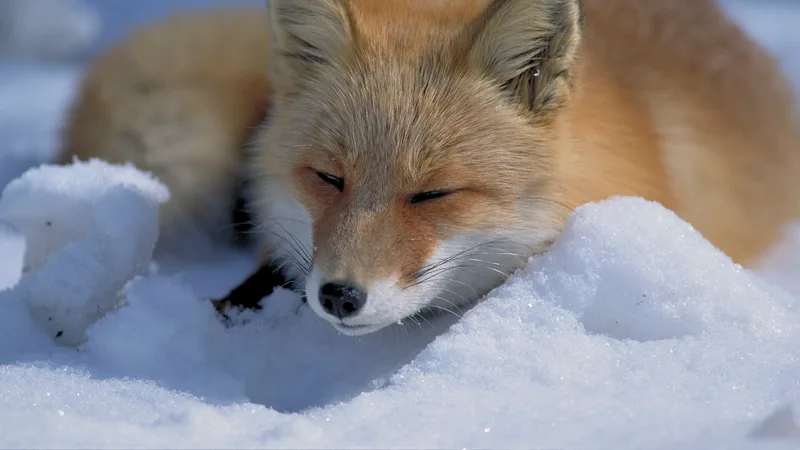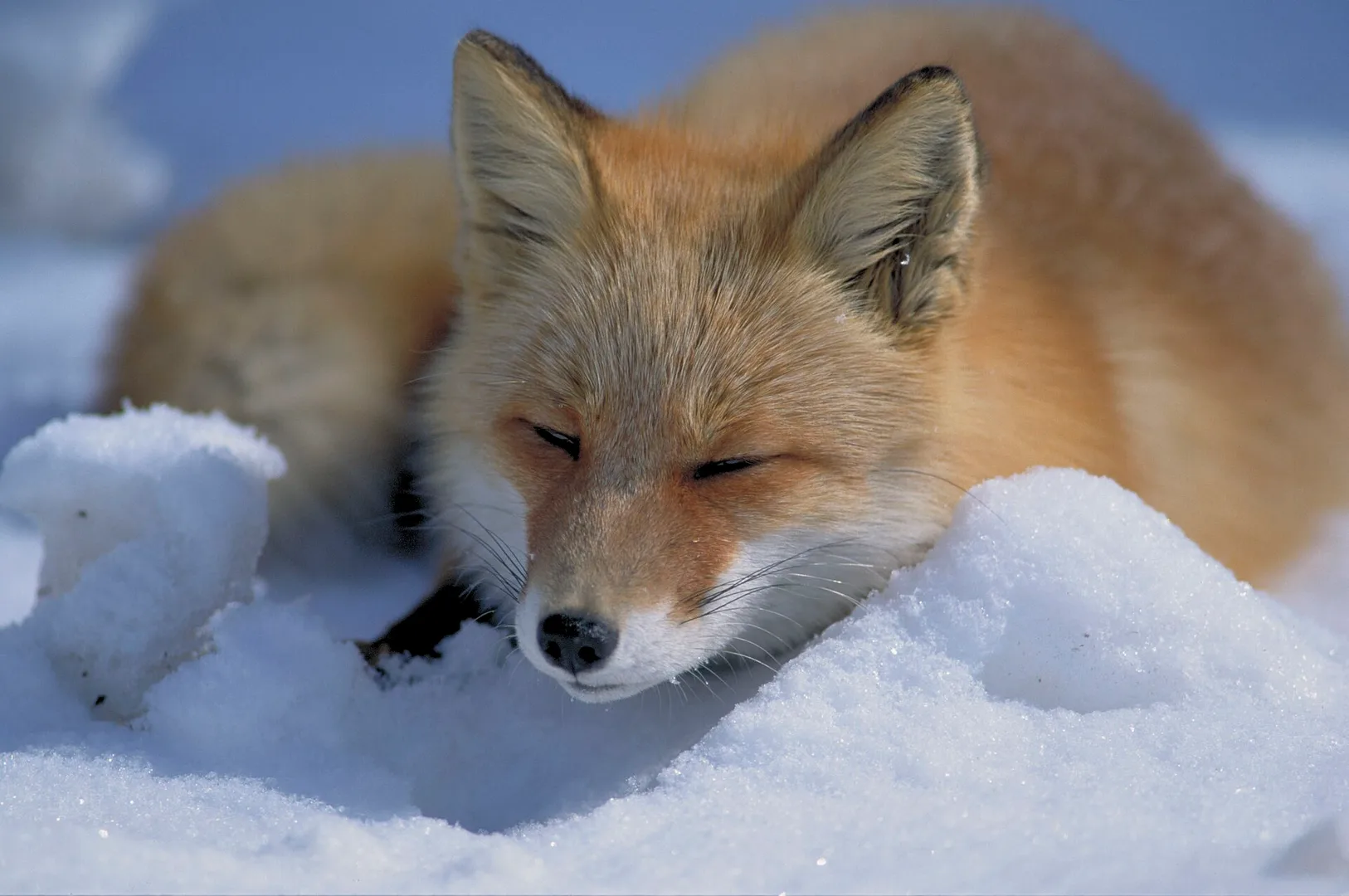
Red fox (Vulpes vulpes schrencki) native to Hokkaido lying in the snow.
Field
notes
The Fox’s Northward Pounce
The red fox (Vulpes vulpes) has a head and body about 46 to 90 centimeters long, a tail up to about 56 centimeters, and a weight of 3 to 14 kilograms, with males slightly larger than females. It is the largest of the true foxes (genus Vulpes) and can run at about 48 kilometers per hour. Alaska’s Department of Fish and Game lists its lifespan as 3 years. In captivity one can live far longer: the AnAge longevity database records a wild-born female still alive at an estimated 21.3 years.
When it hunts mice and other small animals hidden under snow or in tall grass, a fox goes still, listens hard, then leaps high and drives its front paws straight down to pin the prey. Researchers who studied these jumps found that foxes tend to leap in a roughly northeast direction, and when they’re hunting prey they can’t see, under snow or in tall vegetation, successful pounces are tightly clustered to the north, while jumps in other directions mostly miss. The scientists suggest the fox is lining up the strike using Earth’s magnetic field, a case of magnetic alignment that sharpens its aim.
Ears That Hear Digging Red foxes have excellent hearing. They can hear low-frequency sounds and rodents digging underground.
An Omnivore That Eats Whatever Is Available
Foxes mostly eat rodents, rabbits, insects, and fruit, and they’ll also eat carrion. They cache extra food when hunting is good, and have been seen coming back to dig up a cache, check it, and rebury it in the same spot. Being solitary makes it easy for a fox to hide from people, and while other large predators have been pushed away from human development, red foxes have taken advantage of the changed habitat, living in parks and woodland edges. Red foxes are found across much of the Northern Hemisphere, from the Arctic Circle to Central America, the steppes of central Asia, and northern Africa. It is the world’s most widely distributed wild land carnivore. People have also introduced them to Australia and the Falkland Islands.
An Introduced Hunter in Australia
Over the last 200 years or so, more than a tenth of the 273 land mammal species found only in Australia have gone extinct, and scientists point to predation by introduced foxes and feral cats, together with changed fire patterns, as the most likely main cause. As a species, though, the red fox is not threatened: the IUCN rates it Least Concern.
Published Updated
Traits
Intel
& FAQ
Guess
first
How big is a Red Fox, really? Slide, lock in, and see what the sources say. Every answer is a figure from this page, quoted from where it came from.
Sources
- 01Vulpes vulpes (red fox). Animal Diversity Web, University of Michigan.
- 02Red Fox. Alaska Department of Fish and Game.
- 03Red Fox. National Wildlife Federation.
- 04AnAge entry for Vulpes vulpes. AnAge: The Animal Ageing and Longevity Database, Build 15, 2023.
- 05Red Fox. Colorado Parks and Wildlife.
- 06Species Spotlight: Red Fox. U.S. National Park Service, 2025.
- 07Červený et al. (2011). Directional preference may enhance hunting accuracy in foraging foxes. Biology Letters.
- 08Statham et al. (2014). Range‐wide multilocus phylogeography of the red fox reveals ancient continental divergence, minimal genomic exchange and distinct demographic histories. Molecular Ecology.
- 09Woinarski, Burbidge & Harrison (2015). Ongoing unraveling of a continental fauna: Decline and extinction of Australian mammals since European settlement. Proceedings of the National Academy of Sciences.
- 10Soulsbury (2025). Vulpes vulpes. The IUCN Red List of Threatened Species 2025: e.T23062A223595579.
What the sources say: 57 claims checked word for word against these sources →