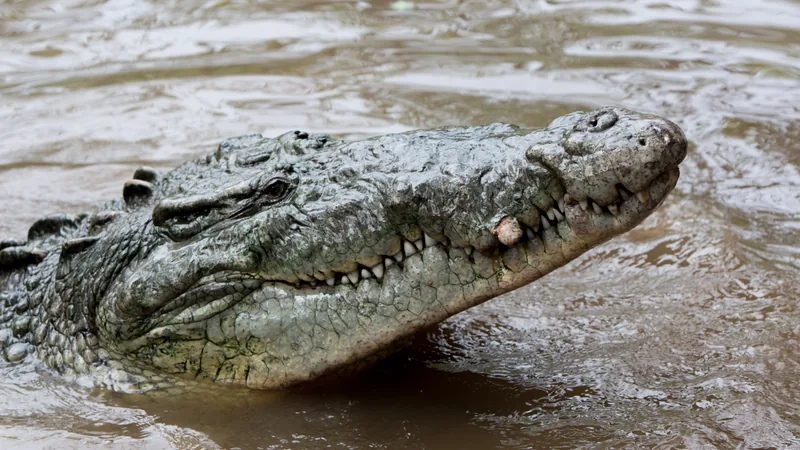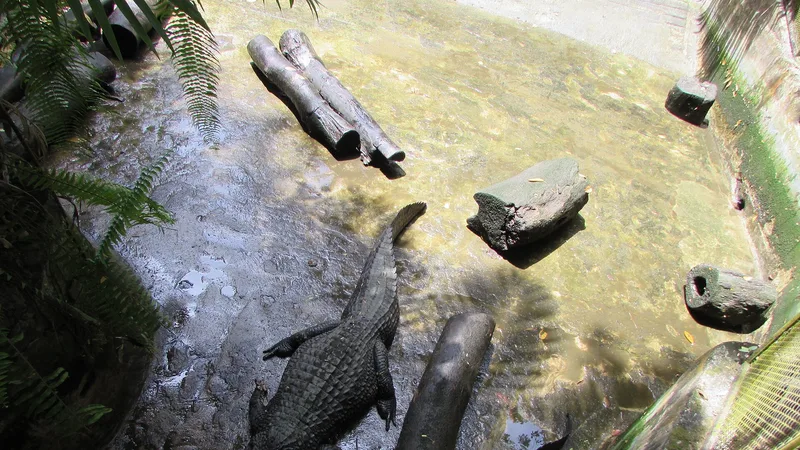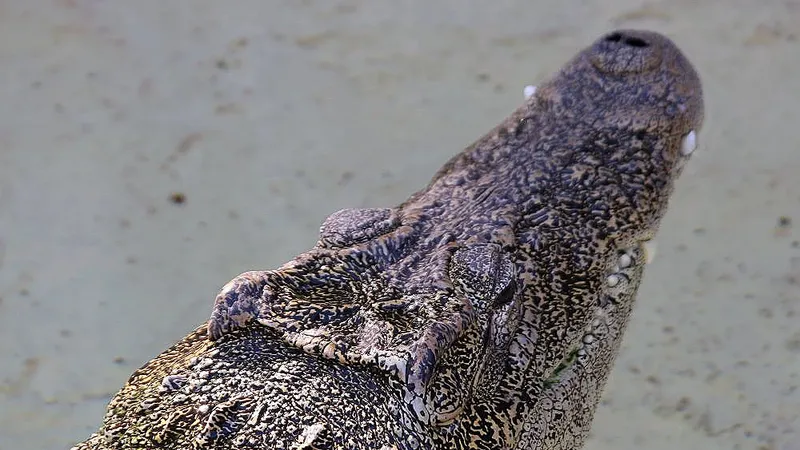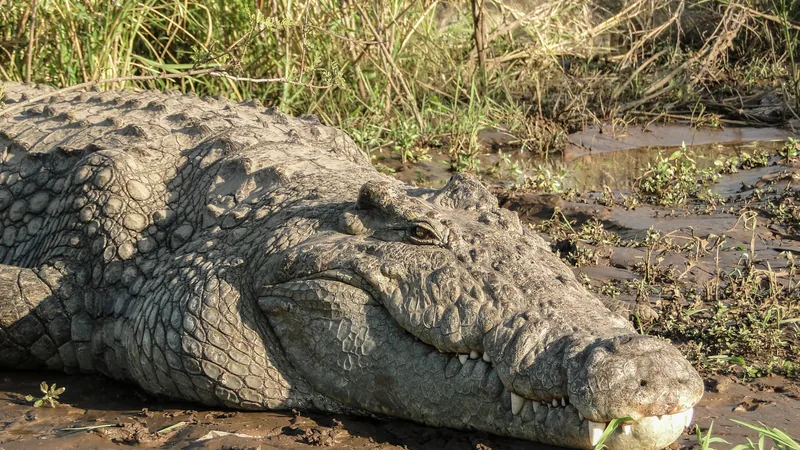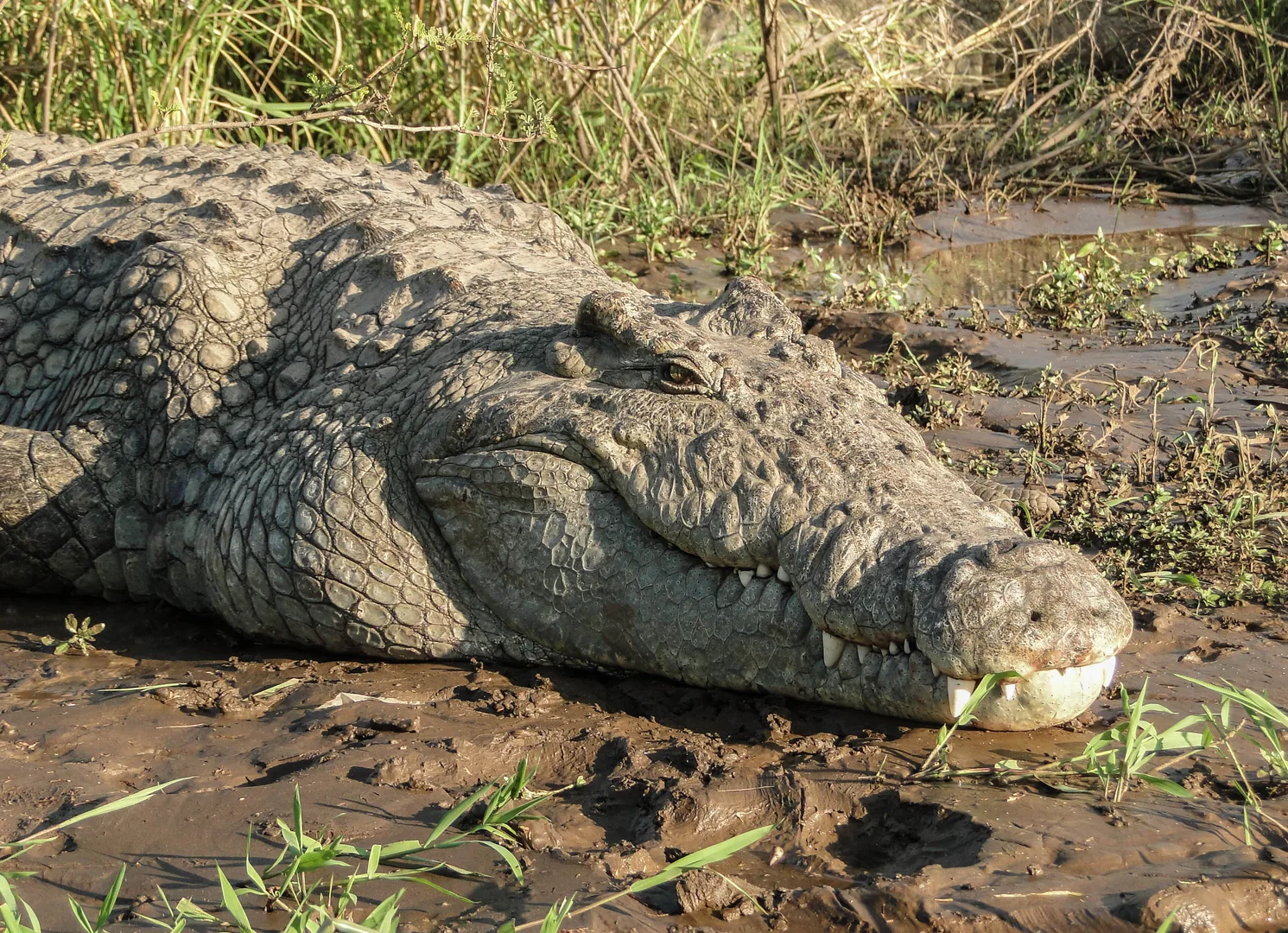
Nile crocodile ( Crocodylus niloticus ) on the shore of Lake Chamo, Ethiopia
Field
notes
Skin that out-feels a fingertip
A Nile crocodile looks like a suit of armor, but its skin is full of sensors. Researchers counted roughly 9,000 sensory organs on a Nile crocodile’s jaws and body scales. In tests on Nile crocodiles and American alligators, these organs were more sensitive to touch than primate fingertips. Some of their nerve units responded most strongly to vibrations of 20 to 35 hertz (cycles per second), which fits reports that the organs detect ripples made by prey on the water surface. The researchers also concluded that the organs help indicate when to bite, based on direct contact with pursued prey.
Africa’s largest crocodiles
Crocodiles of west and central Africa are a newly recognized separate species, Crocodylus suchus. The San Diego Zoo Wildlife Alliance fact sheet this page draws on covers both species together, and together they are the largest crocodiles in Africa. For both, it gives a total length of 2.0 to 3.3 m and a weight of 70 to 100 kg, and males are larger than females. Its maximum recorded length, snout to tail tip, is 5 m, and adults of 1,000 kg have been reported. A wild-born female Nile crocodile was reported living more than 56 years in captivity.
The Nile crocodile itself lives in freshwater lakes, rivers and brackish coastal swamps in eastern and southern Africa and the Nile valley, but not at Africa’s southern tip.
Ambush from the waterline
At the water surface, only its eyes, ears and nostrils are exposed. It swims silently underwater until it is near the shore, may surface with its eyes above the water to check its position, then launches its body out of the water to grab prey. It can lunge several times its own body length onto land. It drags prey into the water to drown it, and tears big prey apart by holding on and rotating until a piece comes away. Its tail bats at birds in the reeds, bending the reeds down and flipping the birds into the water.
Fish are the mainstay of an adult’s diet, but in South Africa’s Kruger National Park it also takes impala, buffalo, giraffes and young hippos. One meal may be up to 20% of its body mass.
Out of water it tires easily. The fastest way a crocodile moves on land is the gallop, which the fact sheet calls typical of the young of some crocodile species. A galloping crocodile reaches 18 km/h for short distances.
Nest temperature picks the sex
Sex by temperature Eggs incubated at 28 to 31 °C hatch only females, while 34 °C produces 81% male hatchlings. Eggs incubated below 27 °C never hatch.
The mother digs a hole with her hind limbs and snout and lays 55 to 60 eggs. Incubation takes 84 to 90 days, and she guards the nest for about 10 to 14 weeks. At hatching, the young call from inside the eggs, and the sound can be heard up to 20 m away. She moves the soil off, gathers hatchlings in her mouth and carries them to the water. A hatchling is about 28 cm long and weighs about 80 g.
Published
Traits
Intel
& FAQ
Guess
first
How big is a Nile Crocodile, really? Slide, lock in, and see what the sources say. Every answer is a figure from this page, quoted from where it came from.
Sources
- 01Nile Crocodiles ( Crocodylus niloticus & C. suchus ) Fact Sheet: Summary. San Diego Zoo Wildlife Alliance Library, 2026.
- 02Nile Crocodiles ( Crocodylus niloticus & C. suchus ) Fact Sheet: Physical Characteristics. San Diego Zoo Wildlife Alliance Library, 2026.
- 03Nile Crocodiles ( Crocodylus niloticus & C. suchus ) Fact Sheet: Behavior & Ecology. San Diego Zoo Wildlife Alliance Library, 2026.
- 04Nile Crocodiles ( Crocodylus niloticus & C. suchus ) Fact Sheet: Diet & Feeding. San Diego Zoo Wildlife Alliance Library, 2026.
- 05Nile Crocodiles ( Crocodylus niloticus & C. suchus ) Fact Sheet: Reproduction & Development. San Diego Zoo Wildlife Alliance Library, 2026.
- 06Nile Crocodiles ( Crocodylus niloticus & C. suchus ) Fact Sheet: Distribution & Habitat. San Diego Zoo Wildlife Alliance Library, 2026.
- 07AnAge entry for Crocodylus niloticus. AnAge: The Animal Ageing and Longevity Database, Build 15, Human Ageing Genomic Resources.
- 08Leitch & Catania (2012). Structure, innervation and response properties of integumentary sensory organs in crocodilians. Journal of Experimental Biology.
- 09Turner & Marais (2017). Crocodylus niloticus. The IUCN Red List of Threatened Species 2017: e.T45433088A203590190.
- 10Kavhu et al. (2025). Mapping human fatalities from megafauna to inform coexistence strategies. Scientific Reports.
What the sources say: 64 claims checked word for word against these sources →