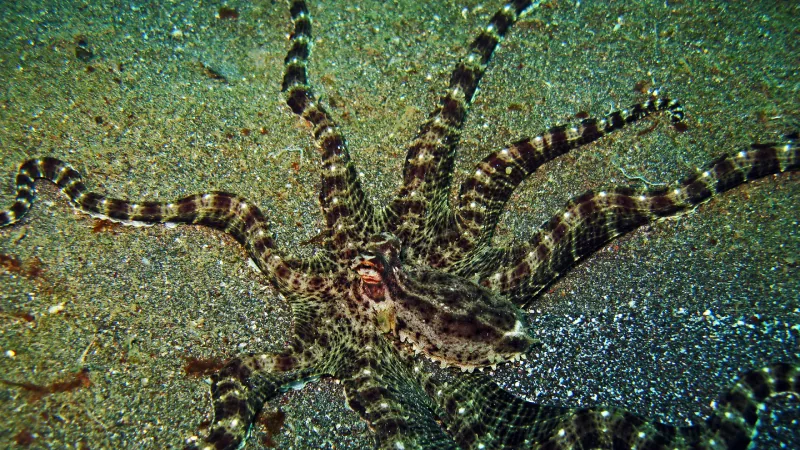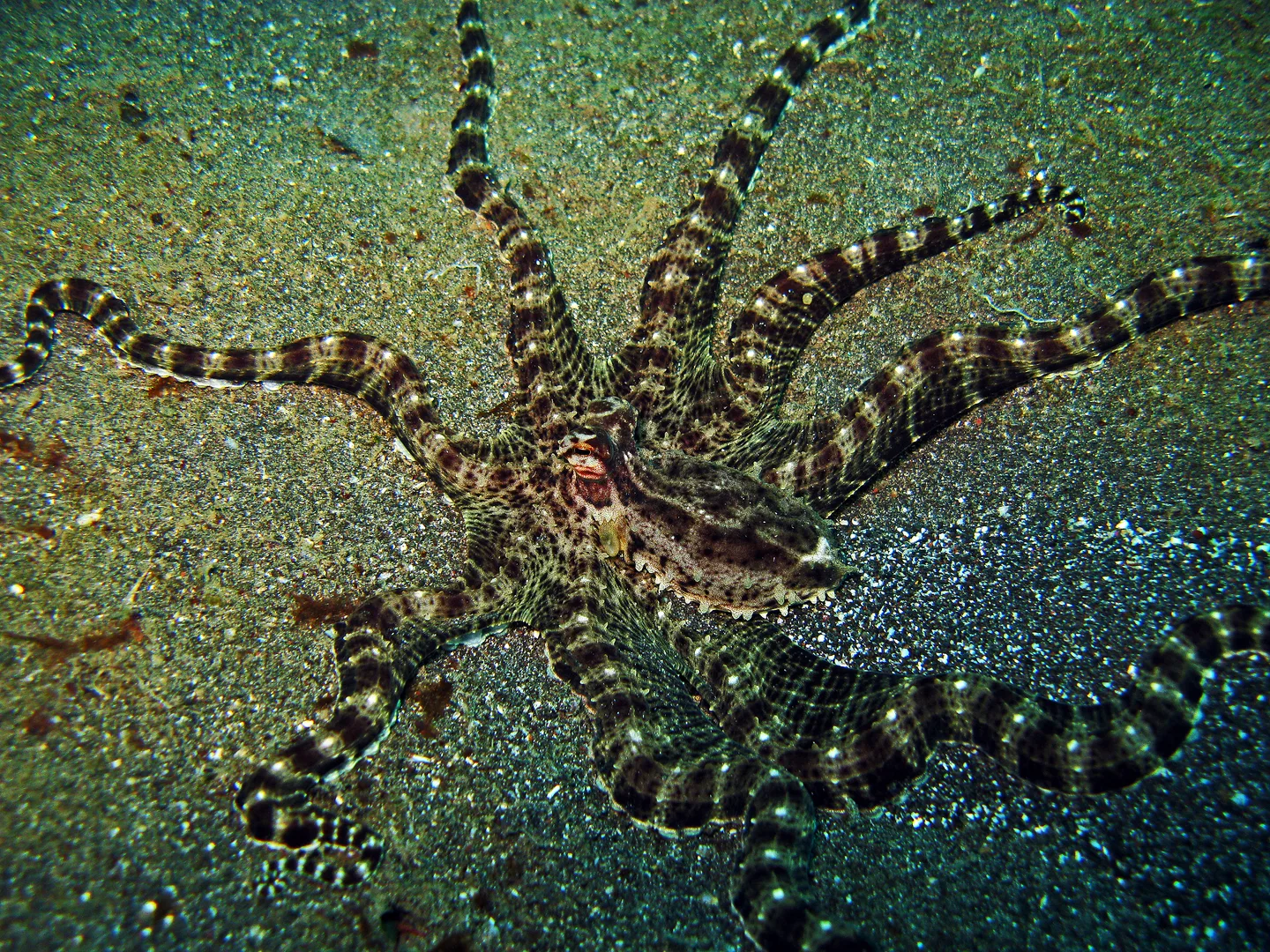
Mimic octopus (Thaumoctopus mimicus) on a sandy seafloor.
Field
notes
An Octopus in Costume
Camouflage is well documented in octopuses and their relatives. The mimic octopus (Thaumoctopus mimicus) forages in daylight on open sand, in full view of predatory fish. Part of its defence is to look like something toxic.
Its arm span reaches up to 60 centimetres, about 2 feet. It was discovered in 1998 off Sulawesi, Indonesia. It lives on silt and sand off river mouths, in water 2 to 12 metres deep, and the team that first studied its mimicry filmed it at Sulawesi and Bali.
It is the first animal of any kind known to shift between several imitations, a talent called dynamic mimicry. A body with no rigid skeleton has fewer limits on the shapes it can take.
Three Costumes
The first study was confident of only three impressions, and each copies a toxic animal.
- Flatfish: it pulls all its arms into a leaf-shaped wedge and undulates through the water like a swimming flatfish. The authors believe the model is a sole, and soles have poison glands at the base of their fins.
- Lionfish: it swims just above the seafloor with its arms trailing, like a lionfish with its banded poisonous spines flared.
- Banded sea snake: it threads six arms down a hole and raises two, banded, curled and undulating. Banded sea snakes inject venom through fangs.
Right costume, right audience Each time the team saw the sea snake pose, it came in answer to an attack by territorial damselfish. Sea snakes hunt by entering burrows and are predators of damselfish. The authors read this as a sign that the octopus chooses the form best suited to the threat.
Hunting Below the Sand
While foraging, it typically crawls along in drab brown, probing holes with its arm tips and using flared webs to trap fleeing prey. Its prey are mainly crustaceans and fish that live in burrows. It can enter a tunnel completely and come out of another hole up to 1 metre away. The authors knew of no other octopus that forages through tunnels.
A later study of two species of so-called mimic octopus in Indonesia analysed nearly 500 episodes of flounder mimicry over 5 days. The octopuses used it only when moving would give them away. When still, they looked like small sponges, tube-worm tubes or colonial tunicates (colony-forming sea squirts).
The octopus even has its own copycat. In 2011, researchers found that the harlequin jawfish sticks close to it and blends in with the colour of its arms while swimming outside its burrow.
The Red List rates the mimic octopus Least Concern.
Published Updated
Traits
Intel
& FAQ
Sources
- 01Norman, Finn & Tregenza (2001). Dynamic mimicry in an Indo–Malayan octopus. Proceedings of the Royal Society of London. Series B: Biological Sciences.
- 02Hanlon, Conroy & Forsythe (2007). Mimicry and foraging behaviour of two tropical sand-flat octopus species off North Sulawesi, Indonesia. Biological Journal of the Linnean Society.
- 03The Talented Mimic Octopus. American Museum of Natural History.
- 04Allcock (2019). Thaumoctopus mimicus. The IUCN Red List of Threatened Species 2019: e.T87585522A87585525.
What the sources say: 49 claims checked word for word against these sources →