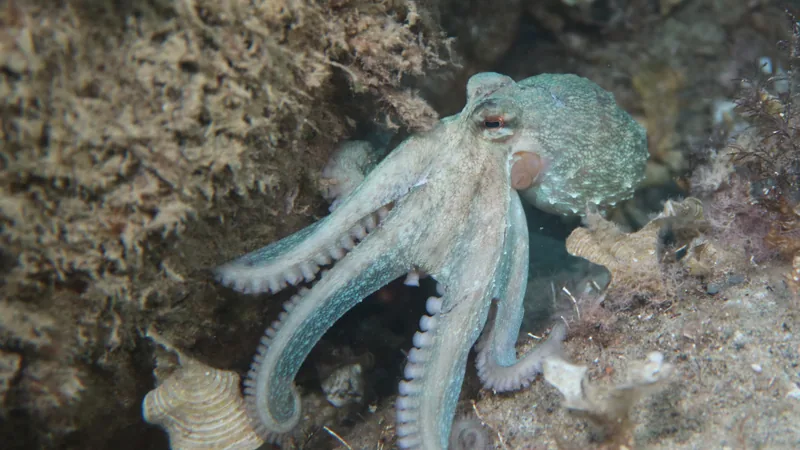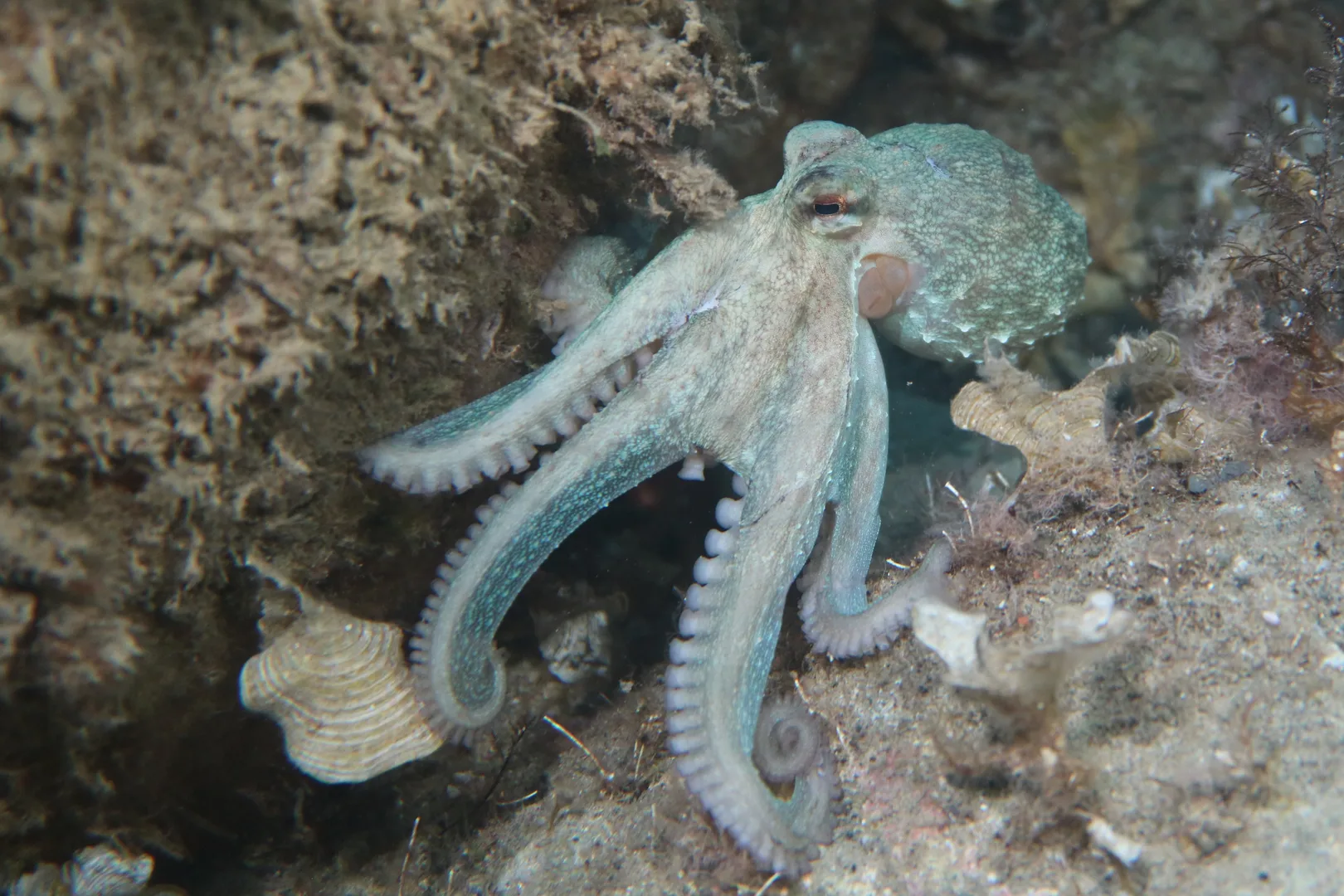
Common octopus off Moneglia, Italy.
Field
notes
Skin Run by Half a Million Neurons
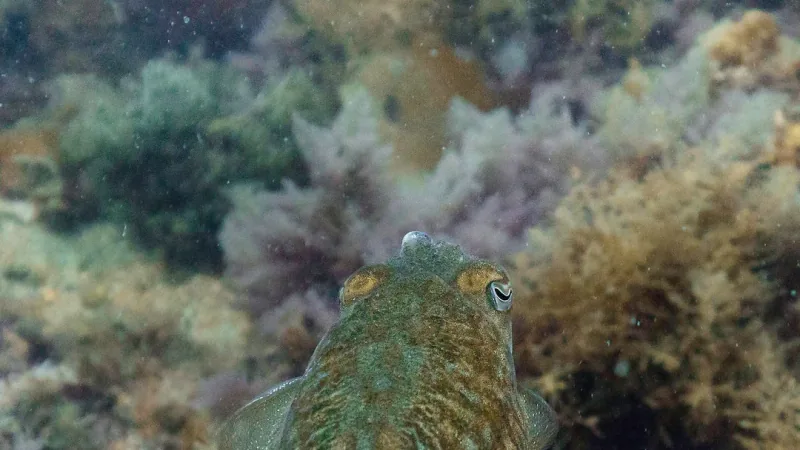
Cephalopods (the octopus and squid group) change their appearance with chromatophores. Each one is an organ in the skin: an elastic sac of pigment with muscles attached. When the muscles contract, the sac expands. When they relax, the sac springs back using the energy it stored. In these animals the optic lobes of the brain, which work largely on visual information, choose a body pattern. That plan is carried out by the chromatophore lobes, which in Octopus vulgaris hold over half a million neurons.
The FAO catalogue lists its living colours as yellow brown, red brown, dark brown or grey.
Long Arms, Short Life
The name Octopus vulgaris has covered look-alike forms in several oceans, which the FAO catalogue calls a species complex in urgent need of revision. The FAO catalogue treats Octopus vulgaris in the strict sense as the form of the Mediterranean and the central and north-east Atlantic, and this page sticks to it. That range includes the Mediterranean, the south coast of England, north-west and west Africa, the Azores, the Canary Islands and the Cape Verde Islands.
It can reach a mantle (body sac) 400 mm long, a total length of around 1.8 m and a weight of over 20 kg. A common size is a mantle of 250 mm. Its arms are 4 to 5.5 times the mantle length, each with two rows of suckers, and in larger animals each normal arm carries around 220 to 320 of them.
Then comes the catch. Its longevity is estimated at one to two years.
Night Shift on the Seabed
It lives on rocky, sandy or muddy ground on the continental shelf. It has been recorded from the shoreline to 250 m deep, but typically lives shallower than 100 m. It is primarily active at night and typically spends the day in a den, which can be a crevice in a reef or one the octopus builds in soft sediment, sometimes using loose rocks or shells.
It probes for prey by touch with its upper arm pairs, or wraps its arm crown around a rock and uses the arm tips to detect and flush prey out. Crabs and lobsters are typical meals, fish when it can catch them, and shelled molluscs, which it typically gets into by boring a hole with its toothed salivary papillae, paralysing or relaxing the animal inside. Cannibalism has been recorded. Its predators include sharks and many fishes, among them groupers, wrasses and eels.
It can learn by watching. In a 1992 experiment, untrained octopuses watched trained ones pick one of two objects that differed only in colour. Tested alone afterwards, the watchers consistently chose the same object as the trained animals had, and they learned faster than the trained animals did during their own conditioning.
One Brood, Then the End
A mother’s last job A female lays 100,000 to 500,000 eggs in strings cemented to her den roof, then stays, stroking and ventilating them. She usually goes without food, burns her own muscle for energy and can shed a third or more of her body weight. When the hatchlings emerge she weakens and dies.
In cool waters the brooding can take up to 4 to 5 months. The hatchlings, called paralarvae, are 1 to 2 mm long and transparent. They swim straight into open water, where the FAO catalogue says the planktonic (drifting) phase is estimated at weeks to months, depending on temperature and conditions. On settling, the young change into a form closer to the adults.
Published Updated
Traits
Intel
& FAQ
Guess
first
How big is a Common Octopus, really? Slide, lock in, and see what the sources say. Every answer is a figure from this page, quoted from where it came from.
Sources
- 01Allcock, Headlam & Allen (2018). Octopus vulgaris. The IUCN Red List of Threatened Species 2018: e.T162571A918906.
- 02Messenger (2001). Cephalopod chromatophores: neurobiology and natural history. Biological Reviews.
- 03Cephalopods of the world, Volume 3: Octopods and vampire squids. FAO Species Catalogue for Fishery Purposes No. 4, Vol. 3.
- 04Fiorito & Scotto (1992). Observational Learning in Octopus vulgaris. Science.
What the sources say: 56 claims checked word for word against these sources →