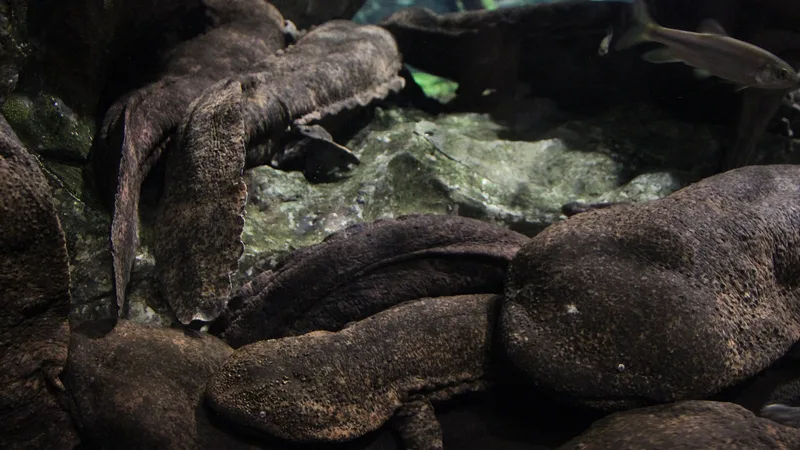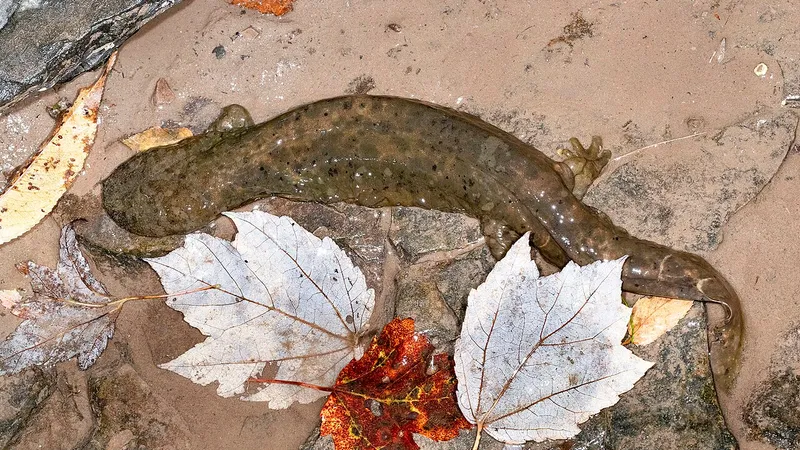
A wild Japanese giant salamander in a shallow stream in Tottori Prefecture, Japan.
Field
notes
A River Boulder With Feet
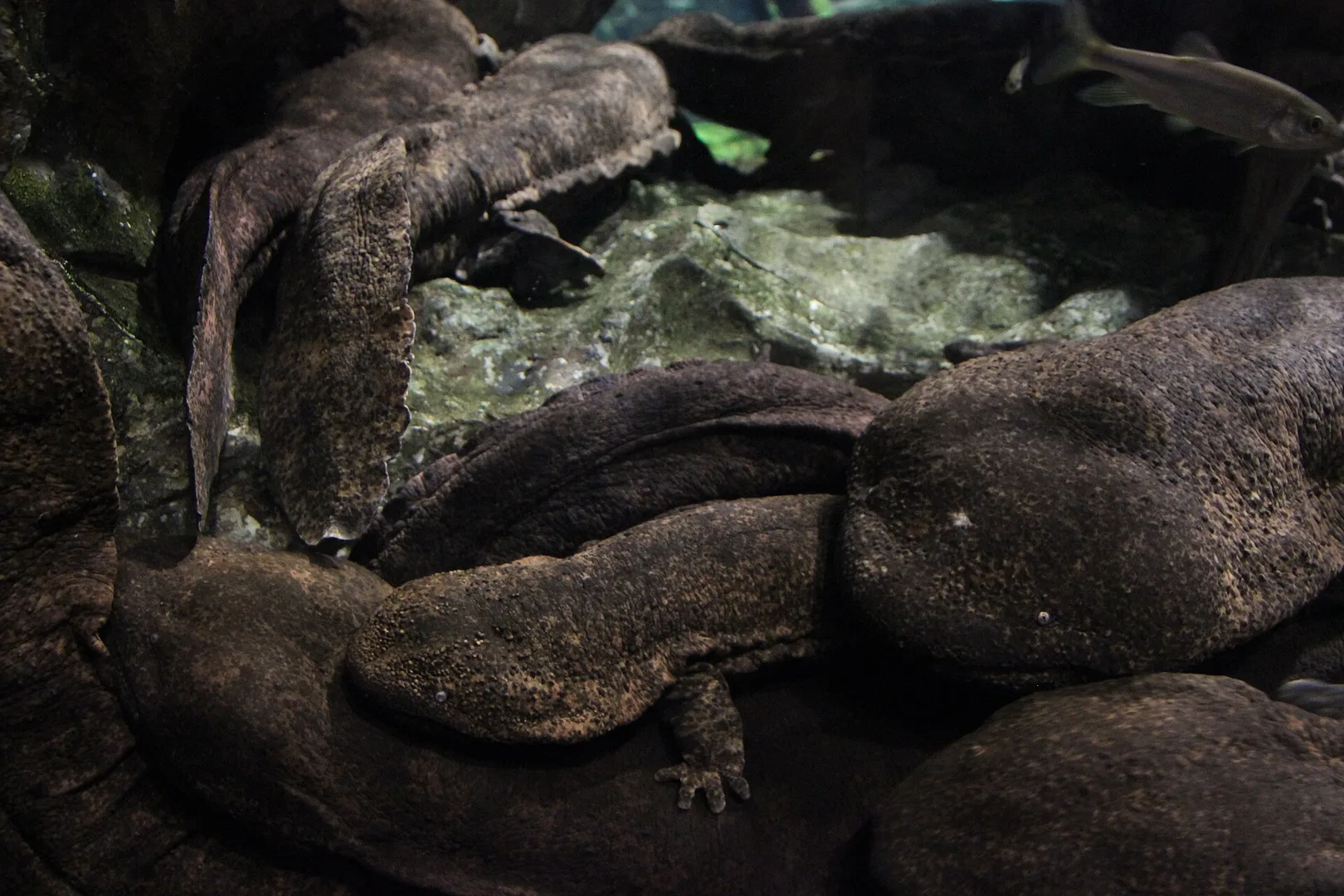
The Japanese giant salamander (Andrias japonicus) is the second-largest salamander species on Earth, after the Chinese giant salamanders. It can reach 1.5 meters (5 feet) long and weigh up to 23 kilograms (55 pounds). Its wrinkled skin is mottled black and brown. Its head is flat and wide, and its eyes are small and lidless. It lives in cold, fast-flowing mountain streams in western Honshu and northern Kyushu, in Japan, from 180 to 1,350 meters above sea level, where the water carries plenty of oxygen. It can live for more than 70 years.
Breathing Through Its Skin
This salamander has no gill openings, and it breathes mainly through its skin. Wrinkles and folds add surface area for swapping oxygen and carbon dioxide with the water, and tiny blood vessels called capillaries run close to the surface, so gases pass through easily. Its single lung is used mainly to control its buoyancy, how high or low it floats.
Its eyesight is poor, so it hunts by smell and by sensing vibrations in the water. Bumps on its skin, mostly around the head, are sense organs that work like a fish’s lateral line, the sensors fish use to feel movement in the water. It feeds by suction. The side of its jaw closest to the prey drops open, and the salamander can hold its catch in one side of its mouth while pushing water out the other if its first suction attempt fails. Fish, crayfish, insects, snails, worms and small mammals are all on the menu.
The Big Pepper Fish When aggravated or stressed, a Japanese giant salamander oozes a sticky white mucus that may be toxic to predators. It smells like Japanese pepper, which gave the species a Japanese name that translates to “big pepper fish.”
The Den Master
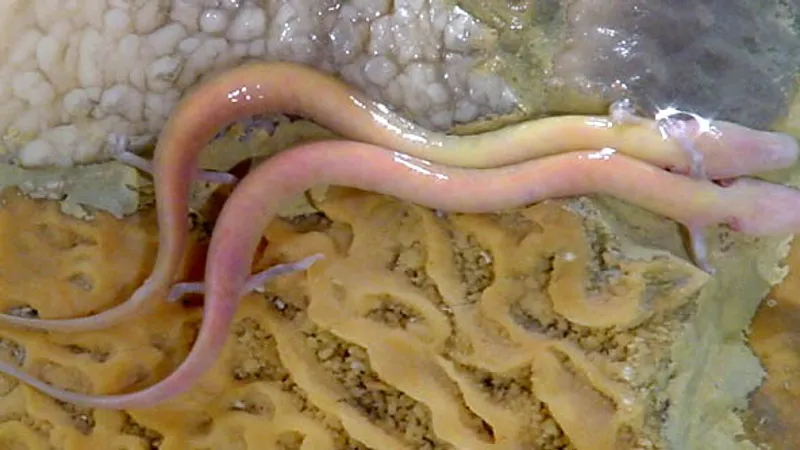
From August to October, the salamanders migrate upriver to spawn in dens: caverns, or burrows 1 to 1.5 meters long in or near the riverbank. The largest, most dominant male on a stretch of river takes over a den, and males fiercely defend the same one for many years. Larger males have killed and eaten smaller ones in the breeding season. Several females may spawn in one den, each typically laying 400 to 600 eggs strung together like beads. The male, sometimes called the den master, fertilizes them, and once the females leave, protecting the eggs is his job.
Before spawning, one den master filmed at a zoo in Hiroshima paddled the nest floor with his front and hind legs every day. That stirred up leaves and twigs buried in the sand, and the current carried them away. Clearing that debris likely leaves less food for water mold, a major cause of death among the young.
Two den masters filmed with their eggs in natural streams fanned them with their tails to bring in oxygenated water, and stirred them with their heads and bodies, which likely stops the yolk sticking. They also ate whiter eggs that looked dead or moldy, which likely keeps the mold from spreading to healthy eggs. Incubation takes 40 to 60 days. In a later study, one male stayed with his hatched larvae until they dispersed the following spring: seven months of care, from eggs to larvae.
Published Updated
Traits
Intel
& FAQ
Guess
first
How big is a Japanese Giant Salamander, really? Slide, lock in, and see what the sources say. Every answer is a figure from this page, quoted from where it came from.
Sources
- 01Japanese giant salamander. Smithsonian's National Zoo and Conservation Biology Institute.
- 02Andrias japonicus. Animal Diversity Web, University of Michigan.
- 03オオサンショウウオを伊丹市内で見つけたら (If you find a Japanese giant salamander in Itami). Itami City, Cultural Promotion Division.
- 04Andrias japonicus. The IUCN Red List of Threatened Species 2022: e.T1273A177177761.
- 05Terry et al. (2018). Preoviposition paternal care in a fully aquatic giant salamander: nest cleaning by a den master. Journal of Zoology.
- 06Okada, Fukuda & Takahashi (2014). Paternal care behaviors of Japanese giant salamander Andrias japonicus in natural populations. Journal of Ethology.
- 07Takahashi, Okada & Fukuda (2016). From embryos to larvae: seven‐month‐long paternal care by male Japanese giant salamander. Journal of Zoology.
- 08Kawano et al. (2024). Applying 3D Models of Giant Salamanders to Explore Form–Function Relationships in Early Digit-Bearing Tetrapods. Integrative And Comparative Biology.
- 09Matsumoto, Fujiwara & Evans (2024). The anatomy and feeding mechanism of the Japanese giant salamander (Andrias japonicus). Journal of Anatomy.
What the sources say: 70 claims checked word for word against these sources →