Carukia barnesi
Field
notes
A fishing lure with a sting
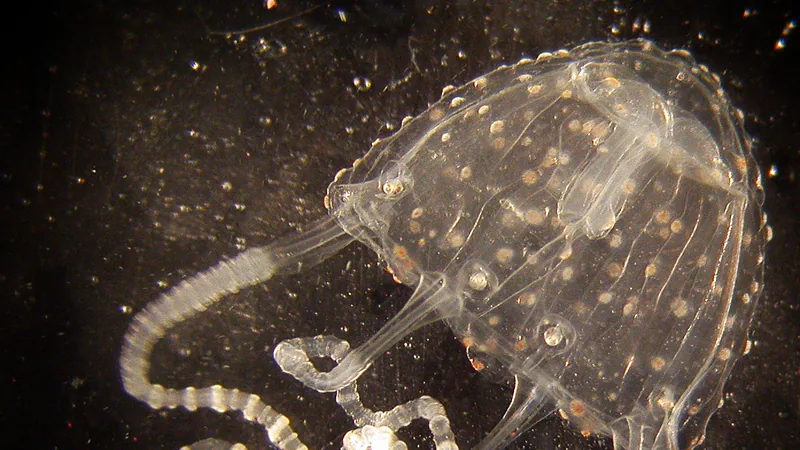
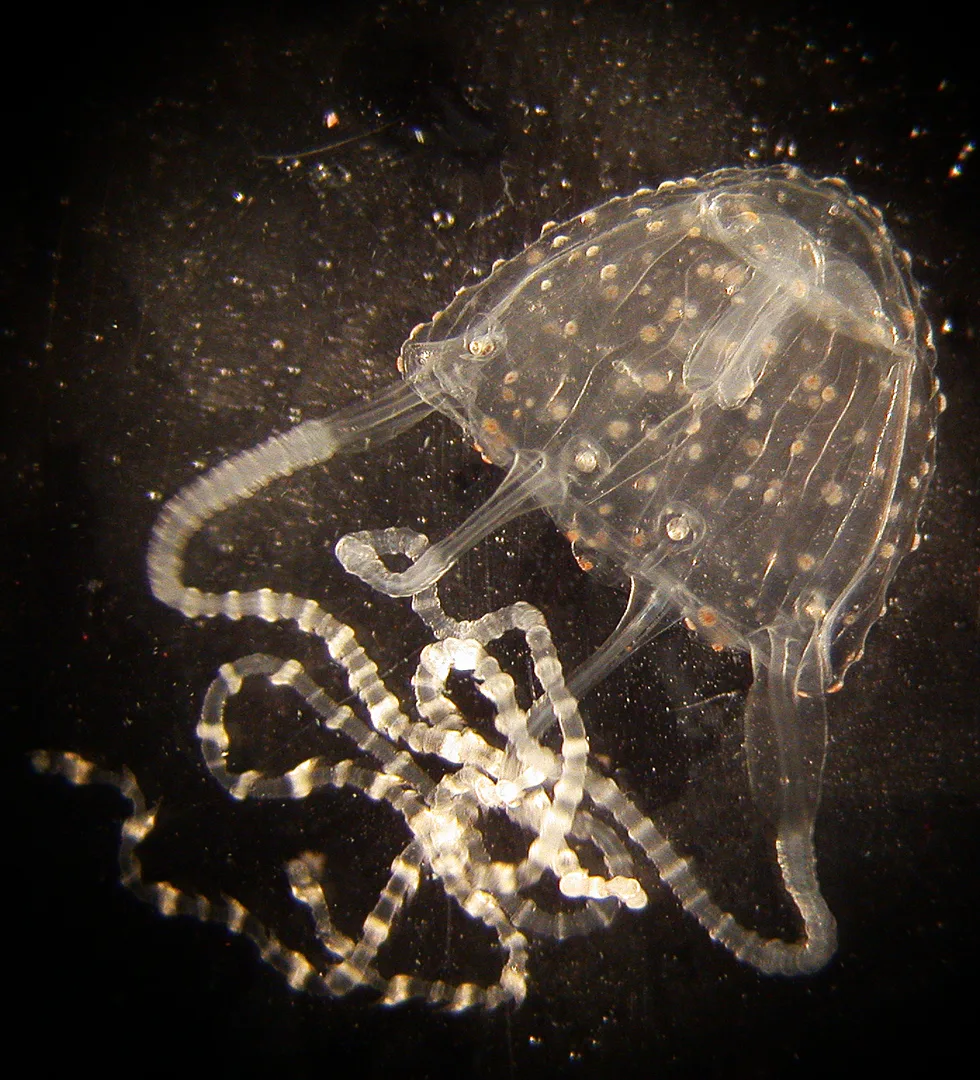
Carukia barnesi is a small box jellyfish. A 2015 study gives its bell, the jelly body, as approximately 20 millimetres wide. A 2016 study says the bell height reaches up to 35 millimetres and the tentacles up to 1.2 metres. Four tentacles hang from the four corners of the bell. Each carries clusters of stinging cells in an alternating pattern of large and small.
Adults use those clusters as bait. In a tank, in light, the jellyfish extends its tentacles and twitches them. The average twitch rate in the light was 6.3 twitches per minute, and no twitching was recorded in the dark. Larger animals twitched their tentacles more often than small ones. The clusters attract larval fish, which are then stung and eaten. It has four sets of six eyes, which is typical among cubozoans, the box jellyfish group. One pair in each set are complex eyes with a cornea, a lens and a retina, though how sharply they see, and what they are used for, is unknown.
The syndrome that arrives late
Irukandji syndrome is linked to this jellyfish, and other small Australian box jellyfish may be linked to it too. The sting behind it is characteristically relatively minor. The syndrome develops after about 30 minutes and consists of severe muscle pains, especially of the lower back, muscle cramps, vomiting, sweating, agitation and high blood pressure. In severe cases there can be acute heart failure. Envenoming by C. barnesi may produce life-threatening Irukandji syndrome.
Where it lives and how it grows
The medusa, the free-swimming jellyfish stage, is present in north Queensland waters between November and May. It is present along the north-eastern coast of Australia from Lizard Island to Fraser Island. The medusa is considered oceanic and planktonic, and has been found around coral reefs or islands. Young jellyfish feed predominantly on crustaceans. Adults feed predominantly on larval fish.
Waiting game In a lab study, most fertilised eggs developed into larvae called planulae that paused for between six days and six months before hatching.
In the same study, the hatched larvae settled and turned into polyps. Mature polyps budded off swimming polyps from their sides. A polyp that made a medusa was left behind, still able to reproduce asexually. A newly detached lab medusa had a bell height of 0.33 to 0.80 millimetres.
Published
Traits
Intel
& FAQ
Guess
first
How big is a Irukandji Jellyfish, really? Slide, lock in, and see what the sources say. Every answer is a figure from this page, quoted from where it came from.
Sources
- 01Courtney, Browning & Seymour (2016). Early Life History of the 'Irukandji' Jellyfish Carukia barnesi. PLOS ONE.
- 02Courtney et al. (2015). Prey Capture Ecology of the Cubozoan Carukia barnesi. PLOS ONE.
- 03Pereira et al. (2010). Intracerebral hemorrhage and death after envenoming by the jellyfish Carukia barnesi. Clinical Toxicology.
- 04Huynh et al. (2003). Severity of Irukandji syndrome and nematocyst identification from skin scrapings. Medical Journal of Australia.
- 05Underwood & Seymour (2007). Venom ontogeny, diet and morphology in Carukia barnesi, a species of Australian box jellyfish that causes Irukandji syndrome. Toxicon.
- 06Tibballs et al. (2012). Australian carybdeid jellyfish causing 'Irukandji syndrome'. Toxicon.
- 07Ramasamy et al. (2005). The in vivo cardiovascular effects of the Irukandji jellyfish (Carukia barnesi) nematocyst venom and a tentacle extract in rats. Toxicology Letters.
- 08Carukia barnesi. Animal Diversity Web, University of Michigan.
What the sources say: 44 claims checked word for word against these sources →