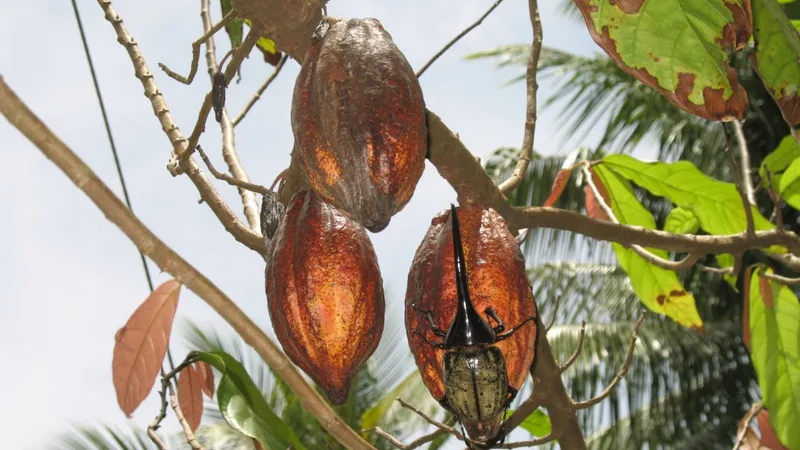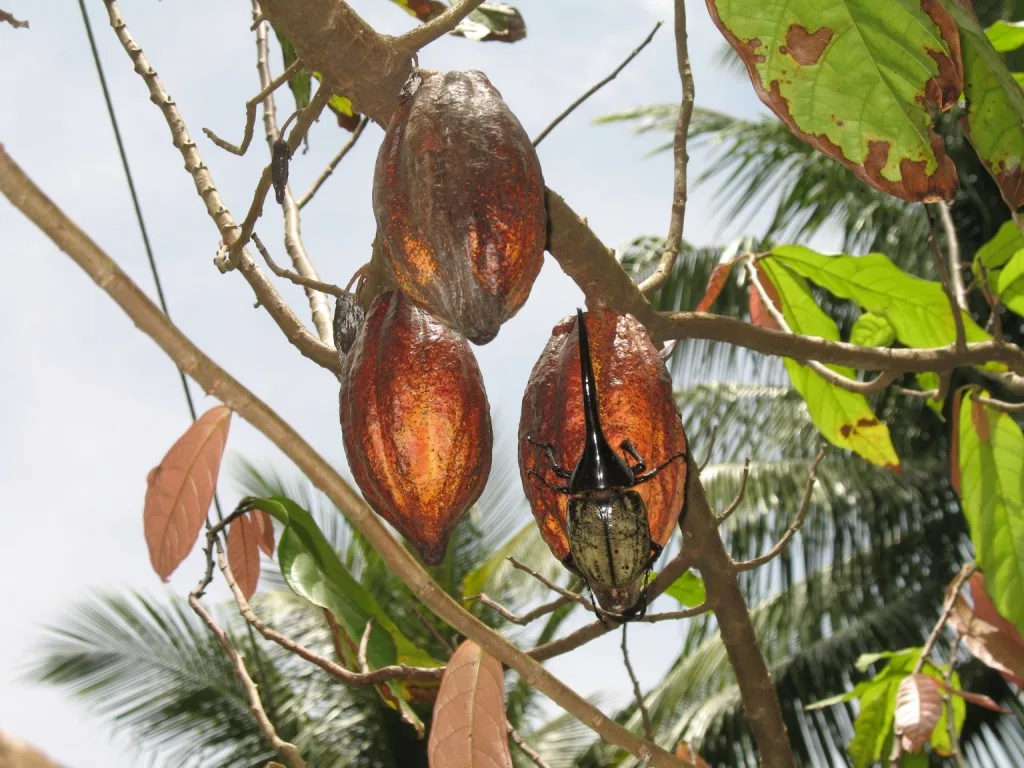
Dominica, natural island in the caribbean, bug on a cocoa-fruit
Field
notes
Up to Seven Inches of Beetle
Adult male Hercules beetles (Dynastes hercules) average around 78 millimeters from the tip of the longer, thoracic horn to the end of the abdomen, and males can reach up to 180 millimeters, about seven inches, which puts them among the largest beetles. Hornless females are smaller, averaging about 62 millimeters. Males average about 34 grams and females about 16. The beetle can make a “huffing” sound by rapidly vibrating its abdomen against its hardened front wings, called elytra; the sound is thought to work in predator defense, perhaps as a warning.
Pliers for Horns
In captive bouts, a male clasps a rival between his long thoracic horn and the shorter horn on his head, then lifts him and slams him down; one study compared the style to a pair of pliers.
Females do not pick by horn. The fights usually happen over access to females, yet horn size is not important to females choosing a mate.
Nearly Two Years to Grow Up, a Few Months to Live
Little is known about the life cycle in the wild; the figures come from beetles raised under laboratory conditions. The egg takes about a month to hatch, and the grub then grows through three stages that together average more than a year. After about a month as a pupa, the adult emerges and lives three to six months in captivity, and the whole life span can reach two years. The species is found from southern Mexico south to Bolivia and in the Lesser Antilles. Adults feed mostly on rotting fruit that has fallen to the ground, while the larvae feed on dead wood in rotten logs.
Gears in Its Jaws, Weather in Its Shell
Dry, a male’s elytra look khaki-green; above 80 percent humidity they turn black. The green comes from a porous layer of columns and stacked horizontal filaments about 3 micrometers under the surface. When water soaks into it, the refractive-index differences weaken and the backscattering disappears, leaving a view of the pigmented, light-absorbing layer beneath. On elytra from dried specimens, the switch reversed and could be repeated many times without damage.
The mandibles are stranger. Their tips don’t meet, so they can’t bite or chew. Filmed in a lab, the beetle used them like a chisel to carve bark, then closed them into a narrow straw-like opening to suck up sap. In the molar area, the two mandibles interlock through gear-like structures that make them move in complete synchrony, and the gears stay engaged even after the beetle dies.
Published Updated
Traits
Intel
& FAQ
Sources
- 01Dynastes hercules. Animal Diversity Web, University of Michigan.
- 02Hercules Beetle Dynastes hercules (Linnaeus, 1758) (Insecta: Coleoptera: Scarabaeidae). UF/IFAS Featured Creatures, University of Florida.
- 03Rassart et al. (2008). Diffractive hygrochromic effect in the cuticle of the hercules beetle Dynastes hercules. New Journal of Physics.
- 04Ichiishi et al. (2019). Completely engaged three-dimensional mandibular gear-like structures in the adult horned beetles: reconsideration of bark-carving behaviors (Coleoptera, Scarabaeidae, Dynastinae). ZooKeys.