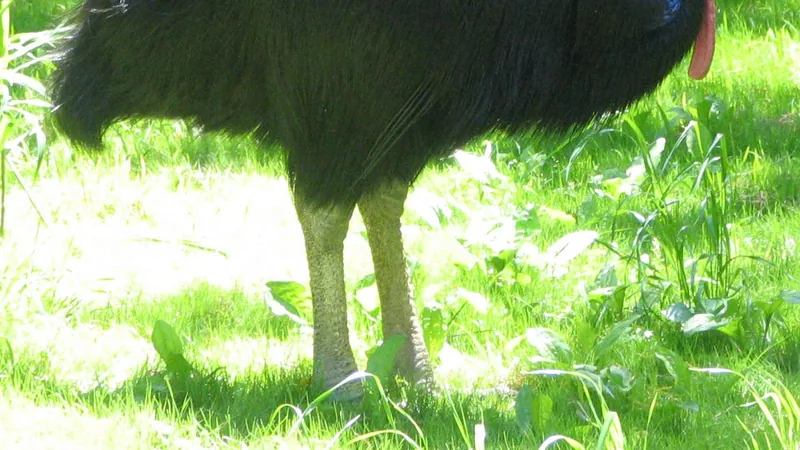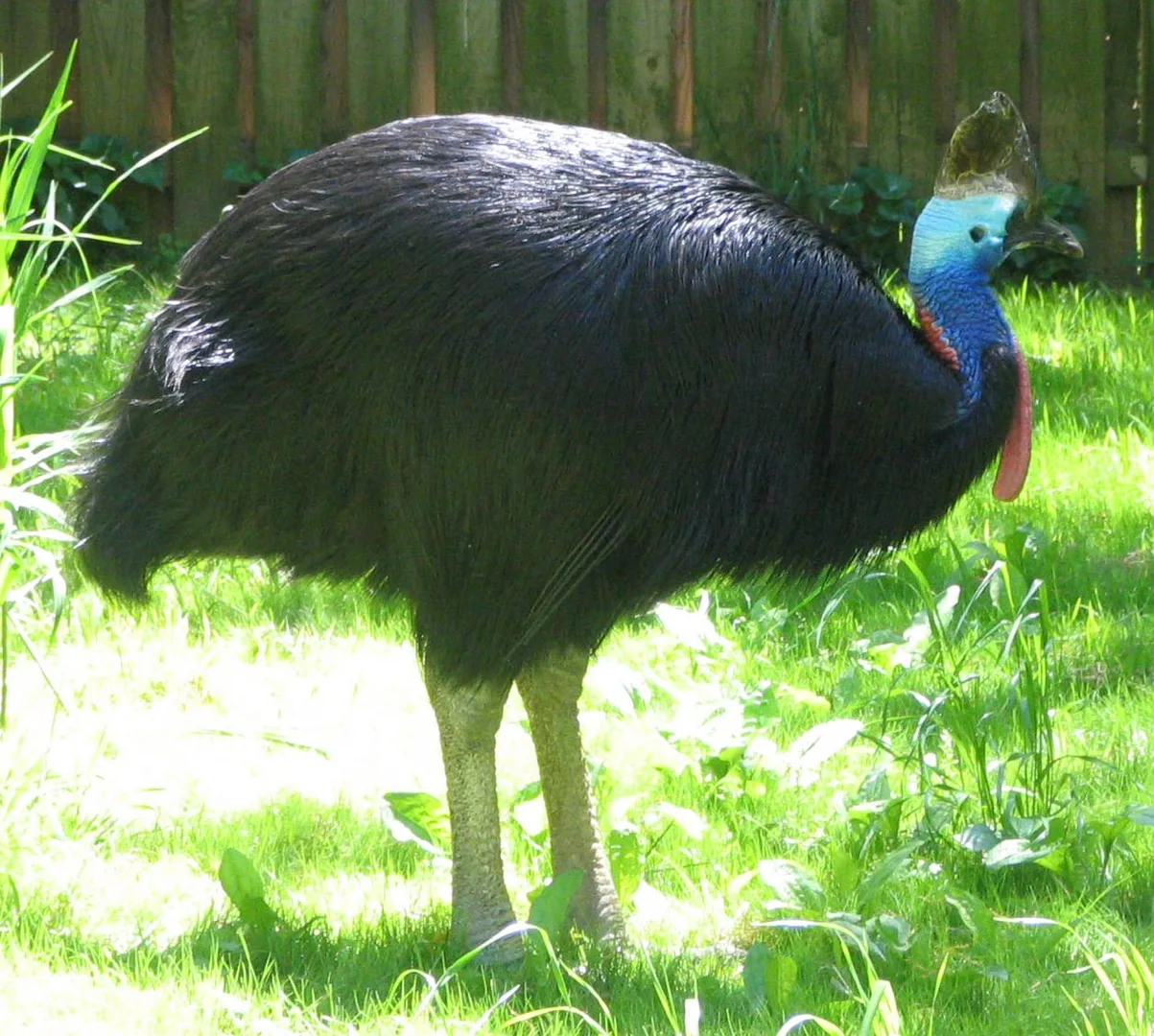
A wild southern cassowary at Coquette Point, Queensland.
Field
notes
The Bird With a Built-In Dagger
The southern cassowary (Casuarius casuarius) has a razor-sharp inner toe on each foot, armed with a five-inch, dagger-like claw. It cannot fly, but it can launch itself up to seven feet off the ground. It can grow to 1.7 meters (5.5 feet) tall. Males weigh up to 55 kilograms (121 pounds), and females are slightly larger. The Smithsonian’s National Zoo gives a wild lifespan of 18 to 20 years, and up to 40 in human care.
Kicks, Charges and One Death
A 1999 review of attacks in Queensland, Australia, noted that cassowaries and ostriches were the only birds known to have caused human deaths by physical attack. It gathered data on 221 cassowary attacks, 150 of them on people. Victims were chased or charged in 71 percent of incidents and kicked in 15 percent. Seven attacks on people caused serious injuries, and one of those led to a death: the victim was trying to kill the cassowary. Three-quarters of the attacks on people were by cassowaries that people had fed before, and in 73 percent of incidents the birds appeared to be expecting or begging for food. Contrary to popular belief, jogging did not provoke attacks.
The Australian subspecies is listed as Endangered under Australian law. Among 110 cassowary deaths studied in Queensland from 1986 to 2004, vehicle strikes caused 55 percent and dog attacks 18 percent.
Rainforest Gardener
Southern cassowaries live in rainforests of northeastern Australia, New Guinea, and Indonesia’s Ceram and Aru islands. They mostly eat fallen fruit, snails, and fungi, and also take small mammals and reptiles, dead or alive. Conservation scientists believe the cassowary is a keystone species, one that helps its forest regrow by spreading the seeds of several hundred rainforest plants far from the parent plant. A year-long study of the seeds of 11 plant species in cassowary droppings found that 70 percent still looked intact and viable after a month, and 38 percent after a year.
The female lays three to five green eggs, and the male incubates them for about 50 days, then guards the chicks for about nine months as they learn to forage. By the time the young are independent, they are nearly full-grown and able to defend themselves.
The Casque Question
The casque, the tall crest on the bird’s head, has puzzled people for nearly 200 years. Its outer layer is keratin, the same substance as our hair and nails. A 2019 study pointed a heat-sensing camera at 20 southern cassowaries in zoos, across a wide range of air temperatures. It found evidence that the casque acts as a thermal radiator, a surface that sheds heat: it offloads heat when the air is hot and restricts heat loss when it is cold. At in-between temperatures, the back half of the casque appeared to warm up before the front half.
A Casque That Glows A 2026 study shone ultraviolet (UV) light on the heads of living cassowaries and museum specimens. Every southern cassowary it examined showed biofluorescence, meaning its casque glowed under the UV light. In six living southern cassowaries, the glow covered about 65 percent of the side of the casque on average. The glowing patterns differ between cassowary species and between individuals, even though casque keratin appears dull in normal light.
Published Updated
Traits
Intel
& FAQ
Guess
first
How big is a Southern Cassowary, really? Slide, lock in, and see what the sources say. Every answer is a figure from this page, quoted from where it came from.
Sources
- 01Southern Cassowary. San Diego Zoo Wildlife Alliance.
- 02Southern cassowary. Smithsonian's National Zoo and Conservation Biology Institute.
- 03Casuarius casuarius: Southern Cassowary. Species Profile and Threats Database, Australian Government Department of the Environment, 2026.
- 04Casuarius casuarius. The IUCN Red List of Threatened Species 2018: e.T22678108A131902050.
- 05Eastick et al. (2019). Cassowary casques act as thermal windows. Scientific Reports.
- 06Kofron (1999). Attacks to humans and domestic animals by the southern cassowary (Casuarius casuarius johnsonii) in Queensland, Australia. Journal of Zoology.
- 07Kofron & Chapman (2006). Causes of mortality to the endangered Southern Cassowary Casuarius casuarius johnsonii in Queensland, Australia. Pacific Conservation Biology.
- 08Bradford & Westcott (2011). Predation of cassowary dispersed seeds: is the cassowary an effective disperser? Integrative Zoology.
- 09Green et al. (2026). Ultraviolet light illuminates species-specific biofluorescent casque patterns in cassowaries (Casuarius). Scientific Reports.
What the sources say: 59 claims checked word for word against these sources →