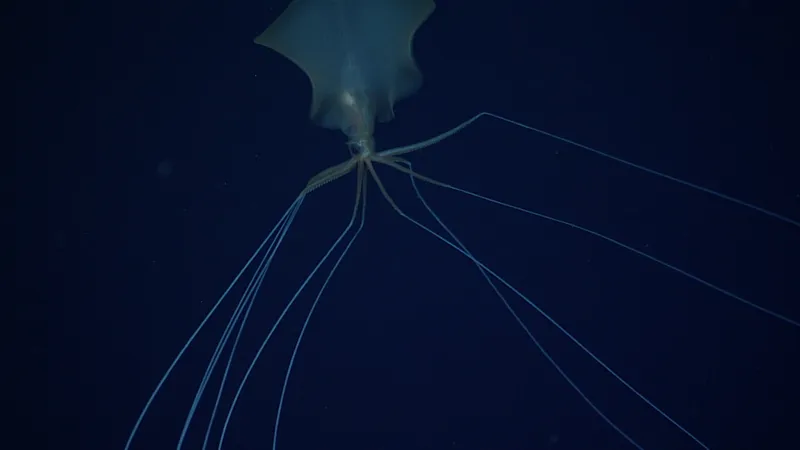
A juvenile filmed in the Monterey Bay National Marine Sanctuary.
Field
notes
A Name From Hell, a Body Built for the Dark
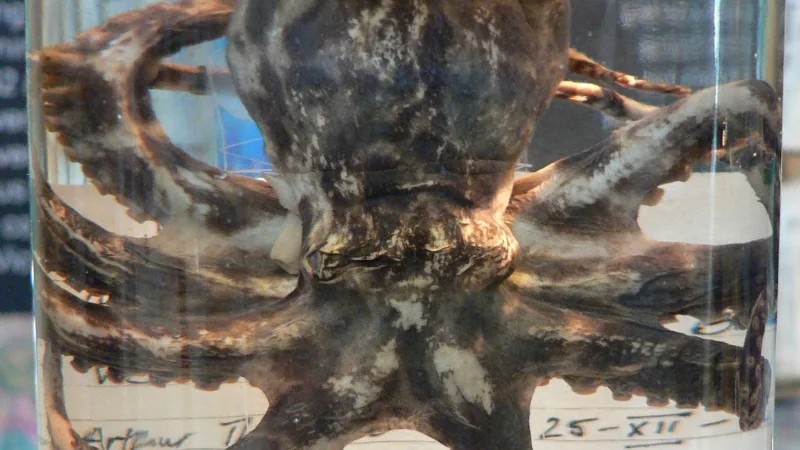
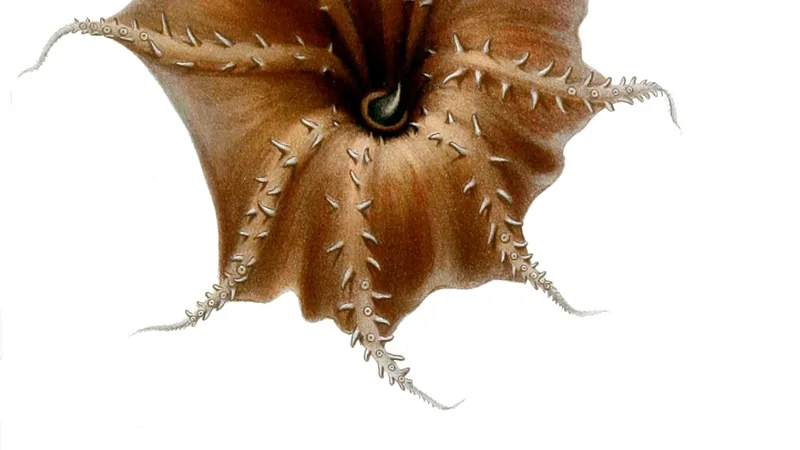
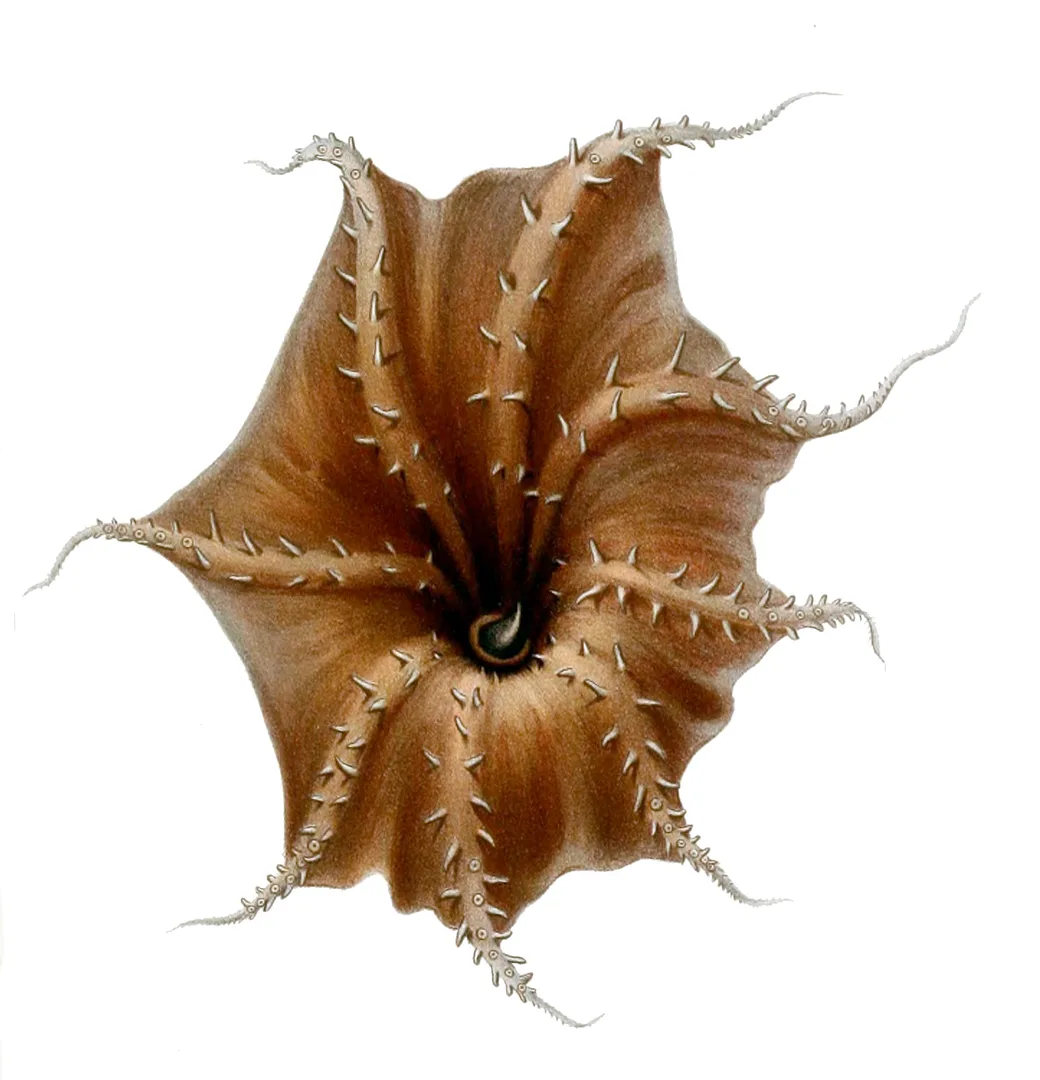
Six hundred to nine hundred meters down, in the ocean’s twilight zone, lives the vampire squid (Vampyroteuthis infernalis). It is especially common in the oxygen minimum zone, where oxygen levels are only a fraction of those near the surface. Its scientific name literally means “vampire squid of Hell,” but it does not suck blood. It isn’t even a true squid: it’s the last surviving member of an ancient group of cephalopods, and scientists group it with the octopuses. It grows to 30 centimeters (12 inches) long at most, with dark reddish-brown skin and velvety webbing that joins its eight arms into a cloak. Its eyes are the real shock: proportionally the largest in the animal kingdom.
Running the Body on Almost Nothing
Surviving here means keeping energy use to a minimum. For its size, the vampire squid has the lowest metabolic rate of any cephalopod. Its blood carries oxygen with hemocyanin, a respiratory protein, and the vampire squid’s version grips oxygen more tightly than that of any cephalopod tested so far, except one Antarctic seafloor octopus. Neutral buoyancy cuts the energy it spends swimming.
It is usually seen drifting and collecting marine snow, a flurry of dead plankton, poop, mucus and other organic material sinking from the waters above. This passive feeding takes very little energy. Two long, thin, sticky filaments collect the “snow.” Suckers add mucus to clump the particles together, then soft, finger-like cirri pass the meal to its mouth. Its stomach often holds pieces of larger prey too, such as crustaceans and fish bones, so marine snow isn’t its only food.
The Pineapple Posture
Few predators can hunt in the oxygen minimum zone, but the vampire squid takes no chances. Most of its cephalopod cousins squirt ink, and shallow-water ones change color to confuse intruders. The vampire squid does neither. It has no ink for defense, and it can’t change color, which would be a pointless strategy in the deep ocean, where little light penetrates. When threatened, it turns its cloak of webbed arms inside out, showing a black underside lined with harmful-looking cirri. This is known as the “pineapple posture.” If danger remains, the tips of its eight arms glow with pulsing blue light, and it can release a glowing cloud of sticky, bioluminescent mucus to distract predators.
A cephalopod that carries no ink fights back with light instead, and it takes a much bigger scare to trigger its glowing cloud than its glowing arm tips.
A Living Fossil That Breeds Again and Again
The vampire squid’s lineage goes back 165 million years in the fossil record, and a 2021 study found that its relatives were already adapted to oxygen-poor deep water by the Oligocene epoch. Female squid, octopuses and cuttlefish usually die after a single, final burst of egg-laying. The vampire squid breaks this deadly pattern. Researchers counted and measured egg cells in 43 females netted off southern California and found that their reproductive organs go dormant between rounds of breeding, something never seen before in soft-bodied cephalopods. Vampire squid reproduce more than 20 times in their lives, and a female releases each egg on its own into the water. With 6,000 to 20,000 eggs to release in a lifetime, the team speculated that the vampire squid may live up to a decade.
Published Updated
Traits
Intel
& FAQ
Guess
first
How big is a Vampire Squid, really? Slide, lock in, and see what the sources say. Every answer is a figure from this page, quoted from where it came from.
Sources
- 01What are the vampire squid and the vampire fish? National Ocean Service, National Oceanic and Atmospheric Administration.
- 02Vampire squid. Monterey Bay Aquarium Research Institute.
- 03Vampire squid live long and reproduce often. MBARI News.
- 04Hoving & Robison (2012). Vampire squid: detritivores in the oxygen minimum zone. Proceedings of the Royal Society B: Biological Sciences.
- 05Robison et al. (2003). Light Production by the Arm Tips of the Deep-Sea Cephalopod Vampyroteuthis infernalis. The Biological Bulletin.
- 06Golikov et al. (2019). The first global deep-sea stable isotope assessment reveals the unique trophic ecology of Vampire Squid Vampyroteuthis infernalis (Cephalopoda). Scientific Reports.
- 07Košťák et al. (2021). Fossil evidence for vampire squid inhabiting oxygen-depleted ocean zones since at least the Oligocene. Communications Biology.
- 08Seibel et al. (1997). Decline in Pelagic Cephalopod Metabolism With Habitat Depth Reflects Differences in Locomotory Efficiency. The Biological Bulletin.
- 09Vampyrotheuthis infernalis (Vampire Squid). The Online Guide to the Animals of Trinidad and Tobago, University of the West Indies.
What the sources say: 60 claims checked word for word against these sources →