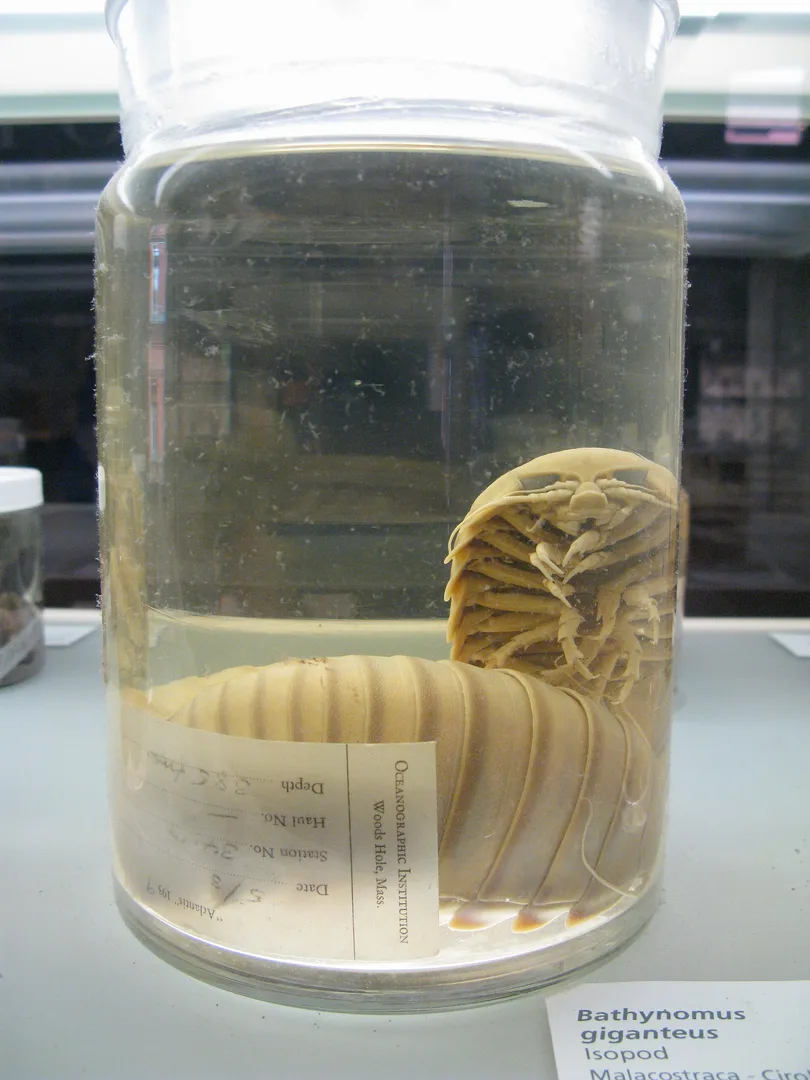
A wild giant isopod (Bathynomus giganteus) with a whip coral (Stichopathes) in the foreground
Field
notes
The Pill Bug’s Giant Deep-Sea Cousin
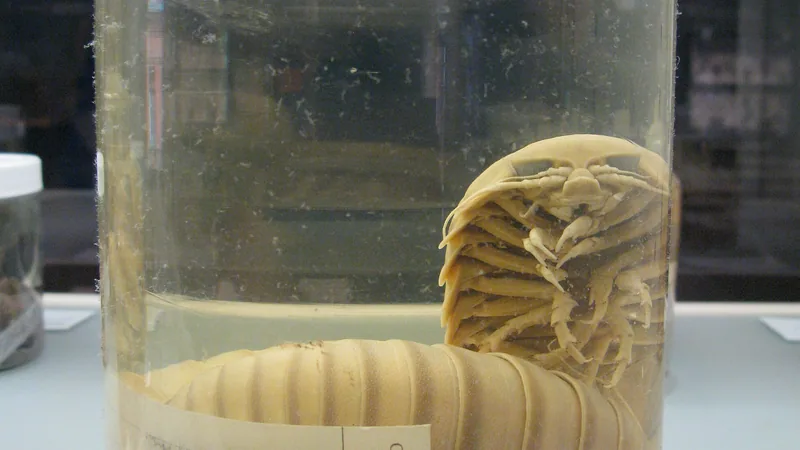
The giant isopod (Bathynomus giganteus) is a deep-sea scavenger and a close relative of the pill bugs, roly-polies and sowbugs found in houses and gardens, but much, much larger. A 2015 study of ocean giants called it the largest known isopod species. It lives on the continental slopes of the Gulf of Mexico and the Caribbean Sea, typically 310 to 1,800 meters down, where the seafloor drops away from the edge of the land. It is less common along the US Atlantic coast, as far north as Georgia.
As of that 2015 study, the largest giant isopod documented in the scientific literature measured 50 centimeters (about 20 inches). A 76-centimeter giant was reported in the popular media, but it could not be confirmed with an actual measurement.
A 2021 study caught 663 giant isopods in baited traps off southern Brazil, between 600 and 1,000 meters deep. It estimated that males there mature at about 34 centimeters long and live about 6 years, while females mature at 28 to 29 centimeters and live about 7.7 years.
Eight Weeks Between Meals
Giant isopods kept in aquariums have survived eight weeks between feedings, according to a 1986 aquarium magazine article. Scientists think their large size may be an adaptation to food that is scarce and sporadic: a bigger body can hold bigger fat reserves, so it can fast for longer. Giant isopods do store large amounts of fat in their hepatopancreas, a digestive gland. A bigger body also lets an animal search a larger area for food, which matters to scavengers and predators alike.
A Scavenger That Can Hunt
Giant isopods are scavengers, feeding on animals that are already dead, and facultative predators, which means they can hunt live prey but do not depend on it. A NOAA expedition about 65 kilometers southeast of Key West, Florida, saw one snacking on a fish head in 2019.
Deep-Sea Eyes, Daylight Damage A 1986 study described the eyes of four giant isopods kept alive in a lab. In animals 22.5 to 37.5 centimeters long, each of the two compound eyes held about 3,500 ommatidia, tiny units that each have their own lens and light-sensing cells. Being brought up from the deep into daylight appeared to cause permanent damage to the light-sensing cells of these animals.
One Molecule, Maybe Two Jobs
Hemocyanin is the protein that carries oxygen in a giant isopod’s blood. In a 2003 lab study, purified hemocyanin from giant isopods worked as phenoloxidase, an enzyme, once a chemical was added to switch it on. Early measurements of the enzyme were consistent with an important role in the animal’s immune system, though the natural switch had not been found. The researchers suggested one molecule may do two jobs: carrying oxygen and defending the body.
Published Updated
Traits
Intel
& FAQ
Guess
first
How big is a Giant Isopod, really? Slide, lock in, and see what the sources say. Every answer is a figure from this page, quoted from where it came from.
Sources
- 01McClain et al. (2015). Sizing ocean giants: patterns of intraspecific size variation in marine megafauna. PeerJ.
- 02Boos, Scalco & Araujo (2021). Biological and ecological traits of Bathynomus giganteus and Bathynomus miyarei (Crustacea: Isopoda): Contribution to the conservation of deep-sea in southern Brazil. Aquatic Conservation: Marine and Freshwater Ecosystems.
- 03Chamberlain, Meyer-Rochow & Dossert (1986). Morphology of the compound eye of the giant deep-sea isopod Bathynomus giganteus. Journal of Morphology.
- 04Pless et al. (2003). Latent phenoloxidase activity and N-terminal amino acid sequence of hemocyanin from Bathynomus giganteus, a primitive crustacean. Archives of Biochemistry and Biophysics.
- 05Chaves-Aguilar et al. (2025). Caracterización biológica del isópodo gigante (Bathynomus giganteus) en aguas profundas del Caribe colombiano. Revista de la Academia Colombiana de Ciencias Exactas, Físicas y Naturales.
- 06Giant Isopod. NOAA Ocean Exploration.
What the sources say: 43 claims checked word for word against these sources →