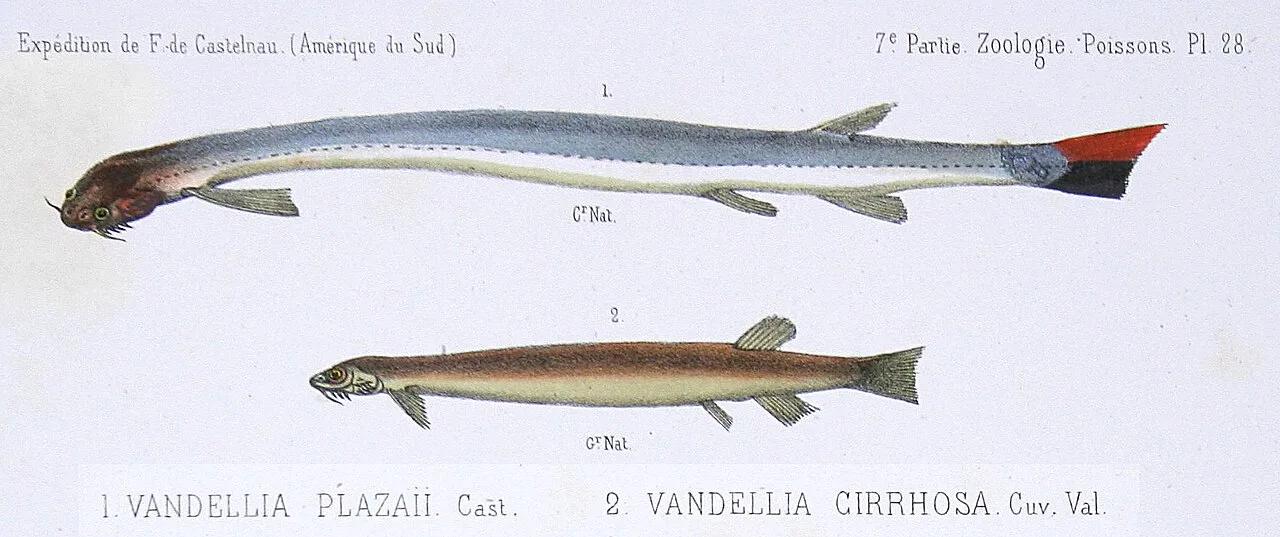
Candiru (François-Louis Laporte, comte de Castelnau).
The Translucent Parasitic Phantom
Measuring only 5 to 15 centimeters (2 to 6 inches) in length with a slender, eel-like body, the candiru (Vandellia cirrhosa) is a specialized parasitic catfish of the Amazon River.
Its body is nearly transparent and slippery with smooth mucus, making it virtually invisible against cloudy, sunlit river shallows as it lies buried in bottom sand waiting for a host.
Chemosensory Gill Navigation
The candiru is a hematophagous feeder, surviving entirely on the blood of larger river fish such as catfish and dorados.
It possesses keen chemoreceptors that detect minute concentrations of ammonia, urea, and respiratory water expelled from the gill chambers of passing fish. When a host is located, the candiru darts into the gill cavity in less than a second.
Opercular Anchoring and Blood Siphoning
Once inside the host’s gills, the candiru erects sharp, backward-pointing spines on its gill covers (operculum) to securely anchor itself against rushing water.
It uses sharp, needle-like teeth to puncture an artery in the gill filament. The host’s own high blood pressure pumps blood directly into the candiru’s distensible gut, allowing the parasite to gorge itself in under two minutes before retracting its spines and dropping back into the riverbed.