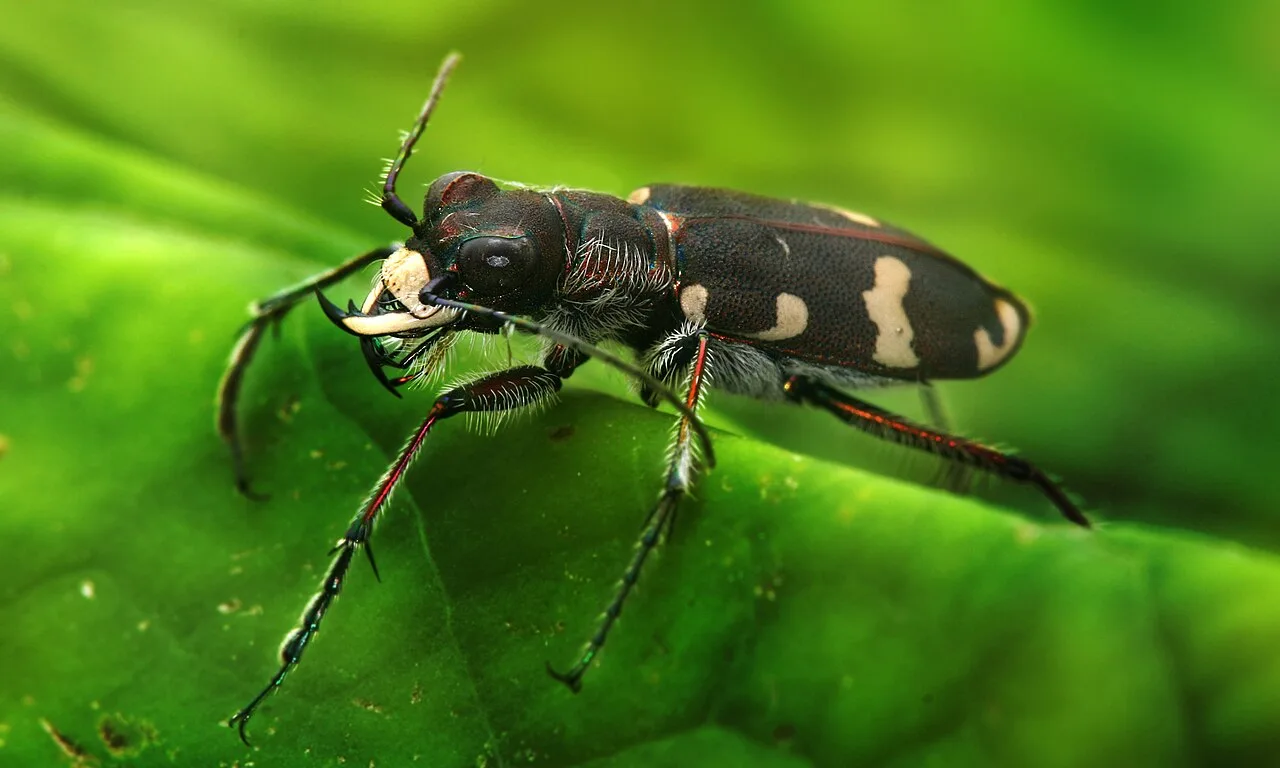
Tiger Beetle (Richard Bartz, Munich aka Makro Freak).
The Strobe-Speed Insect Cheetah
Relative to its body size, the tiger beetle (Cicindela) is the fastest terrestrial running animal on planet Earth. Reaching sprint velocities of 2.5 meters per second (9 km/h or 5.6 mph), it covers 120 body lengths in a single second. If an average human runner could match this proportional sprint rate, they would cross the ground at an astonishing 770 km/h (480 mph).
This extreme speed pushes the physical limits of biological optics. When sprinting at full acceleration, the beetle’s large compound eyes cannot receive and process photons quickly enough to form a continuous visual image. As a result, the beetle temporarily goes completely blind while running, forcing it to sprint in rapid, stop-and-go micro-bursts, pausing for a fraction of a second to reacquire target coordinates before blitzing forward again.
Kinetic & Hunting Metrics:
- Relative Speed: 120 body lengths per second (6x faster than a cheetah proportionally)
- Visual Blackout: Optic processing freezes during maximum acceleration sprints
- Mandible Geometry: Crossed serrated sabers that crush insect armor in 15 milliseconds
- Larval Trap: S-shaped burrow ambush with dorsal anchor hooks to trap passing prey
Sabered Mandibles and Subterranean Pitfalls
When the tiger beetle reaches its target, it deploys enormous, overlapping sickle-shaped mandibles lined with sharp serrated teeth. These jaws snap shut with tremendous hydraulic pressure, instantly slicing through the hard chitin exoskeletons of ants, caterpillars, and spiders.
The beetle’s predatory dominance begins long before adulthood. Tiger beetle larvae construct vertical burrows in dry compacted sand, plugging the burrow entrance with their flat, camouflaged head capsules. When an unsuspecting ant walks across the larva’s head, the larva flips upward, snaps its jaws around the victim, and drags it underground. To prevent large struggling prey from pulling the larva out of its burrow, the larva anchors itself against the earthen tunnel walls with two sharp hooks on its fifth abdominal segment.