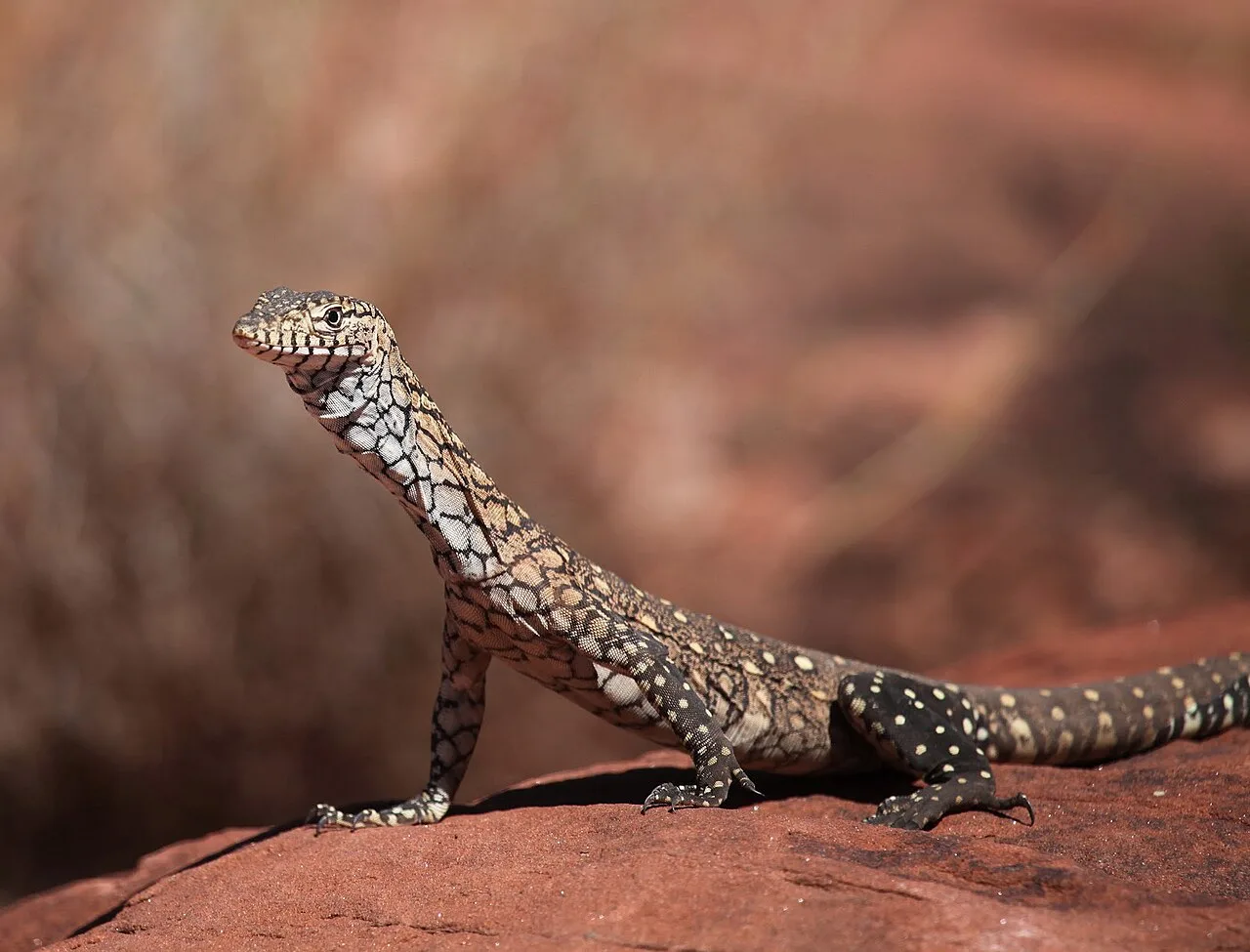
Perentie (Christopher Watson (http://www.comebirdwatching.blogspot.com).
The Megafaunal Desert Monitor
Reaching lengths of over 2.5 meters (8.2 feet) and weighing more than 15 kilograms (33 pounds), the perentie (Varanus giganteus) is Australia’s largest native lizard and the fourth-largest living lizard on Earth.
Its skin is patterned with striking dark brown and cream rosettes that blend seamlessly into the sunbaked gravel of the red desert outback.
The Bipedal Tripod Survey
To spot prey and rivals across wide desert horizons, the perentie can rise up onto its two hind legs, using its thick, muscular tail as a third support leg in a tripod stance.
When chasing down prey, it uses a specialized throat pump mechanism (gular pumping) to force oxygen into its lungs while running at full sprint, avoiding the respiratory fatigue that plagues most reptiles.
Venom Glands and Bone-Crushing Jaws
Research has confirmed that perenties possess oral venom glands in their lower jaw that secrete proteins inhibiting blood clotting and inducing rapid shock.
Combined with backward-curved serrated teeth and immense jaw pressure, a single bite can subdue large venomous snakes, feral cats, and young wallabies in minutes.