The Human Fish of the Dinaric Karst
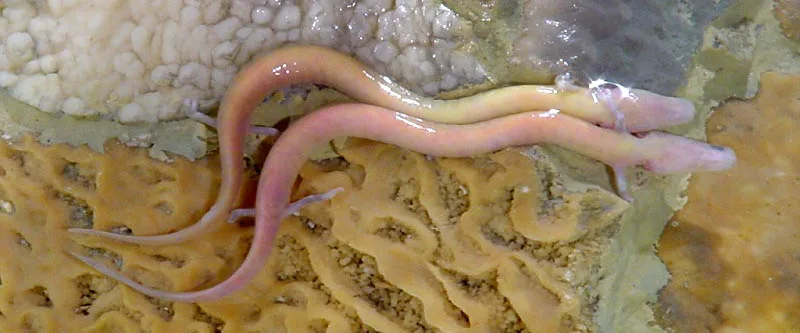
Referred to historically in Slovenian folklore as the offspring of underground dragons, the olm (Proteus anguinus) is an obligate cave-dwelling salamander entirely adapted to life in total darkness.
Its skin is nearly pigment-free and pale pinkish-white, earning it the regional nickname human fish. Although it is born with working eyes, skin grows over them as the animal matures, leaving it completely blind.
Century-Long Subterranean Life
Olms exhibit an exceptionally slow metabolic rate, making them the longest-lived amphibians on Earth with an estimated lifespan exceeding 100 years.
In the nutrient-scarce environment of limestone cave aquifers, food is scarce. Olms can consume large meals of cave shrimp and store energy in hepatic lipids, allowing adult specimens to survive without food for up to ten consecutive years in lab studies without suffering tissue damage.
External Frills and Magnetic Navigation
Because it cannot see, the olm navigates its subterranean world using an array of non-visual sensory systems.
Its snout is packed with electro-receptors that detect faint electrical fields produced by other organisms, while chemical sensors in its nasal cavities can smell prey in parts per billion. Bright red, frilly external gills extend from its neck throughout its life, a condition known as neoteny.