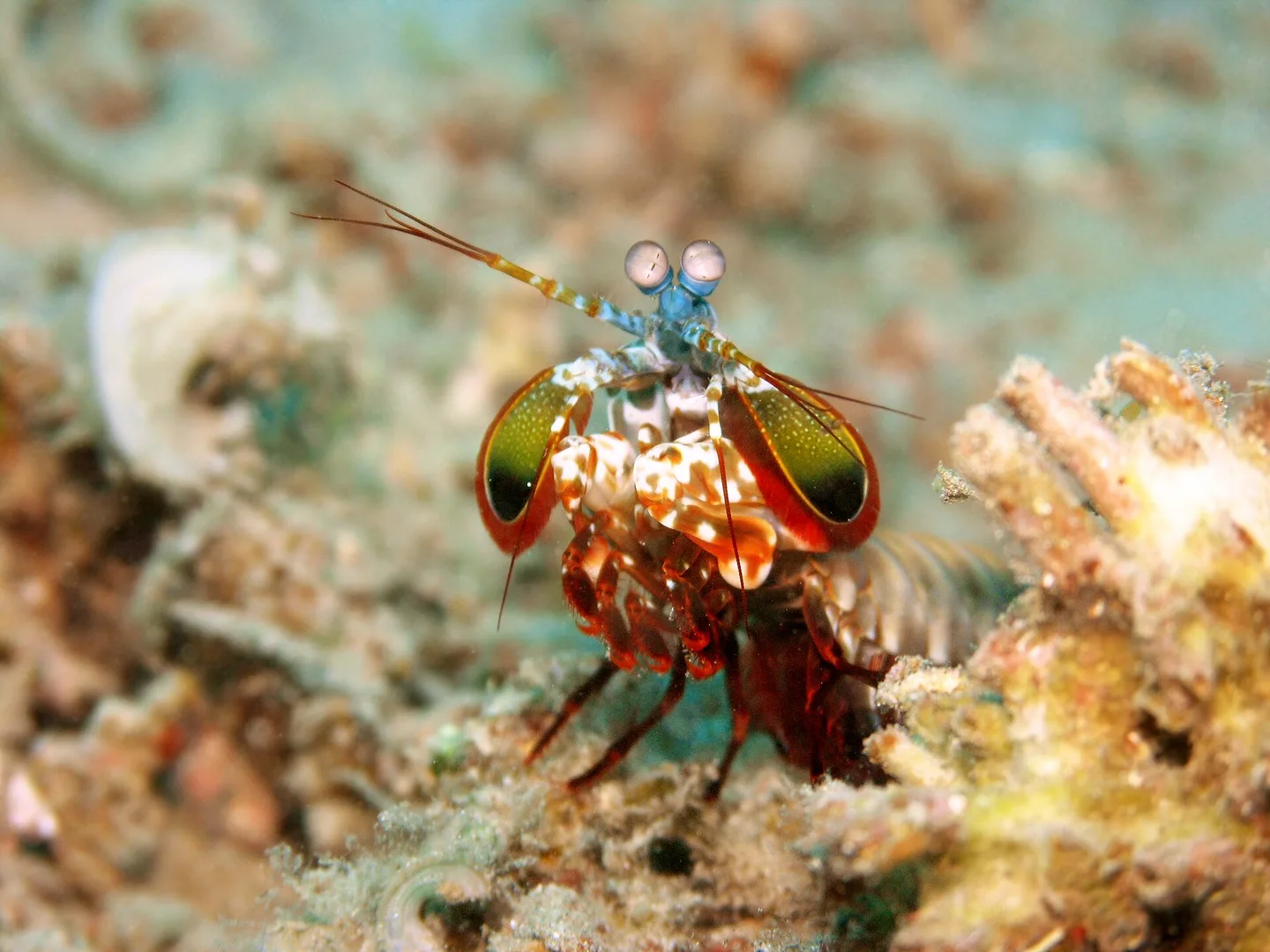
Picture of peacock mantis shrimp (Odontodactylus scyllarus). Taken at Tasik Ria house reef. Manado, Indonesia.
The Technicolor Terror of the Reef
Don’t let the hypnotic rainbow carapace of the Peacock Mantis Shrimp (Odontodactylus scyllarus) deceive you into thinking it’s a peaceful reef decorator. This tiny 18-centimeter marine crustacean packs the most accelerated punch of any animal in recorded evolutionary history.
Armed with two club-like dactyl appendages that operate via a biological spring-and-latch mechanism, the shrimp can unleash its clubs with an acceleration of 10,400 g (greater than a bullet fired from a rifle) reaching speeds of 23 meters per second (50 mph).
Supercavitation: Boiling Water With Pure Speed
The strike moves so rapidly underwater that the water pressure directly between the club and the target’s shell drops to near vacuum levels, generating microscopic vapor bubbles. When these bubbles violently collapse a millisecond later:
The Cavitation Flash: The collapse creates a secondary underwater shockwave that produces temperatures momentarily exceeding 4,700°C (nearly the surface temperature of the Sun) and emits a tiny microscopic flash of light known as sonoluminescence. Even if the shrimp misses its crab prey by a millimeter, the resulting shockwave instantly knocks the crab unconscious!
Alien Vision Systems
While human eyes use 3 types of photoreceptors (red, green, blue) to construct our entire visible spectrum, the Peacock Mantis Shrimp possesses 16 distinct photoreceptor pigments.
It can detect deep ultraviolet light, infrared spectrums, and is the only known creature on Earth capable of perceiving both linear and circularly polarized light, allowing it to communicate secretly with other mantis shrimp through polarized reflections off its armor that are completely invisible to octopuses and barracudas.