Overview
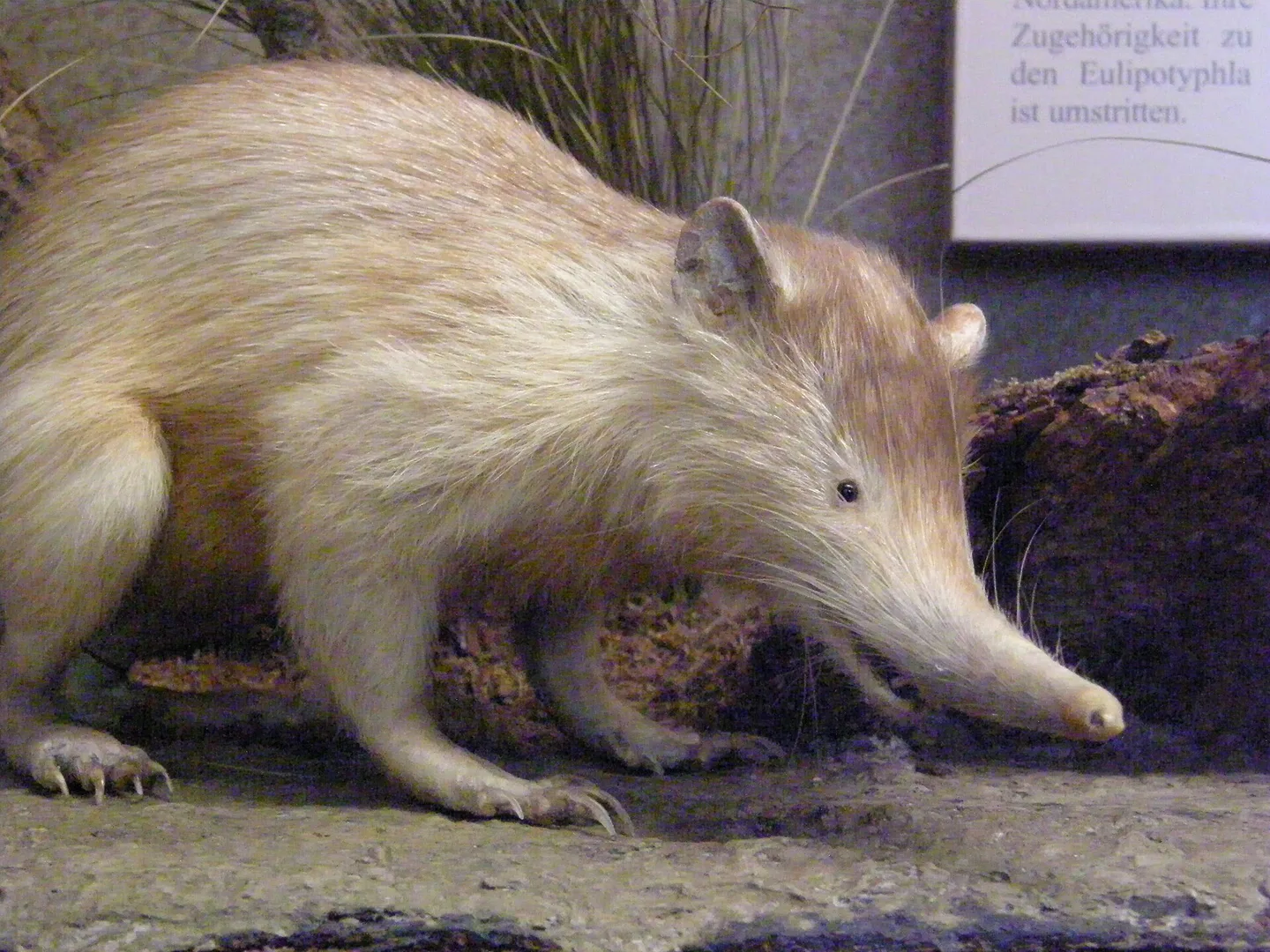
The Hispaniolan Solenodon (Solenodon paradoxus) is a remarkable living fossil that branched off from all other placental mammals over 76 million years ago during the age of the dinosaurs. Resembling a large shrew with an elongated flexible snout, it delivers toxic venom through grooved teeth.
Habitat & Biology
Found exclusively on the Caribbean island of Hispaniola (Dominican Republic and Haiti) in undisturbed montane forests.
Musical Pairing & Sonic Spirit
Matched with Swans’ “Screen Shot” — dark, hypnotic repetition, tense rhythmic momentum, and ancient primal weight reflecting an unbroken 76-million-year evolutionary journey.
Fun Facts
- Survived the asteroid impact that wiped out the non-avian dinosaurs 66 million years ago with minimal morphological change.
- Its flexible snout is connected to a ball-and-socket joint (os proboscidis) that allows it to probe deep into rock crevices.
- Possesses primitive echolocation capabilities, clicking its tongue to navigate dark limestone caves and dense undergrowth.