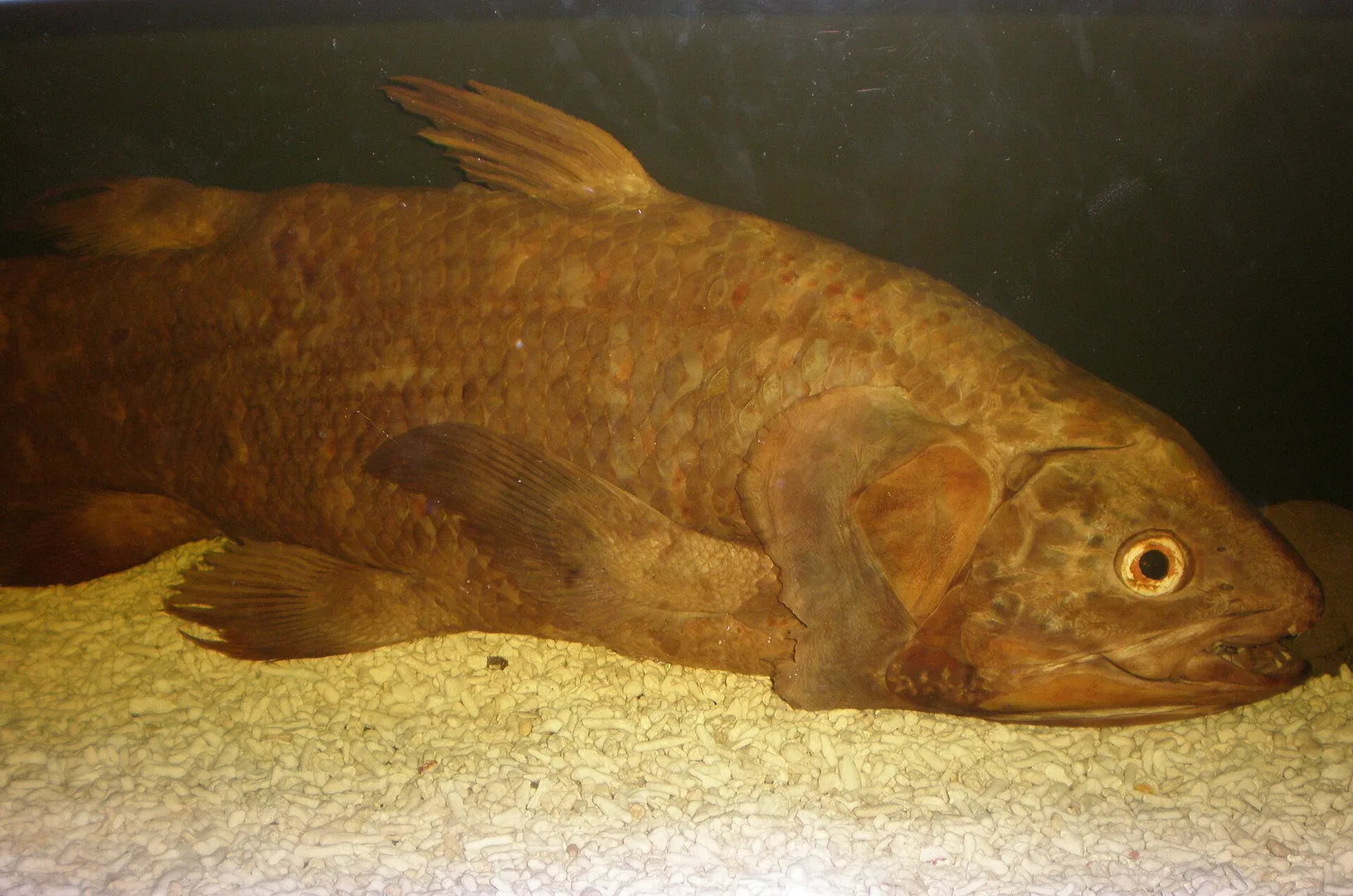
A preserved (Latimeria chalumnae) at the Steinhart Aquarium of the California Academy of Sciences in
The Lowdown
Believed to have gone extinct alongside the non-avian dinosaurs 66 million years ago, the coelacanth (Latimeria chalumnae) astonished the scientific world when a living specimen was hauled from South African waters in 1938. This prehistoric survivor represents an evolutionary bridge between water and land life.
Its unique anatomy includes fleshy lobed fins supported by internal bony limb arches that move in an alternating diagonal pattern matching the walking gait of horses and tetrapods. Its skull features an intracranial joint that allows it to lift the upper half of its head while swallowing large deep-sea prey.
Biological Fact: Coelacanths give birth to live young after an astounding gestation period of nearly five years—the longest recorded gestation of any vertebrate.
Equipped with an oil-filled vestigial lung and a specialized gel-filled rostral organ in its snout, the coelacanth detects the faint bio-electric fields of hiding prey while performing slow-motion headstands along submarine volcanic cliffs.