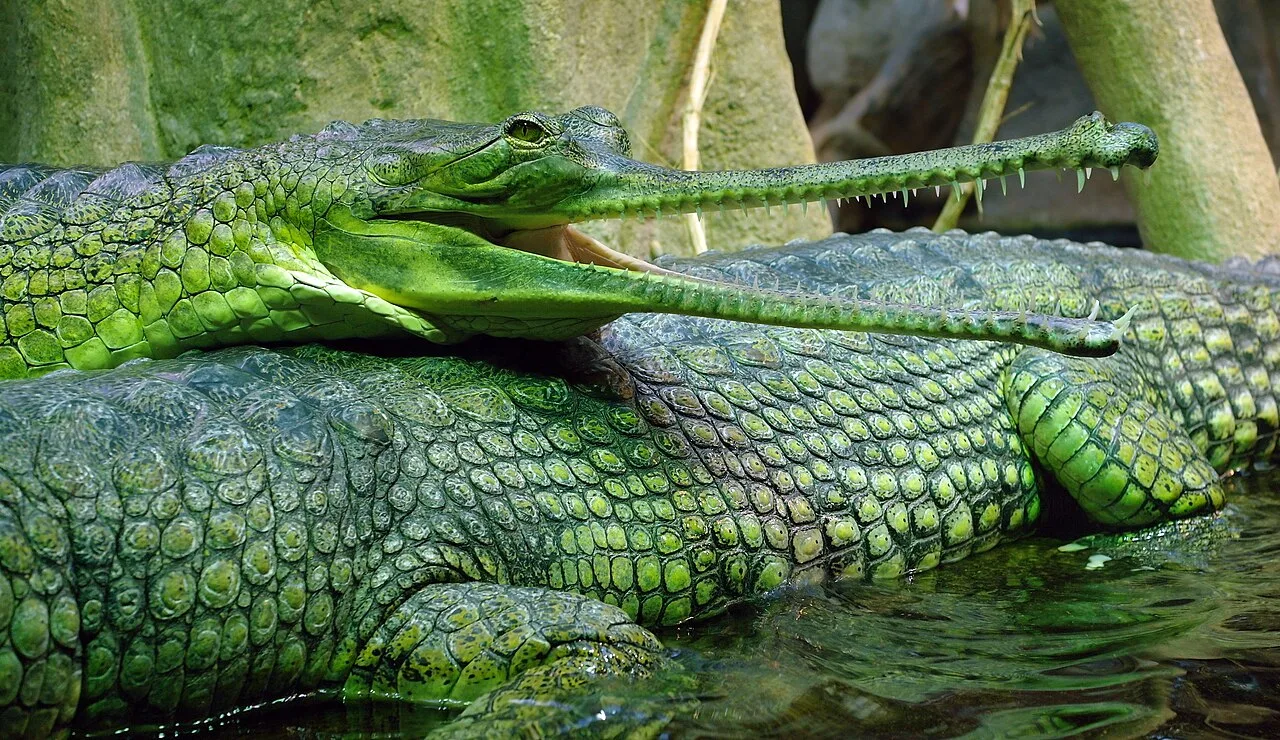
Gharial (Vojtěch Hála, edited by kaʁstn Disk/Cat (color balance, denoising of a few areas).
The Needle-Jawed River Specialist
Reaching lengths of up to 6 meters (20 feet), the gharial (Gavialis gangeticus) is one of the longest crocodilians in existence, distinguished by its exceptionally long, slender snout.
Lined with 110 interlocking needle-sharp teeth that remain exposed when the mouth is closed, its skull is hydrodynamically shaped to minimize water resistance when snapping sideways through schools of river fish.
The Ghara Acoustic Resonator
Mature male gharials develop a large, hollow bulbous growth at the tip of their snout, resembling an Indian clay pot known as a ghara.
This structure acts as an acoustic resonator. By forcing air through the ghara, territorial males generate loud buzzing calls, popping noises, and underwater hisses audible over 100 meters away across wide riverbanks to attract females and warn off rivals.
Aquatic Mastery on the Brink of Extinction
Because its leg muscles are weak compared to broad-snouted crocodiles, an adult gharial cannot perform a high walk on land. It can only slide forward on its belly when hauling out onto sandbars to bask.
Once widespread across rivers from the Indus to the Irrawaddy, habitat loss, river damming, and sand mining have reduced wild populations to fewer than 1,000 breeding adults, making them critically endangered.