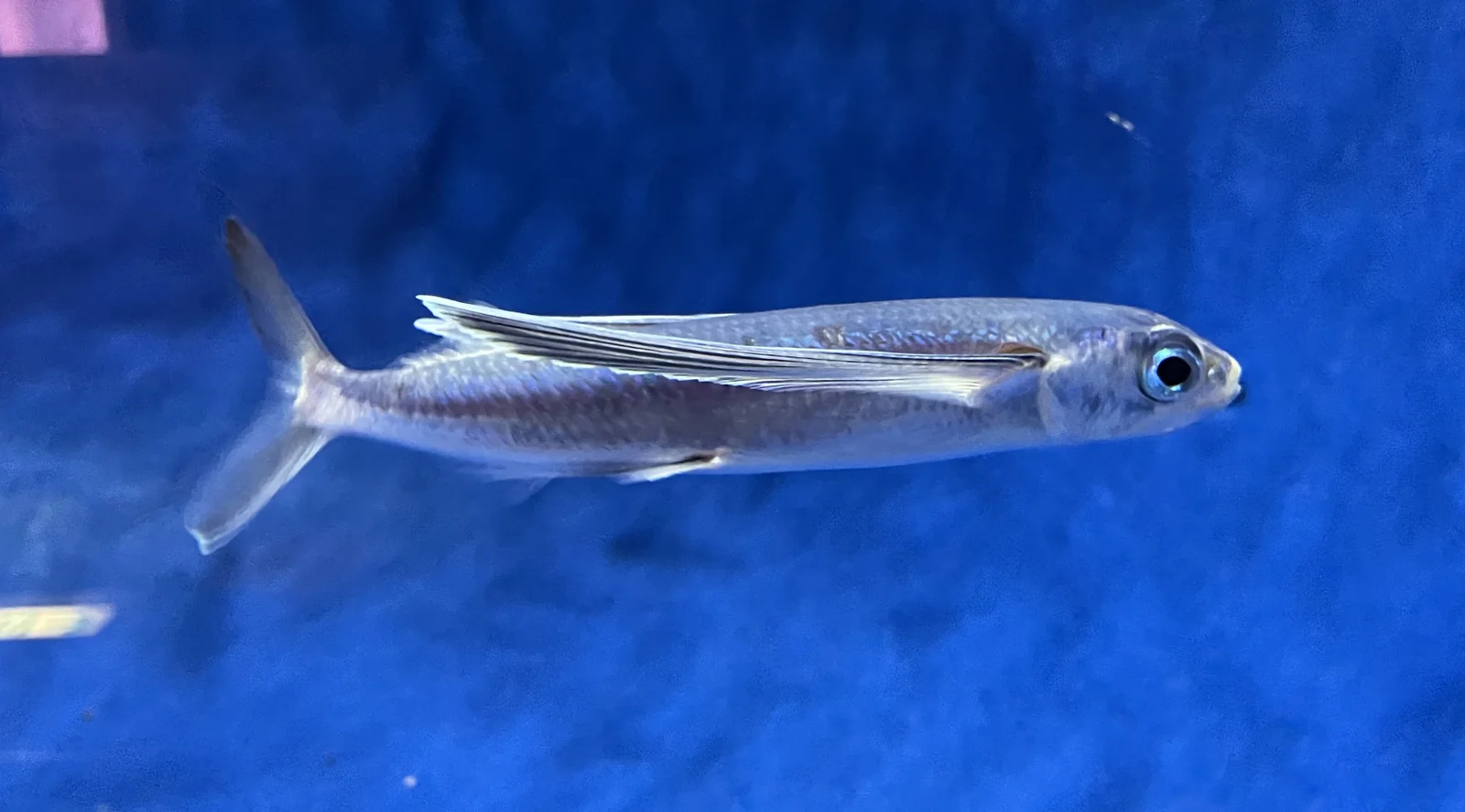
Atlantic Flying Fish swimming underwater showing wing-fins
Levitating Over the Open Ocean
When chased by high-speed pelagic predators like mahi-mahi, sailfish, or tuna, the Atlantic flying fish takes the ultimate escape route: it leaves the water entirely.
Accelerating towards the surface from deep blue water, the fish bursts through the air-sea boundary at 35 km/h. By spreading its enormously enlarged, wing-like pectoral fins, it transforms from an aquatic swimmer into an efficient aerodynamic glider.
The 70 km/h Tail-Propulsion Engine
To build flight velocity, the flying fish utilizes an uneven tail fin (hypocercal caudal fin), where the lower lobe is significantly longer and stiffer than the upper lobe.
Keeping its body airborne above the water while the lower tail lobe remains submerged, the fish beats its tail back and forth up to 70 times per second. This taxiing motor drives the fish across the wave tops, boosting its airborne speed to over 70 km/h before lifting off completely.
Wave-Ground Effect and Multi-Glide Leaps
Once airborne, flying fish ride oceanic wind updrafts using ground effect aerodynamics, skimming just inches above the water for 50 to 100 meters per glide.
As flight speed decays, the fish can re-dip its extended lower tail lobe into the crest of a passing wave, sculling furiously to gain a fresh burst of acceleration without re-entering the water. By linking multiple glides together, flying fish can travel over 400 meters in a single flight.