Photonic Nanocrystal Color Shifting
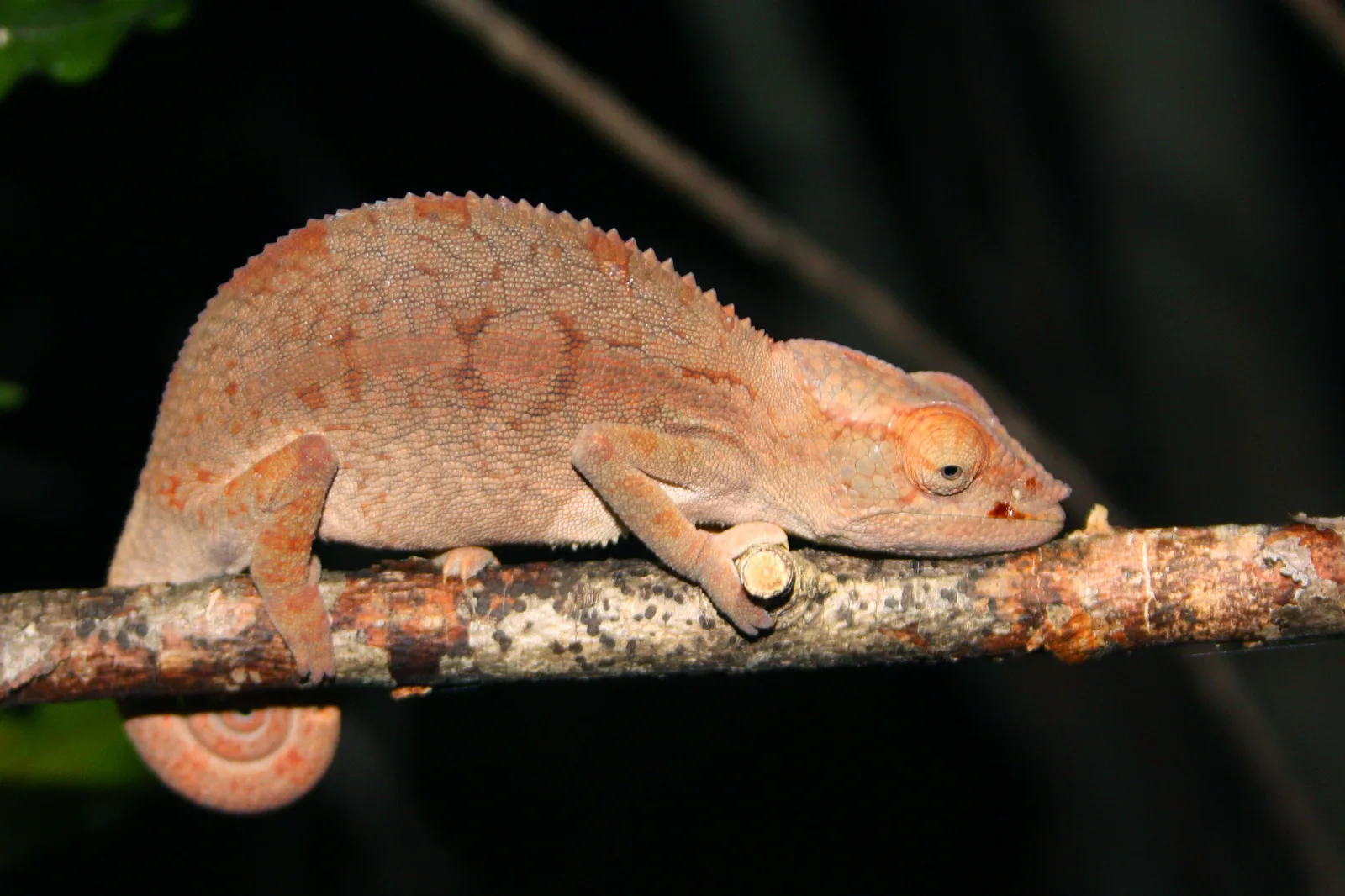
Contrary to common myths, panther chameleons do not change color to blend into backgrounds; they change color to communicate mood, assert dominance, and regulate temperature. A calm male resting in foliage appears soft emerald green, but when encountering a rival, it shifts into vivid turquoise, crimson, and bright yellow in under 20 seconds.
This color change is governed by an active lattice of microscopic guanine nanocrystals inside dermal iridophore cells. By contracting or relaxing its skin, the chameleon alters the spacing between these crystals, changing the wavelength of light reflected off its scales.
The 0.07-Second Ballistic Tongue Strike
The panther chameleon’s tongue is an extraordinary elastic catapult. Powered by a modified hyoid bone and collagen spring sheaths, the tongue accelerates from zero to 97 km/h in a fraction of a second, exerting forces exceeding 40 g.
Reaching prey at distances up to two and a half times the length of the chameleon’s body, the club-like tip wraps around the insect with specialized suction muscles and high-viscosity mucus, pulling the meal back into the mouth in less than a tenth of a second.
Independent 360-Degree Turret Eyes
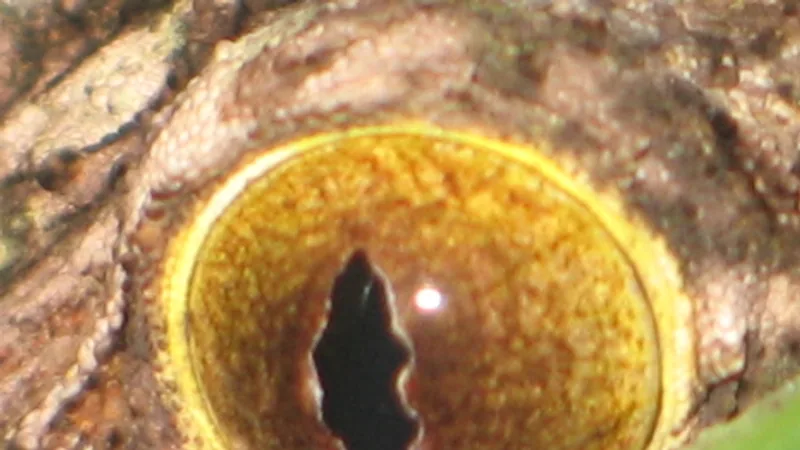
Each eye of the panther chameleon is housed in a raised cone-shaped turret with eyelids fused around a tiny pupil aperture. The two eyes move independently, allowing the lizard to scan two completely different visual fields simultaneously over a full 360-degree sphere.
When a potential target is detected, both eyes pivot forward in tandem to lock onto the prey, switching to precise stereoscopic depth perception before initiating the ballistic strike.