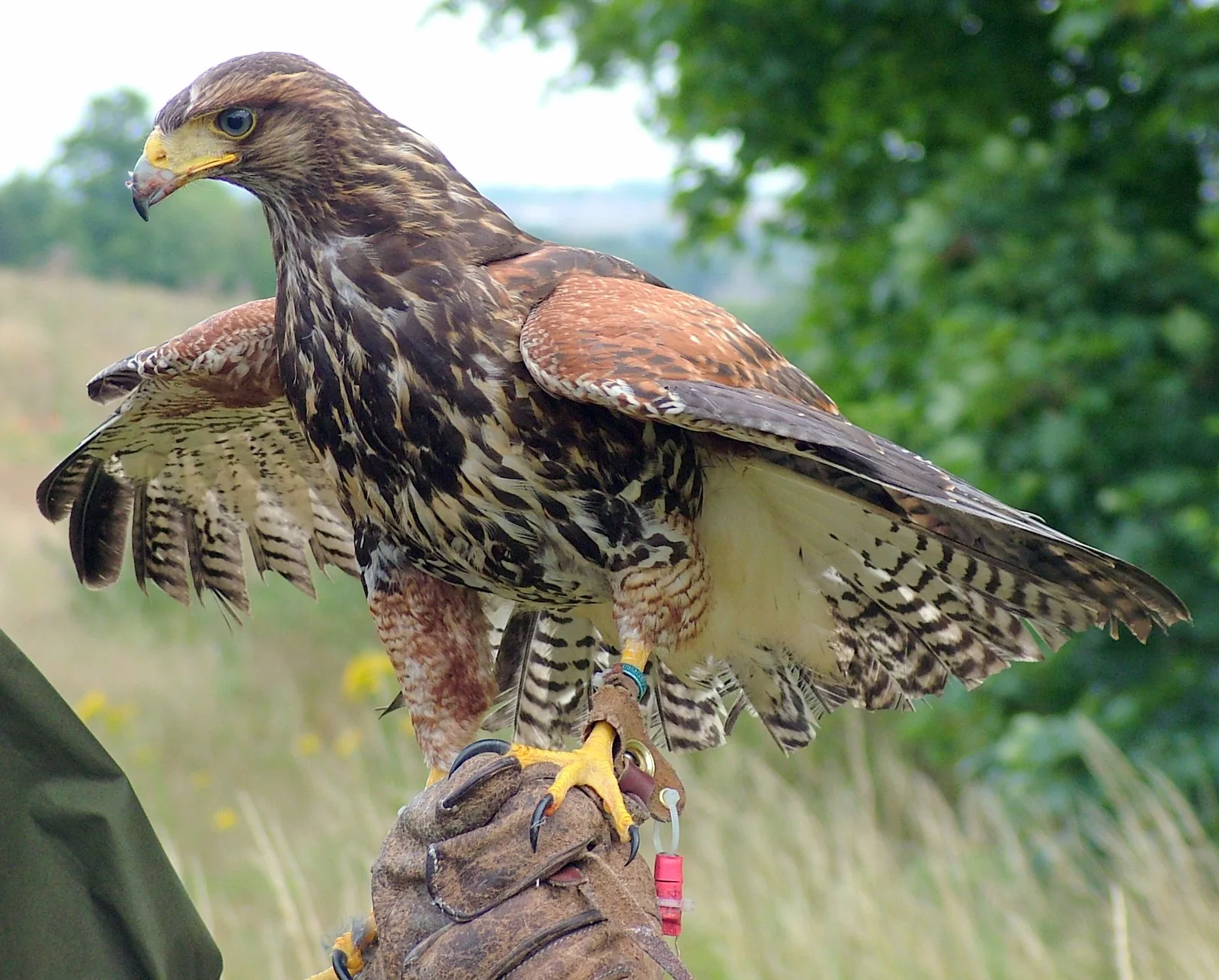
Harris's Hawk (Flickr user whiskymac (Reg McKenna)).
The Wolves of the Sky
While almost all birds of prey hunt as solitary predators, Harris’s hawks operate in coordinated family packs of two to seven individuals. Native to the Sonoran and Chihuahuan deserts, these raptor groups are led by a dominant alpha female, who is up to 40% larger and stronger than her male counterparts.
When pursuing desert cottontails or jackrabbits, the pack executes sophisticated tactical drives. One scout bird flushes the prey from dense thorny brush, while team members flank the escape corridor and the alpha female delivers the decisive pounce.
Perch-Stacking Desert Surveillance
In flat desert environments where tall trees are scarce, Harris’s hawks engage in a unique cooperative behavior known as “back-standing” or perch-stacking. Two or three hawks will stand directly on top of one another’s backs atop a single saguaro cactus or telephone pole.
This living totem pole elevates the topmost hawk’s line of sight across vast distances of arid terrain while sharing the prickly perch without damaging the birds’ talons.
Cooperative Nesting and Desert Survival
Pack cooperation extends to family rearing. Subordinate male helpers, often older offspring from previous broods, assist the breeding pair by defending the nest against coyotes and bobcats, incubating eggs, and delivering fresh food to the nestlings.
This social structure allows Harris’s hawks to thrive in extreme arid environments where solitary raptors struggle to capture enough moisture-rich mammalian prey to sustain a brood during summer heatwaves.