Slow surface swimming earned the species its common name from early mariners.
The Gentle Leviathan of the North Atlantic
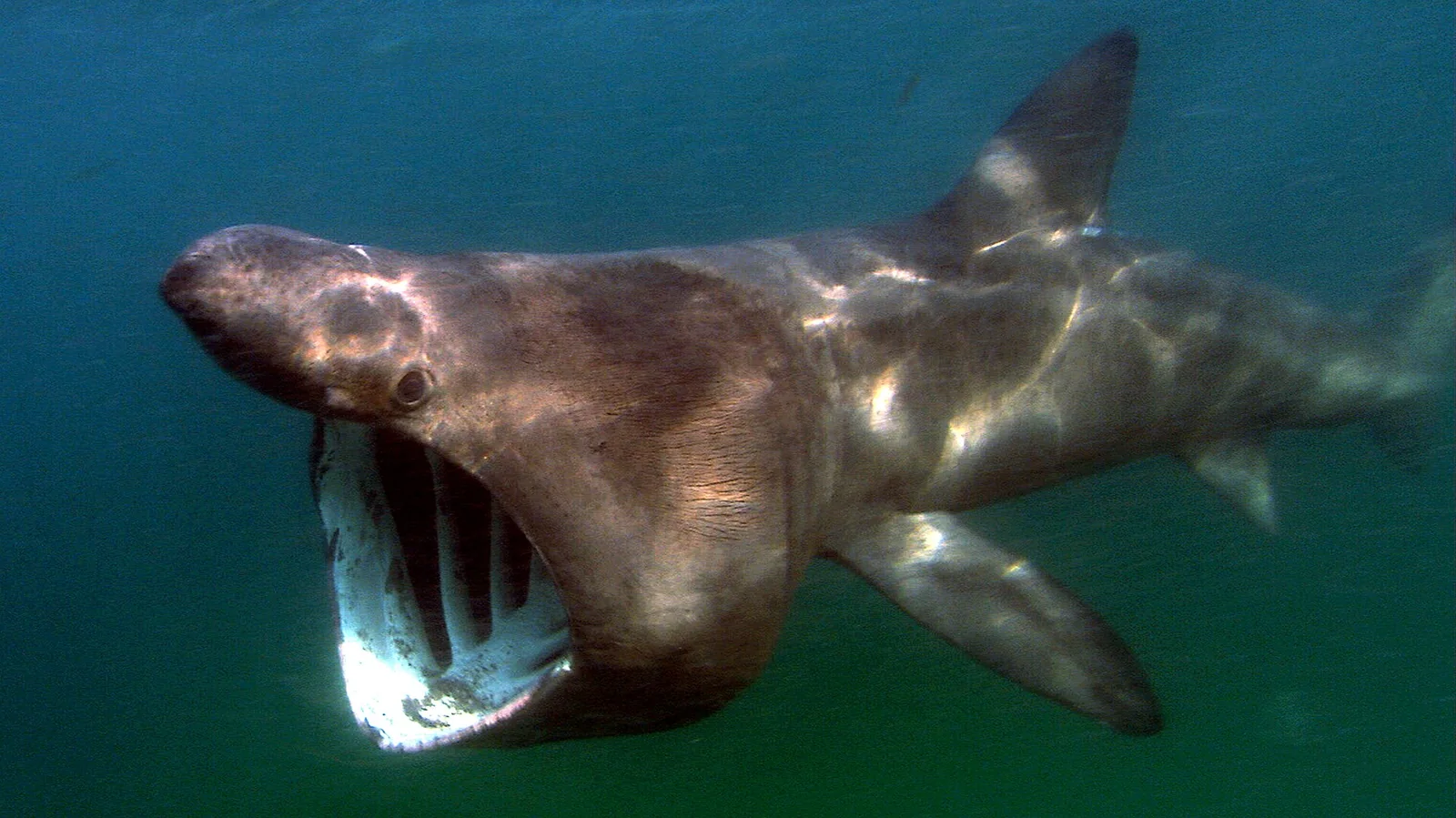
The Basking Shark (Cetorhinus maximus) is the second-largest fish on Earth, trailing only the whale shark in sheer bulk. Gliding through temperate coastal shelf waters across the globe, these massive chondrichthyans can reach lengths of up to 10 meters (33 feet) and weigh more than four metric tons.
Despite their intimidating size and gaping maw, basking sharks are docile planktivores. They swim slowly through dense ocean slicks with their mouths locked wide open, scooping up microscopic calanoid copepods, krill, and fish eggs. Early fishermen observed them idling lazily in calm surface waters and believed they were sunbathing, giving rise to their common name.
The 2,000-Ton Hydraulic Sieve
To sustain its colossal body mass purely on zooplankton, the basking shark relies on a passive ram filtration system. Five enormous gill slits wrap almost completely around its neck, housing thousands of dark, bristle-like gill rakers made of hardened mucus and keratin.
As the shark glides forward at roughly 3.5 km/h, it funnels up to 2,000 metric tons of seawater through its pharynx every single hour. The gill rakers strain out organisms as small as half a millimeter, while excess water discharges smoothly through the gill slits. Periodically, the shark closes its mouth, contracting its pharynx to swallow dense boluses of concentrated plankton.
Deep Twilight Migrations and Explosive Breaches
During winter months when shallow plankton blooms dissipate, basking sharks do not hibernate on the sea floor as was once assumed. Satellite telemetry tags reveal they undertake trans-equatorial journeys, descending into the mesopelagic twilight zone between 200 and 1,000 meters depth to track deep-water plankton layers.
In an astonishing display of power for a gentle giant, basking sharks frequently breach entirely out of the water. Propelled by powerful strokes of their crescent caudal fin, they breach ocean surfaces at speeds reaching 18 km/h, crashing back down with immense oceanic shockwaves to dislodge parasitic sea lampreys and signal to distant schools.